

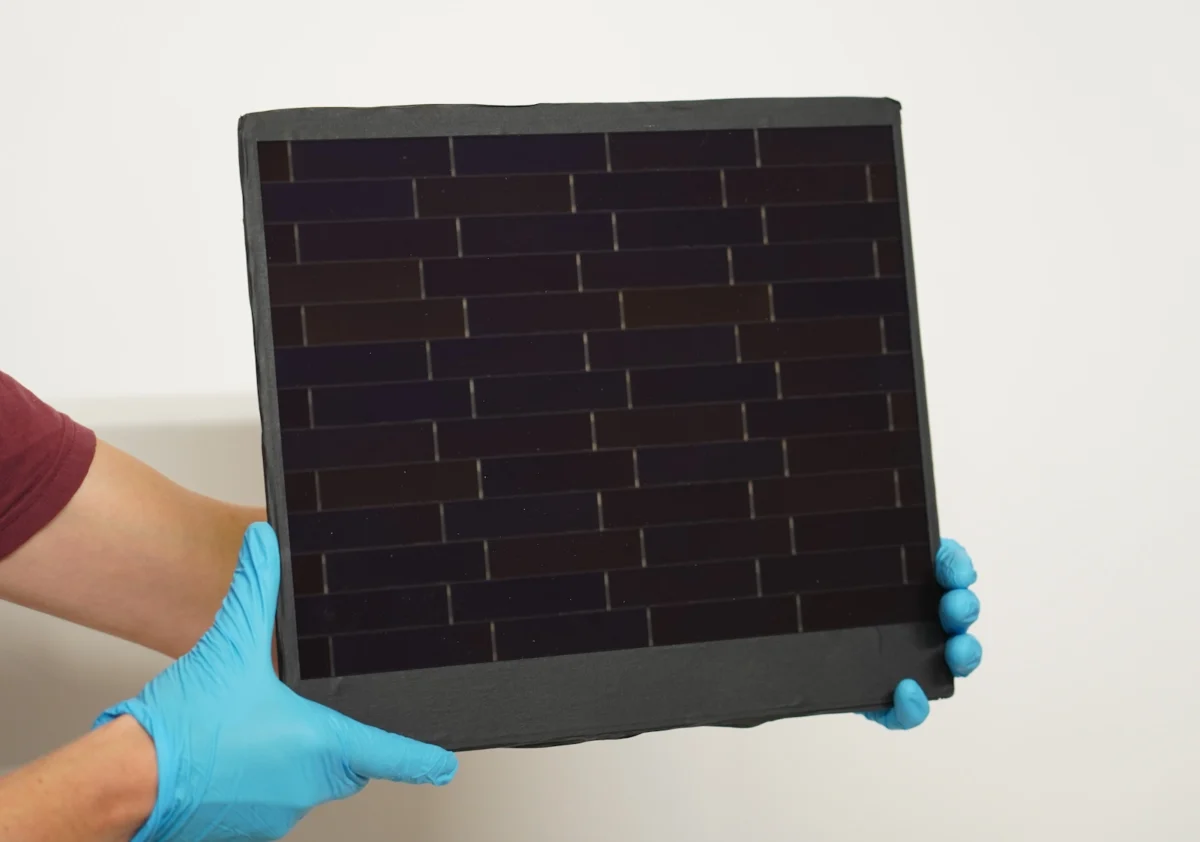
The Fraunhofer Institute for Solar Energy Systems (ISE), a premier research institution in the field of renewable energy, has announced a significant breakthrough in photovoltaic technology by achieving a module efficiency of 34.4 percent. This record-breaking performance was realized through the integration of high-efficiency III-V germanium-based solar cells and a sophisticated "shingle matrix" interconnection method. The achievement, part of the federally funded "Vorfahrt" research project, marks a substantial leap in the performance of terrestrial solar modules and underscores the potential for space-grade technology to be adapted for high-end ground-based applications.
This new milestone was reached just months after the research team established a previous world record of 34.2 percent in early 2026. By refining the interconnection architecture, the researchers managed to squeeze an additional 0.2 percentage points of efficiency from the same core cell technology. The module, which covers an area of 833 square centimeters, represents a collaborative effort between Fraunhofer ISE, industrial partner AZUR SPACE Solar Power GmbH, and the precision optics specialists at temicon. The record-breaking hardware is scheduled for public exhibition at the Intersolar / The Smarter E trade fair in 2026, where it will be showcased at the Fraunhofer ISE pavilion.
The Evolution of Multi-Junction Photovoltaic Technology
The core of this efficiency record lies in the use of III-V triple-junction solar cells. Unlike conventional silicon solar cells, which utilize a single p-n junction to convert a specific portion of the solar spectrum into electricity, III-V cells are composed of multiple layers of semiconductor materials. These materials, named after their positions in the periodic table (Groups III and V), include elements such as gallium, indium, phosphorus, and arsenic, typically grown on a germanium substrate.
Each layer in a triple-junction cell is engineered with a specific "bandgap," allowing it to absorb a distinct segment of the solar spectrum. The top layer captures high-energy blue and ultraviolet light, the middle layer absorbs the visible green and yellow spectrum, and the bottom germanium layer captures the lower-energy infrared light. This stacking method significantly reduces thermalization losses—the energy wasted as heat when high-energy photons hit a low-bandgap material—thereby allowing the cell to exceed the theoretical Shockley-Queisser limit of approximately 33.7 percent for single-junction silicon cells.
Historically, III-V multi-junction cells have been the gold standard for space applications, powering satellites and Mars rovers due to their extreme efficiency and radiation hardness. However, their high production costs have traditionally limited their use on Earth to concentrated photovoltaics (CPV), where lenses or mirrors focus sunlight onto tiny, high-performance cells. The "Vorfahrt" project aims to bridge this gap by adapting space-grade technology for large-area terrestrial modules that can operate under standard, non-concentrated sunlight.
Shingle Matrix Technology: A Structural Revolution
The transition from a 34.2 percent efficiency record to 34.4 percent was driven primarily by advancements in module assembly, specifically the "shingle matrix" technology. In traditional solar module construction, rectangular or square cells are laid out side-by-side with small gaps between them. These cells are then connected using solder-coated copper ribbons or "busbars." While effective, this traditional design has two major drawbacks: the copper ribbons shade a portion of the active cell area, and the gaps between cells represent "dead space" that does not contribute to power generation.
The shingle matrix approach, developed by Fraunhofer ISE in collaboration with German mechanical engineering partners, reimagines this layout. The solar cells are cut into narrow strips and arranged in an overlapping, shingled pattern, similar to roof tiles. These strips are then connected using electrically conductive adhesives (ECA) rather than traditional solder.

This architecture offers several critical advantages:
- Elimination of Shading: Because the electrical contact is made on the underside of the overlapping area, there is no need for busbars on the front of the module. This ensures that 100 percent of the exposed surface area is active and capable of harvesting sunlight.
- High Area Utilization: The overlapping design eliminates the gaps between cells. In a standard module, these gaps can account for several percentage points of lost efficiency relative to the total module area. The shingle matrix maximizes the "packing density" of the semiconductor material.
- Reduced Mechanical Stress: Traditional soldering involves high temperatures that can induce thermal stress and micro-cracks in fragile III-V materials. The use of conductive adhesives allows for a low-temperature bonding process, improving the long-term reliability and mechanical resilience of the module.
- Improved Aesthetics and Flexibility: The seamless, uniform appearance of shingled modules is highly desirable for integrated applications, such as vehicle-integrated photovoltaics (VIPV) or building-integrated photovoltaics (BIPV).
Chronology of the "Vorfahrt" Project Success
The "Vorfahrt" project has followed a rapid trajectory of innovation throughout 2026. The project’s primary objective was to take the triple-junction technology optimized by AZUR SPACE for the harsh environment of space and re-engineer it for the terrestrial solar spectrum (AM1.5g). This required adjusting the thickness and composition of the semiconductor layers to account for the filtering effect of the Earth’s atmosphere.
In the first quarter of 2026, the team successfully produced an 833-square-centimeter module that reached 34.2 percent efficiency. This was already a world-leading figure, proving that III-V technology could be scaled to module-sized formats without losing the performance advantages seen at the cell level. The cells used in this iteration were produced on standard wafer formats, ensuring that the manufacturing process remained compatible with existing industrial semiconductor fabrication lines.
Following this success, the research team focused on the interconnection loss factor. By implementing the shingle matrix technology and utilizing precision anti-reflective coatings provided by temicon, the team was able to further reduce optical reflection and internal electrical resistance. By mid-2026, these refinements culminated in the new 34.4 percent record. The anti-reflective coatings on the front glass were particularly vital, as they ensured that the maximum number of photons reached the high-performance cells, even at shallow angles of incidence.
Comparative Data and Market Context
To understand the magnitude of this achievement, it is necessary to compare the 34.4 percent figure with current market standards. The vast majority of solar modules installed globally today utilize crystalline silicon (c-Si) technology. High-end commercial silicon modules, such as those using Tunnel Oxide Passivated Contact (TOPCon) or Heterojunction (HJT) technologies, typically offer efficiencies between 22 and 24 percent.
The Fraunhofer ISE module is approximately 50 percent more efficient than the best silicon modules currently available to consumers. In practical terms, this means that for a given surface area—such as a residential rooftop or the roof of an electric vehicle—the III-V module can generate significantly more power.
While the cost of III-V materials remains significantly higher than silicon, the "Vorfahrt" project demonstrates a path toward high-value niche markets. In applications where space is at a premium and power density is the primary concern, the cost-to-benefit ratio begins to favor these ultra-high-efficiency modules. For instance, in the burgeoning field of Vehicle-Integrated Photovoltaics (VIPV), the limited surface area of a car’s roof and hood makes every percentage point of efficiency critical for extending the vehicle’s driving range.
Official Statements and Industrial Collaboration
The success of the project has been attributed to the seamless collaboration between academia and industry. AZUR SPACE Solar Power GmbH, a global leader in multi-junction solar cells for space and concentrator applications, provided the foundational cell technology. By adapting their space-grade cells for terrestrial use, they have opened new avenues for high-performance energy generation.

Project coordinators at Fraunhofer ISE noted that the shingle matrix technology is not merely a laboratory curiosity but is already being integrated into commercial module manufacturing in Germany. This suggests a relatively short lead time for the technology to move from record-breaking prototypes to specialized industrial products.
The involvement of temicon was equally crucial. Their contribution of advanced anti-reflective coatings on the front glass addressed one of the most common causes of efficiency loss: Fresnel reflection. By minimizing the amount of light that bounces off the module surface, temicon’s coatings ensured that the internal triple-junction cells could operate at their peak theoretical capacity.
Broader Implications for the Global Energy Transition
The achievement of 34.4 percent efficiency is more than just a scientific record; it is a signal of the diversifying future of solar energy. As the world pushes toward aggressive decarbonization goals, the demand for solar power is moving beyond traditional utility-scale farms and into integrated environments.
The implications of this technology are particularly profound for:
- Aerospace and Stratospheric Platforms: High-altitude long-endurance (HALE) unmanned aerial vehicles (UAVs) and pseudo-satellites require maximum power at minimum weight. These modules provide the ideal solution for sustained flight.
- Electric Mobility: As electric vehicles (EVs) become the standard, integrated solar panels can provide "passive" charging, reducing the frequency of plug-in sessions and alleviating pressure on the charging grid.
- Urban Energy Harvesting: In dense urban environments where roof space is limited, ultra-high-efficiency modules can allow skyscrapers and apartment complexes to generate a larger portion of their own energy needs.
Furthermore, the research conducted during the "Vorfahrt" project provides valuable data for the development of tandem solar cells. Many researchers believe the next major evolution in mass-market solar will be a "silicon-perovskite" or "silicon-III-V" tandem cell, which stacks a high-efficiency layer on top of a standard silicon base. The interconnection techniques perfected by Fraunhofer ISE, such as the shingle matrix and the use of conductive adhesives, will likely serve as the blueprint for assembling these future hybrid modules.
In conclusion, Fraunhofer ISE’s 34.4 percent efficiency record stands as a testament to the power of iterative engineering and cross-sector collaboration. By taking the most advanced materials known to photovoltaic science and housing them in a revolutionary module architecture, the institute has redefined the ceiling for solar power performance on Earth. As these technologies continue to mature and production costs decrease, the gap between space-age performance and terrestrial accessibility will continue to close, paving the way for a more efficient and sustainable global energy landscape.
