

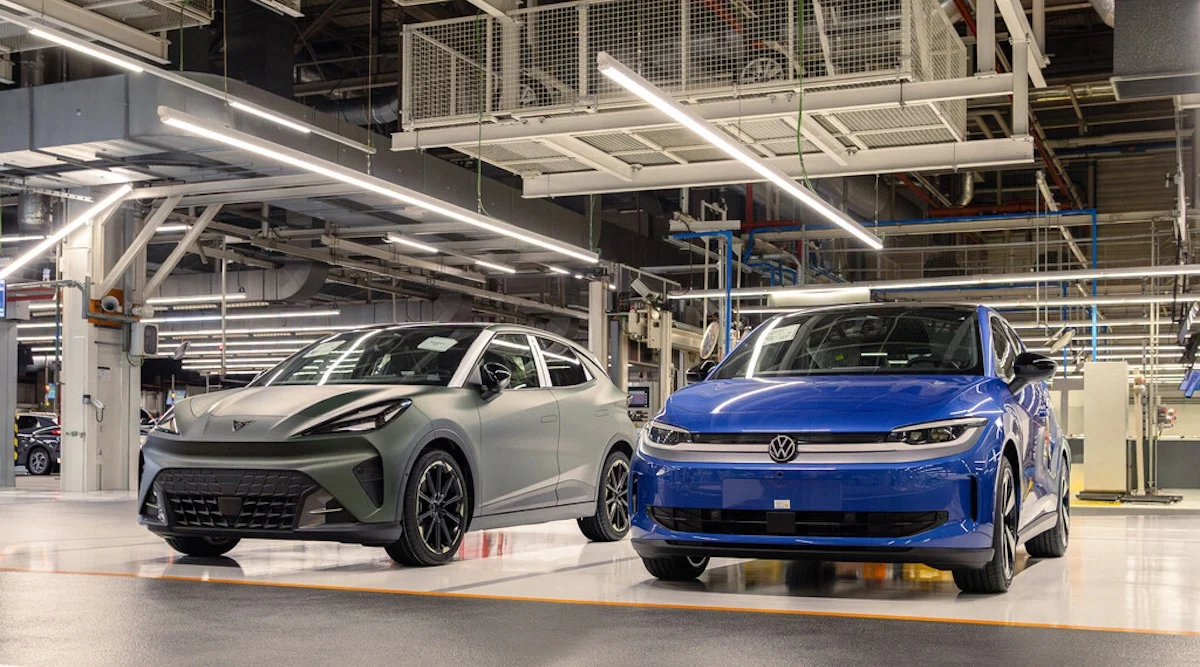
The automotive landscape in Southern Europe has reached a pivotal turning point as the SEAT & CUPRA manufacturing facility in Martorell officially commences production of the Electric Urban Car Family. This ambitious industrial project, spearheaded by SEAT & CUPRA on behalf of the Volkswagen Group’s Brand Group Core, marks the beginning of a coordinated effort to mass-produce affordable electric vehicles (EVs) for the European market. By integrating four distinct models from three different brands into a single production ecosystem, the Volkswagen Group aims to democratize electric mobility, making it accessible to a broader demographic while solidifying Spain’s position as a premier hub for sustainable transportation.
The start of production for the CUPRA Raval and the Volkswagen ID. Polo represents more than a factory update; it is the culmination of a multi-billion-euro transformation of the Martorell plant. This transition was celebrated at an institutional event attended by high-ranking officials and industry leaders, including the Prime Minister of Spain, Pedro Sánchez; the CEO of the Volkswagen Group, Oliver Blume; Thomas Schäfer, CEO of the Volkswagen Brand and Head of the Supervisory Board of SEAT & CUPRA; and Markus Haupt, CEO of SEAT & CUPRA. Their presence underscored the strategic importance of this project to both the Spanish national economy and the broader European industrial strategy.
A Strategic Transformation of the Martorell Industrial Complex
The shift toward electrification at the Martorell plant is the result of a massive investment exceeding €3 billion. This capital infusion has been used to overhaul production lines, retrain thousands of workers, and implement advanced digital manufacturing technologies. The goal is to transform the facility into a flexible industrial powerhouse capable of producing electric, hybrid, and highly efficient combustion engine vehicles simultaneously. This adaptability is seen as crucial for navigating the current volatility of the global automotive market.
Markus Haupt, CEO of SEAT & CUPRA, noted that the project is a testament to the power of cross-brand collaboration within the Volkswagen Group. By leading the Electric Urban Car Family project, SEAT & CUPRA has demonstrated its ability to manage large-scale, complex engineering and logistics operations. The initiative is a cornerstone of the "Future: Fast Forward" project, a broader €10 billion investment plan involving the Volkswagen Group, its battery subsidiary PowerCo, and dozens of strategic partners. This investment is the largest of its kind in the history of the Spanish automotive sector and aims to create a complete EV ecosystem in the country, from battery cell production in Sagunto to vehicle assembly in Martorell and Pamplona.

The Electric Urban Car Family: Synergies and Innovation
The Electric Urban Car Family is built upon the MEB21 platform, a derivative of the Modular Electric Drive Matrix (MEB) specifically optimized for smaller, more affordable vehicles. This shared architecture is the key to the project’s financial viability. By using a common platform across the CUPRA, Volkswagen, and Skoda brands, the Group has realized approximately €600 million in cost savings through shared research and development, procurement, and production logistics.
Despite the shared technical foundation, each of the four models is designed to cater to distinct market segments and consumer preferences:
The Volkswagen ID. Polo: Reimagining a Legend
The Volkswagen ID. Polo carries the weight of a legendary nameplate. With over 20 million units sold globally over several decades, the Polo has been a staple of European urban life. The all-electric ID. Polo represents a systematic reimagining of the model for the digital age.
Technically, the ID. Polo sets a high bar for the entry-level EV segment. It offers a WLTP range of up to 454 kilometers, a figure that addresses "range anxiety" for city dwellers and regional commuters alike. Key features include the new Connected Travel Assist with automatic traffic light recognition and an efficient one-pedal driving system. Furthermore, the inclusion of vehicle-to-load (V2L) functionality allows the car to act as a mobile power source, capable of charging external devices like e-bikes or camping equipment.
The CUPRA Raval: Defining the Radical Urban EV
While the ID. Polo focuses on timeless design and utility, the CUPRA Raval is positioned as the radical, performance-oriented sibling. Measuring approximately four meters in length, the Raval features a sporty silhouette and an immersive, driver-centric interior.
The Raval utilizes the MEB+ platform, offering a range of roughly 450 kilometers. It incorporates avant-garde design elements such as 3D-knitted CUP Bucket seats and dynamic light projections within the door panels. Scheduled for a market launch in summer 2026, the Raval is expected to accelerate CUPRA’s rapid growth. The brand, which recently celebrated its eighth anniversary, has already sold over one million vehicles and is targeting a 3% market share in Europe.
Economic Impact and the "Made-in-Europe" Strategy
The launch of the Electric Urban Car Family comes at a critical time for the European automotive industry. As global competition—particularly from Chinese manufacturers—intensifies, the Volkswagen Group is emphasizing a "Made-in-Europe" strategy. Oliver Blume, CEO of the Volkswagen Group, highlighted that the investment in Spain is a vote of confidence in the European industrial base.
"Compelling entry-level cars, affordable for many, offering space and top technology… with the Electric Urban Car Family, Volkswagen Group is stepping up the pace of electrification in Europe," Blume stated. He emphasized that building these vehicles in Europe for European consumers is essential to maintaining a level playing field and protecting the continent’s industrial sovereignty.
The project is also a major employment driver. SEAT & CUPRA currently employs over 13,000 professionals. The transition to EV production has required an extensive upskilling program to prepare the workforce for the complexities of electric powertrains, high-voltage battery integration, and software-defined vehicle architectures. The Martorell, El Prat de Llobregat, and Barcelona centers form a tightly integrated network that exports over 80% of its output to more than 70 countries.
Chronology of the Transformation
The road to the start of production has been marked by several key milestones:

- 2021: The announcement of the "Future: Fast Forward" project, signaling the intent to electrify the Spanish automotive industry.
- 2022: Confirmation of Martorell and Pamplona as the primary sites for the Electric Urban Car Family production.
- 2023: Groundbreaking of the PowerCo gigafactory in Sagunto (Valencia), which will supply battery cells to the Martorell plant.
- 2024: Completion of major factory overhauls in Martorell and the start of pre-production trials for the MEB21 platform.
- 2025: Final validation and ramp-up of the production lines.
- 2026: Official start of series production for the CUPRA Raval and Volkswagen ID. Polo, with market deliveries scheduled for the summer.
Broader Implications for European Mobility
The success of the Martorell project is likely to serve as a blueprint for other European manufacturing hubs. The ability to produce high-quality EVs at an entry-level price point (targeted below €25,000 for some variants) is the "holy grail" of the current automotive transition. If the Volkswagen Group can successfully scale these models, it will significantly lower the barrier to entry for consumers who have previously been priced out of the electric car market.
Furthermore, the project reinforces the role of Spain as the second-largest vehicle producer in Europe. By securing the production of the Electric Urban Car Family, Spain has ensured its relevance in a future where internal combustion engines are phased out. The integration of the battery supply chain through the Sagunto gigafactory further reduces logistics costs and the carbon footprint of production, aligning with the EU’s Green Deal objectives.
Conclusion: A Milestone for SEAT & CUPRA
As SEAT & CUPRA undertakes the most significant transformation in its 75-year history, it is evolving from a traditional car manufacturer into a leading force in the mobility of the future. The company remains the only automotive firm in Spain that designs, develops, manufactures, and markets vehicles entirely in-house. This end-to-end capability, combined with the scale and resources of the Volkswagen Group, positions Martorell at the heart of the European electric revolution.
The production of the CUPRA Raval and the Volkswagen ID. Polo is the first chapter in a new era. With two additional models from the Electric Urban Car Family yet to be fully detailed, the momentum in Martorell is only expected to grow. For the European consumer, this means more choices, better technology, and a more sustainable path forward for urban transportation. For the Spanish industry, it is a definitive statement of leadership on the global stage.
