

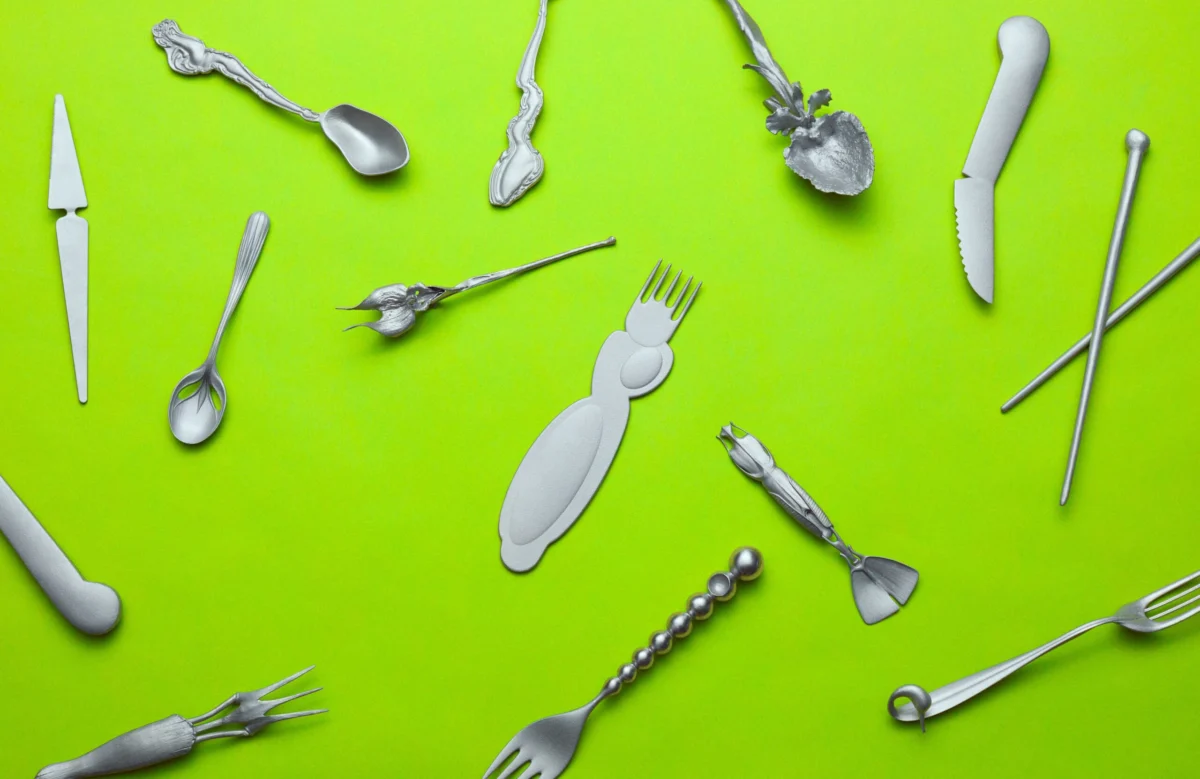
The exhibition is structured as both a retrospective and a forward-looking laboratory. While it honors the legacy of 20th-century masters, it also serves as the premiere for "KFS 3.0," a visionary series of 3D-printed stainless-steel flatware sets. This specific collection was conceived by Dung Ngo, a prominent collector and editor, who sought to push the boundaries of what contemporary cutlery can represent. By commissioning 11 new sets from a diverse group of international designers, Ngo has provided a snapshot of the current "digital craft" era, where software and additive manufacturing allow for forms that were previously impossible to forge or cast.
A Century of Design Evolution: 1900 to the Present
The narrative of the exhibition begins at the turn of the 20th century, a period when flatware transitioned from a symbol of aristocratic excess to a triumph of industrial design. In the early 1900s, silver was the standard for those who could afford it, often featuring intricate, labor-intensive patterns that signaled social status. However, the rise of the Bauhaus and the International Style in the 1920s and 30s began to strip away ornamentation in favor of functionalism.

The mid-century section of the exhibition highlights the "Golden Age" of stainless steel. Following World War II, designers like Arne Jacobsen and Tapio Wirkkala revolutionized the industry by utilizing high-quality steel alloys that were durable, dishwasher-safe, and sleekly contoured. This era marked a democratization of design, where the average household could own pieces that were both utilitarian and museum-worthy. The Denver Art Museum’s collection meticulously tracks this progression, showing how the ergonomic concerns of the 1950s paved the way for the radical, often playful experiments of the Post-modernist 1980s.
The KFS 3.0 Series: Bridging the Digital and the Physical
At the heart of the current exhibition is the KFS 3.0 project, a collaboration between Dung Ngo and the Marta gallery. This collection represents the cutting edge of material innovation, utilizing 3D-printed stainless steel to create "out-there" designs that challenge the traditional definitions of a knife, fork, or spoon.
"We use flatware every day without thinking about it," notes curator Darrin Alfred. "But if you look closely, you can see a century of design-thinking, cultural change, and material innovation laid out in objects small enough to hold in one hand."

The designers involved in KFS 3.0 were encouraged to ignore the constraints of mass production. Marcin Rusak, for instance, contributed the "Ghost Orchid" set, which renders hyper-detailed botanical forms into functional tools. These pieces appear almost organic, as if grown rather than manufactured, highlighting the precision of modern 3D printing. Similarly, the firm Charlap Hyman & Herrero offered "Liquid Flatware," a surrealist interpretation of Baroque silverware that looks as though it is melting or caught in a state of digital flux.
Other designers focused on the tactile origins of design. Minjae Kim began his process by hand-sculpting utensils in modeling clay, later digitizing those forms to be printed in steel. This method preserves the "hand-made" feel of the object while utilizing the most advanced technology available today. The results are pieces that feel ancient and futuristic simultaneously.
Global Rituals and the Decolonization of the Table
One of the most significant contributions to the exhibition comes from Nigerian designer Nifemi Marcus-Bello. His work, titled FKS_2026, includes a bowl designed specifically for rinsing one’s fingers. This inclusion is a deliberate move to expand the definition of "flatware" beyond the Western trio of the knife, fork, and spoon.

In many cultures, including Marcus-Bello’s native Nigeria, eating with one’s hands is a deeply rooted ritual. By including a finger-washing bowl in a high-design exhibition, the curators are acknowledging that "extraordinary design" must account for global habits and diverse traditions. "It was important that the designs express our rituals and habits for eating, globally, today," Dung Ngo explained. This perspective shifts the focus from the objects themselves to the human behaviors they facilitate.
The inclusion of chopsticks and other non-Western tools further emphasizes this global scope. As the world becomes more interconnected, the tools we use at the table are increasingly influenced by a blend of culinary traditions. The exhibition argues that the future of flatware is not a single aesthetic but a plurality of forms that reflect a multi-cultural world.
Chronology of Modern Flatware Milestones
To understand the context of the Denver Art Museum’s exhibition, it is helpful to look at the timeline of flatware innovation that led to this moment:

- 1900–1920: The dominance of ornate sterling silver; flatware as a primary wedding gift and heirloom.
- 1930s: The introduction of "Cromargan" (stainless steel) by companies like WMF, making high-quality design accessible to the middle class.
- 1950s: The rise of Scandinavian Modernism; designers like Georg Jensen and Alessi begin to treat cutlery as sculpture.
- 1980s: The Memphis Group and Post-modernism introduce color, asymmetry, and humor into table settings.
- 2000s: Experimental materials like titanium and carbon fiber are explored by luxury brands.
- 2020s: The KFS 3.0 project and the Denver Art Museum exhibition highlight 3D printing as the new frontier of bespoke, on-demand manufacturing.
Technical Analysis: The Impact of Additive Manufacturing
The move toward 3D-printed stainless steel, as seen in the work of Jolie Ngo and David Wiseman, represents a significant shift in the economics of design. Traditionally, producing a new flatware pattern required expensive molds and large-scale manufacturing runs to be profitable. This often led to "safe" designs that appealed to the widest possible audience.
Additive manufacturing (3D printing) removes these barriers. It allows designers to produce complex geometries—such as David Wiseman’s "Lattice" or Johnston Marklee’s "ROCK. PAPER. SCISSORS."—without the need for traditional tooling. This enables "on-demand" production, where a consumer can order a unique set that is printed specifically for them. This shift from mass production to mass customization is one of the key implications of the exhibition, suggesting a future where our "everyday tools" are as unique as our fingerprints.
Official Responses and Market Impact
The exhibition has already garnered significant attention from the design community. Critics have praised the show for its ability to make high design feel accessible. By focusing on objects that everyone uses, the Denver Art Museum has created a bridge between the specialized world of art curators and the general public.

The commercial aspect of the project is also noteworthy. The KFS 3.0 series is not merely a museum display; it is a viable commercial venture. Available through the Marta gallery, these pieces are entering the homes of collectors, further blurring the line between a functional tool and a work of art. The accompanying book, published by August Editions, provides additional scholarship on Dung Ngo’s collection, ensuring that the research behind the exhibition is preserved for future generations of designers.
Broader Implications for the Future of Design
Knife Fork Spoon: Everyday Tools, Extraordinary Design serves as a reminder that even the most overlooked objects are products of intense creative labor. As we move further into the 21st century, the exhibition suggests that the tools of the future will be defined by three pillars: sustainability, technology, and inclusivity.
- Sustainability: 3D printing reduces waste by only using the exact amount of material needed for the object. As stainless steel is infinitely recyclable, the exhibition points toward a more circular economy in homewares.
- Technology: The "extraordinary" nature of these tools is now driven by software. The ability to simulate weight, balance, and ergonomics in a digital environment before a single piece of metal is printed is changing how designers work.
- Inclusivity: By showcasing tools like Marcus-Bello’s finger bowl alongside traditional European forks, the museum is promoting a more holistic view of design history—one that values the "rituals and habits" of all people.
As the exhibition continues its four-year run in Denver, it stands as a testament to the enduring power of design to elevate the mundane. Whether it is a 1920s Bauhaus spoon or a 2026 3D-printed knife, these objects remain our most intimate connection to the food we eat and the cultures we inhabit. Through the lens of this exhibition, the table is no longer just a place for sustenance; it is a gallery of human ingenuity.
