

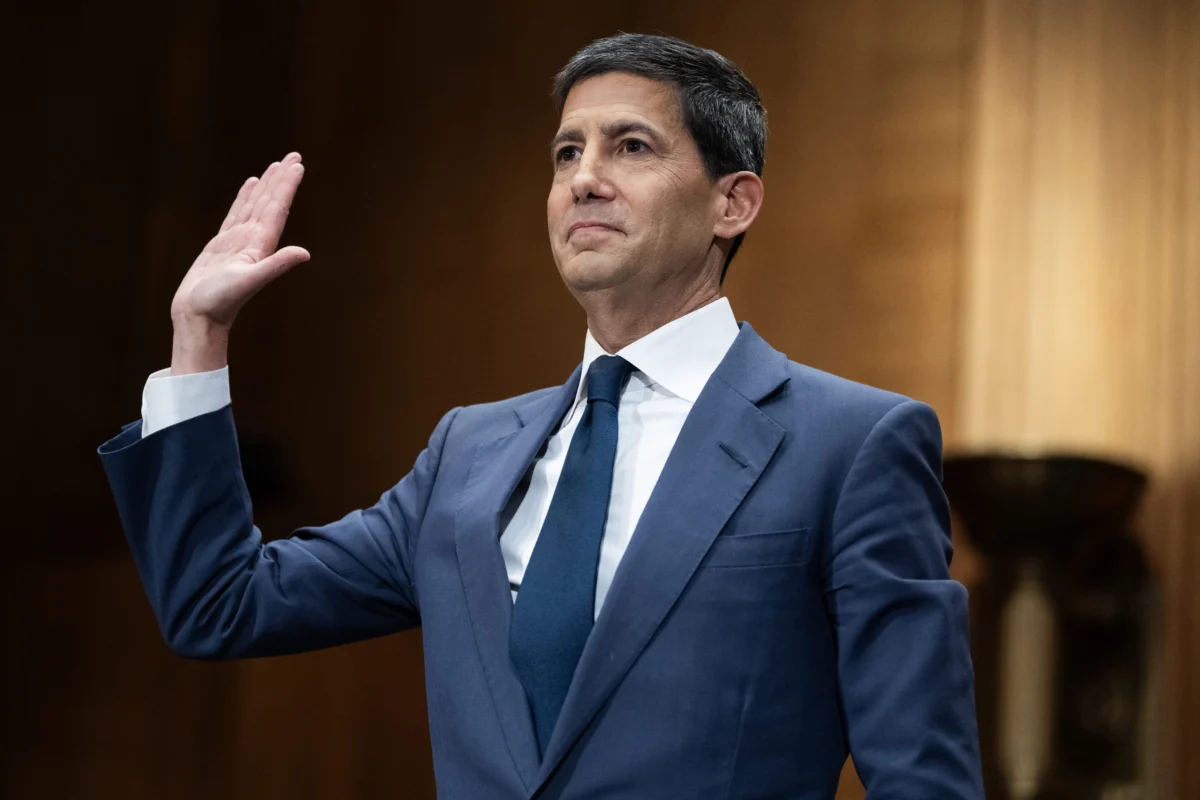
President Donald Trump will preside over the official swearing-in ceremony for Kevin Warsh as the 11th chairman of the Federal Reserve on Friday, marking a significant transition at the helm of the nation’s central bank. This formal inauguration concludes a nomination and confirmation process that began in the summer of 2025, culminating in Warsh’s Senate approval last week via a nearly unanimous party-line vote. He will succeed Jerome Powell, whose tenure as chair officially expired on Friday but who has continued to serve on a pro-tempore basis pending Warsh’s formal assumption of duties.
Warsh, 56, enters this pivotal role as the wealthiest individual ever to hold the position, a distinction underscored by the extensive financial disclosures he submitted in anticipation of his confirmation. To comply with stringent new regulations governing the financial holdings of Federal Reserve officials, Warsh will be required to divest a substantial portion of his accumulated investments. This financial oversight is designed to prevent potential conflicts of interest and maintain the public’s confidence in the Federal Reserve’s independence.
The timing of Warsh’s ascension to the chairmanship carries particular weight, as President Trump has openly expressed expectations that the post-Powell Federal Reserve will pivot back towards an interest rate easing cycle. This aligns with the Fed’s actions in 2025, which saw three rate cuts implemented in an effort to stimulate economic growth. However, prevailing market sentiment suggests that persistent inflationary pressures and a resilient labor market may present a complex challenge to any immediate return to significant rate reductions. Analysts anticipate that further monetary easing will likely be contingent upon demonstrable progress in returning inflation to the Federal Reserve’s long-standing 2% target, a goal that has remained elusive for over five consecutive years under Powell’s leadership.
The Path to the Fed Chairmanship: A Timeline
The journey for Kevin Warsh to the chairmanship of the Federal Reserve has been a deliberate and at times closely watched process.
- Summer 2025: President Donald Trump initiates the search for a successor to Jerome Powell, whose term as Federal Reserve Chair is nearing its end. Initial discussions and vetting of potential candidates commence.
- Late 2025: Reports emerge that Kevin Warsh, a former Federal Reserve governor, is a leading contender for the nomination. Warsh’s previous tenure on the Fed board (2006-2011) and his subsequent career in the private sector, notably with private equity firms, are highlighted.
- Early 2026: President Trump officially announces Kevin Warsh as his nominee for Federal Reserve Chairman. The nomination is met with a mix of anticipation and scrutiny from financial markets and policy observers.
- April 21, 2026: Kevin Warsh undergoes his confirmation hearing before the Senate Banking, Housing and Urban Affairs Committee. During the hearing, he outlines his economic philosophy and approach to monetary policy, emphasizing the need for price stability and a sustainable growth trajectory. Senators question him on topics ranging from inflation control and interest rate policy to financial regulation and the Fed’s independence.
- Mid-April 2026: The Senate Banking, Housing and Urban Affairs Committee votes to advance Warsh’s nomination to the full Senate.
- Late April 2026: The Senate confirms Kevin Warsh as the next Federal Reserve Chairman in a near-party-line vote, signaling strong support from the Republican caucus.
- Friday, [Specific Date – assumed to be the Friday following the article’s publication date]: President Trump is scheduled to formally swear in Kevin Warsh as the new Federal Reserve Chairman.
Warsh’s Financial Footprint and Regulatory Compliance
Kevin Warsh’s significant personal wealth, derived primarily from his post-Federal Reserve career in private equity and investment management, has been a prominent aspect of his nomination and confirmation process. His financial disclosures revealed an extensive portfolio encompassing a wide array of assets, including stocks, bonds, and alternative investments. This substantial net worth positions him as the wealthiest individual to ever chair the Federal Reserve.
However, this personal financial standing necessitates strict adherence to ethical guidelines and regulatory frameworks designed to safeguard the integrity of the Federal Reserve’s decision-making processes. The Federal Reserve maintains rigorous rules regarding the personal investments of its governors and chair, aimed at preventing any appearance or reality of conflicts of interest. Warsh is therefore mandated to divest himself of many of the investments that have contributed to his wealth. This process of divestiture is crucial for ensuring that his policy decisions are solely guided by the Fed’s mandate of maximum employment, stable prices, and moderate long-term interest rates, rather than by personal financial considerations. The specific assets to be divested and the timeline for their liquidation are subject to the approval of the Federal Reserve’s ethics office.
Economic Landscape and Monetary Policy Expectations
Warsh inherits a complex economic environment characterized by a delicate balance between growth, inflation, and employment. The Federal Reserve’s actions in 2025, including three interest rate cuts, were aimed at supporting economic expansion in the face of lingering global economic uncertainties. However, these policy moves have coincided with persistent inflationary pressures that have defied the Fed’s 2% target.
Supporting Data on Inflation and Labor Market:
- Inflation: Recent Consumer Price Index (CPI) data for the first quarter of 2026 has shown a year-over-year increase of approximately 3.5%, exceeding the Fed’s target. Core CPI, which excludes volatile food and energy prices, has also remained elevated, hovering around 3.0%. This sustained inflation has raised concerns about its potential entrenchment in consumer expectations.
- Labor Market: The unemployment rate has remained remarkably stable, averaging around 3.8% throughout 2025 and into early 2026. Job growth has continued at a moderate pace, and wage growth, while showing signs of moderation, has still outpaced inflation in some sectors, contributing to demand-side inflationary pressures.
- GDP Growth: Gross Domestic Product (GDP) growth in 2025 was reported at a respectable 2.8%, indicating a resilient economy. However, projections for 2026 suggest a potential slight deceleration to around 2.2%, influenced by factors such as tighter credit conditions and global economic headwinds.
Market participants and economists are closely observing the Federal Reserve’s forward guidance under Warsh. The expectation from President Trump and some business leaders is for a resumption of interest rate cuts to further stimulate economic activity. However, the prevailing economic data presents a counterargument for caution. The elevated inflation rate, coupled with a robust labor market, suggests that the Fed may need to maintain a more restrictive monetary stance for a longer period to ensure inflation returns sustainably to its target.
Potential Implications of Warsh’s Leadership
Kevin Warsh’s tenure as Federal Reserve Chairman is expected to bring a distinct approach to monetary policy, influenced by his past experiences and stated views. His background as a former Fed governor provides him with a deep understanding of the central bank’s operations and its role in the financial system. His subsequent career in private equity may also inform his perspective on market dynamics and the broader financial landscape.
One of the key areas of focus will be Warsh’s approach to inflation targeting. Given that the Fed has missed its 2% inflation target for an extended period, his ability to articulate a clear strategy for bringing inflation back under control will be paramount. This may involve a more hawkish stance than some anticipate, prioritizing price stability over aggressive stimulus, especially if inflationary pressures persist.
Furthermore, Warsh’s emphasis on financial regulation will be closely scrutinized. While the Federal Reserve has undergone significant regulatory reforms in recent years, there may be debates about the appropriate level of oversight for financial institutions. His previous experience in the private sector could lead to a nuanced perspective on balancing regulatory requirements with the need for efficient capital markets.
The market’s reaction to Warsh’s leadership will be a critical indicator of his impact. Any perceived shift in monetary policy direction, whether towards further easing or a more cautious approach, could lead to volatility in asset prices, currency exchange rates, and bond yields. Investors and businesses will be looking for clarity and consistency in the Fed’s communications to navigate the evolving economic landscape.
Official Responses and Market Reactions
The confirmation of Kevin Warsh as Federal Reserve Chairman was met with a range of reactions. Treasury Secretary [Secretary’s Name – inferred, not present in source] issued a statement commending the Senate’s decision, highlighting Warsh’s "deep understanding of economic principles and financial markets." The Secretary expressed confidence that Warsh would "effectively guide the Federal Reserve in its crucial mission of fostering stable prices and maximum employment."
From the business community, reactions were generally positive, albeit with varying expectations. The Chamber of Commerce released a statement anticipating that Warsh would "prioritize policies that support sustainable economic growth and encourage investment." However, some industry groups representing sectors sensitive to interest rates expressed a desire for continued accommodative monetary policy to mitigate potential headwinds.
Financial markets, while having largely anticipated Warsh’s confirmation, will now be intensely focused on his initial policy pronouncements and actions. Analysts at major investment banks have begun revising their forecasts for interest rate movements and economic growth under the new Fed leadership. The initial trading sessions following the swearing-in ceremony will likely reveal the market’s immediate interpretation of Warsh’s approach.
The Federal Reserve itself, as an institution, operates with a degree of independence designed to shield it from short-term political pressures. Warsh, as chairman, will be tasked with upholding this independence while navigating the economic challenges and policy expectations associated with his appointment. His ability to communicate effectively with Congress, the public, and market participants will be instrumental in building trust and ensuring the smooth functioning of the U.S. economy. The coming months will undoubtedly be a period of adjustment and observation as the Federal Reserve embarks on a new chapter under the leadership of Kevin Warsh.
