

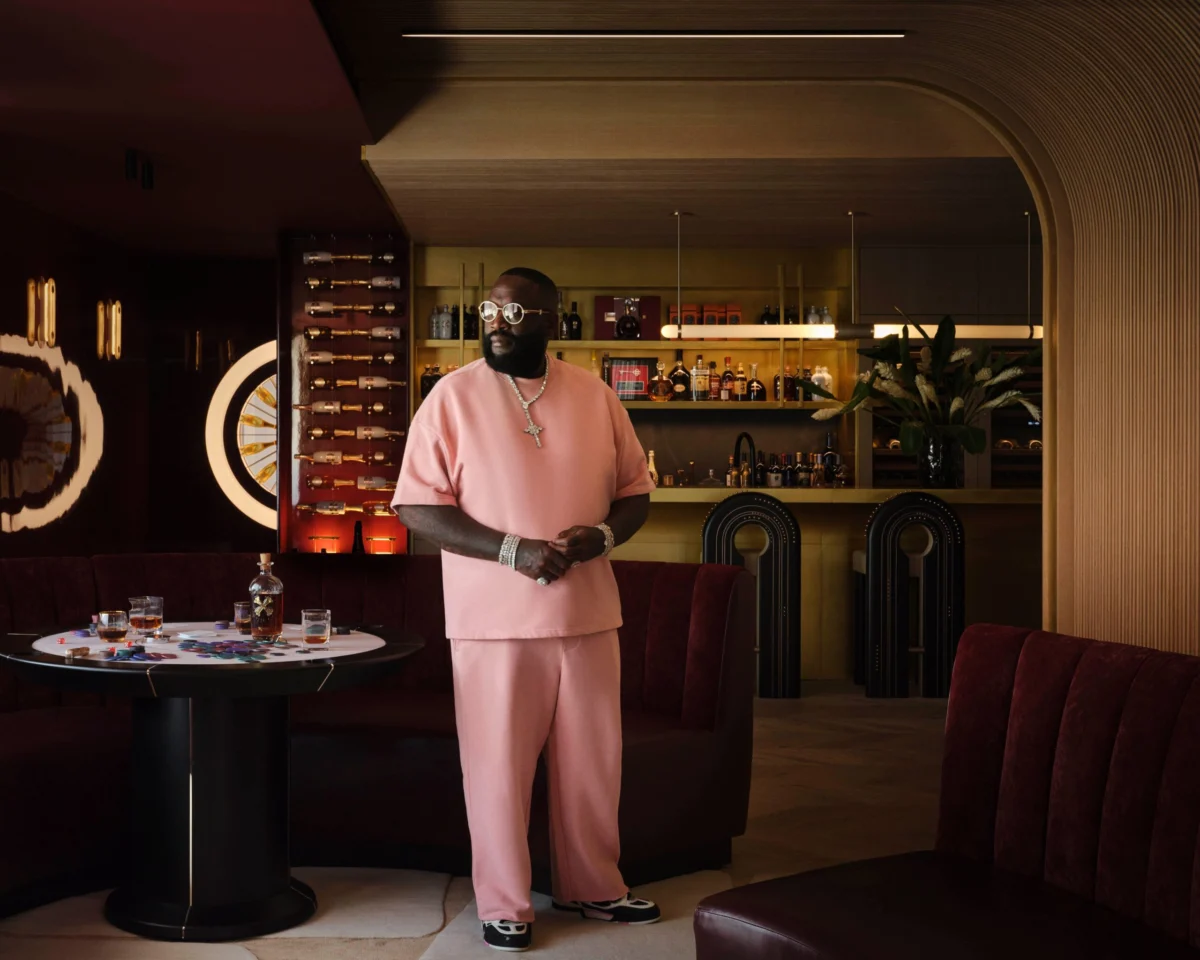
The intersection of hip-hop royalty and ultra-luxury real estate has reached a new zenith on Miami Beach’s Star Island, where William Leonard Roberts II—the multi-platinum artist and entrepreneur known globally as Rick Ross—has completed a comprehensive renovation of his nearly 15,000-square-foot estate. Defined by a design philosophy that balances "elegance with audacity," the property serves as both a private sanctuary and a physical manifestation of the "Boss" brand that Ross has cultivated over a two-decade career. Under the guidance of interior designer Kai Williamson of Studio 7 Design Group and the technical precision of "Billionaire Builder" Manny Angelo Varas, the residence has been transformed from a standard luxury mansion into a bespoke architectural statement featuring 35 tons of imported marble and a curated collection of contemporary art.

Architectural Significance and the Star Island Enclave
Star Island remains one of the most exclusive man-made islands in Biscayne Bay, accessible only via a single bridge and protected by 24-hour security. The neighborhood’s reputation as a "billionaire’s row" is well-earned; its residents have historically included figures such as Gloria Estefan, Shaquille O’Neal, and Ken Griffin. The local real estate market in this specific corridor has seen a dramatic appreciation in value over the last five years, with average property prices often exceeding $4,000 per square foot. For Ross, whose lyrical narrative is inextricably linked to his Miami upbringing, securing a primary residence on Star Island represents the ultimate professional and personal milestone.

The estate itself spans approximately 15,000 square feet and sits on a sprawling lot that overlooks the Atlantic shipping channels, providing a direct view of the cruise ships and yachts that define the Miami skyline. The renovation process, which lasted approximately two years, involved gutting the majority of the existing structure to accommodate a more modern, "futuristic yet calm" aesthetic. Despite the extensive overhaul, Ross insisted on retaining and enhancing the home’s central staircase, which was widened and clad in premium marble to serve as the residence’s anchor.

The Design Philosophy: Elegance Meets Audacious Customization
Kai Williamson, the lead designer on the project, noted that the objective was to create a space that reflected the rapper’s larger-than-life persona while providing the tranquility required for high-level business operations. This duality is most evident in the "Great Room," a space Ross refers to as the "power circle." The room is anchored by a curved custom couch from Kreiss, designed to facilitate high-stakes negotiations. Ross famously remarked that to sit in this room, one should be discussing deals worth "$100 million and up."

The aesthetic throughout the home is a blend of neutral, calming tones—creams, whites, and soft greys—interrupted by bold, audacious bursts of color and texture. In the primary bedroom, a burgundy bed sits beneath a Solomon Adufah panel painting that depicts a woman partially obscured by blooming flowers. This penchant for art extends to the exterior, where the swimming pool features a massive mosaic of two faces by artist Shira Barzilay (known as Koketit). Ross personally initiated the collaboration after discovering Barzilay’s work on Instagram, illustrating his hands-on approach to the property’s artistic direction.

A Masterclass in Materiality: The Significance of 35 Tons of Marble
The most striking technical achievement of the renovation is the integration of 35 tons of marble. This material choice was not merely for aesthetic prestige but served to create a sensory experience of "enrobement." The marble appears throughout the home, from the widened grand staircase to the primary bathroom, which features rare emerald-hued marble panels.

The primary bathroom serves as a private spa, equipped with a tub by Antoniolupi and double showerheads—a design choice Ross justifies with a simple "why not?" The lighting in these spaces is equally bespoke, featuring sconces by Soktas and chandeliers from Studio Nordhaven. The use of high-end materials extends to the furniture and fixtures, with pieces from Minotti, John Pomp Studios, and Carlyle Collective appearing in key living areas.

From Carol City to Star Island: A Narrative of Persistence
To understand the scale of the Star Island project, one must view it through the lens of Ross’s history. Growing up in Carol City, a neighborhood in Miami Gardens, Ross lived in a modest three-bedroom house. A pivotal moment in his childhood occurred in the fifth grade when his family home burned down. The fire resulted in the loss of his prized Nintendo collection, an event that Ross recalls with vivid clarity.

The transition from a home without central air conditioning—which Ross describes as a "blown away" moment when his mother first explained the concept to him—to a 15,000-square-foot estate with a real-time climate management system is the core of his "hustle" narrative. His builder, Manny Angelo Varas, noted that the home’s infrastructure is among the most advanced in the region, monitoring everything from air quality to humidity to ensure the preservation of the extensive marble work and the rapper’s collection of mink coats.

Advanced Infrastructure and the Billionaire Builder
The technical execution of the property was overseen by Manny Angelo Varas, whose firm specializes in high-net-worth residential projects. Varas described the construction as a massive logistical undertaking that required over 100 craftsmen on-site daily. Ross reportedly maintained a high level of morale among the crew by bringing in local food trucks to provide meals throughout the two-year build.

Beyond the aesthetic finishes, the home is a marvel of modern engineering. The climate management system is designed to adjust the environment in real-time based on occupancy and external weather conditions. This is particularly crucial for the "hidden" prep kitchen, where private chefs prepare meals for the rapper and his guests. The kitchen features custom cabinetry, counter stools by Anna Karlin, and a chandelier by Christopher Boots, seamlessly blending utility with high design.

The Extension of a Brand: The Hangar and Beyond
The Star Island residence is only one component of Ross’s extensive asset portfolio. Nearby, he maintains a large airplane hangar that houses his private jet, branded with the Rick Ross logo. This hangar serves as a secondary leisure space, containing his collection of approximately 15 luxury vehicles—including several Maybachs—and a vintage arcade collection that serves as a symbolic replacement for the Nintendo games lost in his childhood fire.

Even the home’s gym reflects this brand-conscious lifestyle. Built around a Louis Vuitton punching bag, the fitness center is equipped with Technogym machinery and leads into a wood-paneled sauna. The sauna features a "starry" ceiling inspired by the interior of a Rolls-Royce Phantom, allowing for a continuation of the luxury experience even during recovery and wellness routines.

Broader Implications for the Miami Luxury Real Estate Market
The completion of Ross’s Star Island estate is indicative of a broader trend in the Miami luxury market, where high-profile celebrities are moving beyond "off-the-shelf" luxury and toward highly customized, branded environments. This shift has driven up demand for specialized designers like Kai Williamson and builders like Manny Angelo Varas, who can navigate the complexities of bespoke architectural requests.

Economically, such investments contribute to the stabilization of ultra-high-end property values in Miami-Dade County. As more entrepreneurs and entertainers consolidate their wealth into substantial real estate holdings in Florida—drawn by favorable tax laws and the burgeoning "Wall Street South" movement—properties like Ross’s Star Island home set a new benchmark for what constitutes a "trophy property."

Conclusion: The Renaissance of a Boss
For Rick Ross, the Star Island home is more than a residence; it is a testament to the "Renaissance of a Boss," a theme he explores in his recently published memoir. The property represents a full-circle journey from the challenges of Carol City to the pinnacle of international success.

As the sun rises over the Atlantic, Ross often finds himself on his deep terraces or the lawn, taking in the view of the passing cruise ships. Despite his "Biggest Boss" persona, he admits to a sense of awe regarding his surroundings. The estate stands as a physical manifestation of his career—audacious in its scale, elegant in its execution, and deeply rooted in the Miami landscape that he has spent his life celebrating. In a city defined by constant reinvention, the Star Island estate is, as the name of his upcoming album suggests, "Set in Stone."
