

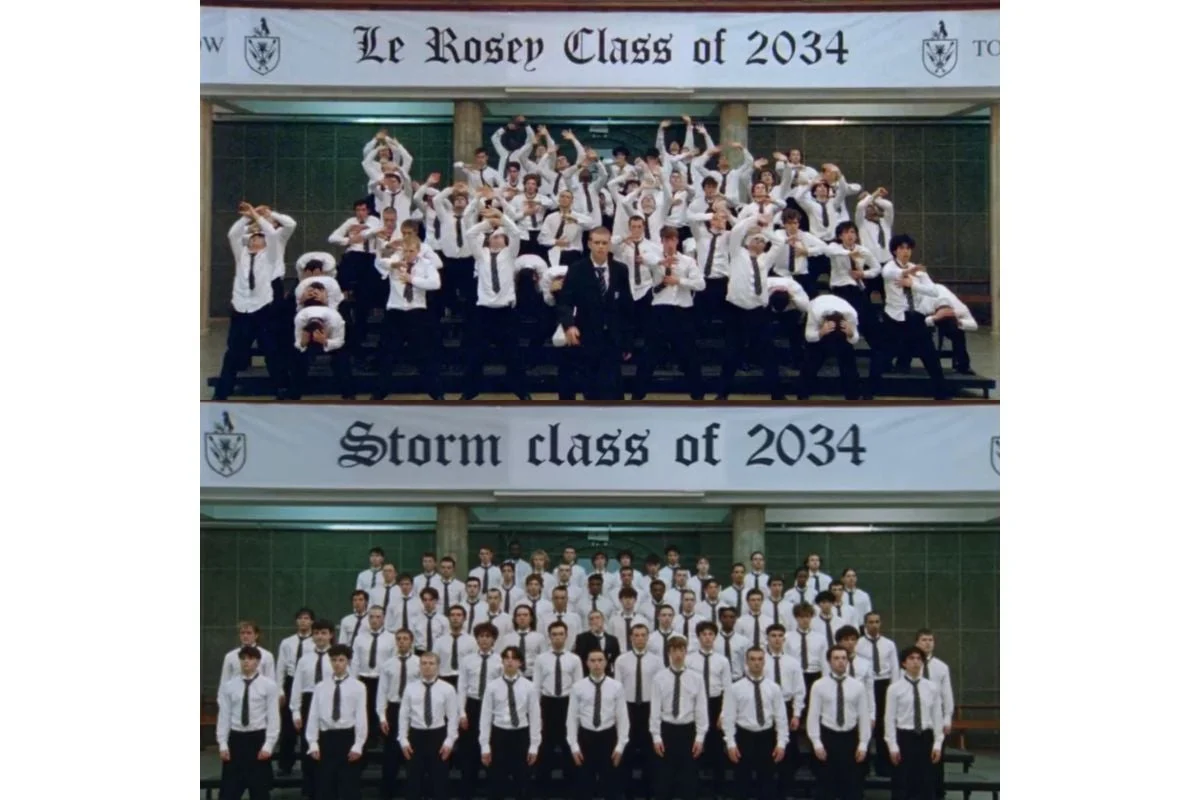
A shroud of intrigue has descended upon the music video for Swedish rapper Yung Lean’s track "Storm," as an explicit reference to one of the world’s most elite boarding schools, Institut Le Rosey, has been conspicuously removed from the latest version. The video, a visually arresting piece directed by Romain Gavras and a collaboration with French producer GENER8ION, has captivated audiences, amassing over 11 million views on YouTube within a mere three weeks of its release on April 24th. This swift and substantial viewership underscores the video’s potent cultural impact, amplified by its striking choreography and cinematic narrative.
Initially, the video featured a prominent banner displaying "Le Rosey Class of 2034," placing the fictionalized setting of the music video within the prestigious halls of the Swiss institution. Institut Le Rosey, renowned for its exclusivity and illustrious alumni, has long been dubbed "the school of kings." Situated in Rolle on the picturesque shores of Lake Geneva, it commands annual boarding fees reaching upwards of $207,200. Its alumni roster reads like a royal and dynastic roll call, including King Albert II of Belgium, the Aga Khan IV, and former King Juan Carlos I of Spain. Further distinguishing itself, Le Rosey operates a unique winter campus in Gstaad from January to March, dedicating weekday afternoons to alpine pursuits.
However, the on-screen endorsement, or at least association, has now been erased. In the current iteration of the video, the Le Rosey banner has been replaced by one bearing the song’s title, "Storm." This alteration, while subtle in its execution, has ignited speculation regarding the motivations behind the change and the potential implications for both the artist and the renowned educational establishment.
A Cinematic Narrative of Boarding School Life
The music video unfolds as a short film, depicting a fictionalized boarding school environment. Yung Lean is portrayed as a student, embodying a bullying persona. The narrative showcases a range of disruptive behaviors, including kicking other students’ bags, defacing school property with graffiti, engaging in physical altercations, and a particularly unsettling scene where a student’s head is forced into a toilet. These dramatic elements, set against the backdrop of a meticulously choreographed student body, contribute to the video’s provocative and memorable aesthetic.
The choreography, a central element of the video’s success, features rows of dancers, costumed as students, moving with precise, almost mechanical synchronicity. This powerful visual, with Yung Lean often positioned as a static, almost ominous figure at the center of the synchronized movement, has been widely shared and is credited with driving the video’s broad appeal beyond its core music fanbase.
The Unraveling of the Le Rosey Connection
The inclusion of "Le Rosey Class of 2034" in the video’s initial release appears to have gone largely unnoticed by the wider public for a significant period. While the video garnered widespread praise for its artistic merit, including its cinematic quality and ambitious choreography, the specific branding element remained under the radar. The eventual discovery and subsequent removal have prompted questions about the nature of the agreement, if any, between the production and the school, and the reasons for the sudden excision.
When approached for comment by Spear’s, Institut Le Rosey declined to provide a statement on the matter. Similarly, a spokesperson for Yung Lean did not immediately respond to requests for clarification. This silence from both parties only serves to deepen the mystery surrounding the video’s edit.
Legal and Reputational Considerations
Thomas Rudkin, a partner at Farrer & Co with expertise in reputation and privacy law, offered insight into the potential legal ramifications of the video’s initial content. He suggested that while the reference to Le Rosey might have been intended as a "tongue-in-cheek" nod, it could have nonetheless presented reputational challenges for the school.

"Defamation may well be the basis on which it was removed (if indeed the school complained); most likely, it might have been suggested that the video was defamatory in associating the school with an environment rife with bullying," Rudkin explained. He elaborated that the legal threshold for such a claim would likely hinge on whether the reference could be interpreted as asserting factual claims about the school, a point he deemed "pretty debatable" within the context of a music video. Nevertheless, Rudkin acknowledged that it would be understandable for a production team to "de-risk" the situation if a complaint had been lodged by the institution.
The Mechanics of Video Editing on YouTube
The technical possibility of making such an edit to an already published YouTube video is straightforward. While YouTube does not permit the complete replacement of a video file, creators possess the capability to modify uploaded content. Utilizing the built-in editing tools within YouTube Studio, filmmakers can trim or remove specific segments of a video after its initial publication. This functionality allows for content to be altered or deleted without impacting the video’s view count, comments, or its permanent link, suggesting that the removal of the Le Rosey banner was a deliberate and technically feasible decision.
Wider Repercussions and Parallels
The controversy surrounding the Le Rosey reference is not the first time that depictions of educational institutions in media have stirred debate. The filming location for the video, Cardinal Mercier College in Belgium, also reportedly faced scrutiny from its staff. Director Gregory De Smet acknowledged in an interview with The Bulletin that while the involvement of established creative figures initially helped secure approval, certain scenes in the final edit were deemed "violent" and "not images we want to see associated with a school." This sentiment highlights a recurring tension between artistic expression and the desire of educational institutions to maintain a specific public image.
The impact of the Yung Lean video has extended beyond its immediate viewership. Notably, Shiplake College, a private boarding school in Oxfordshire, even recreated elements of the choreography on TikTok, demonstrating the video’s cultural reach and its ability to inspire engagement across different platforms and demographics. This widespread imitation underscores the viral nature of the content and its influence within broader cultural conversations.
Chronology of Events
- April 24th, 2026: The music video for Yung Lean’s "Storm," featuring GENER8ION and directed by Romain Gavras, is released on YouTube. The initial version includes a banner referencing "Le Rosey Class of 2034."
- Early May 2026: The video gains significant traction, amassing millions of views due to its striking choreography and cinematic style.
- Mid-May 2026: The reference to Institut Le Rosey is removed from the video. The banner is replaced with the song’s title, "Storm."
- Late May 2026: Spear’s contacts Institut Le Rosey and Yung Lean’s representatives for comment. Le Rosey declines to comment, and Yung Lean’s team does not immediately respond. Legal experts weigh in on potential reputational and legal implications.
Supporting Data and Context
Institut Le Rosey’s reputation is built on decades of catering to an elite clientele. Its winter campus in Gstaad, a renowned luxury ski resort, further emphasizes its exclusive positioning. The school’s rigorous academic program is complemented by a wide array of extracurricular activities, particularly sports, including skiing, tennis, and equestrian pursuits. The "school of kings" moniker is not merely a marketing slogan but reflects a historical legacy of educating the children of royalty, business magnates, and international diplomats. The annual fee of over $200,000 places it among the most expensive educational institutions globally, a fact that underscores the significance of any public association.
Yung Lean, whose real name is Jonatan Aron Leandoer Håstad, emerged from Stockholm’s cloud rap scene and gained international recognition for his distinctive style and melancholic, often surreal, lyrical themes. His collaborations with GENER8ION and Romain Gavras, a director known for his visually dynamic and often controversial music videos (including work for artists like Justice and M.I.A.), indicate an artistic ambition that pushes boundaries. The "Storm" video aligns with this artistic trajectory, exploring darker themes through a high-concept visual narrative.
Broader Implications
The incident raises pertinent questions about the intersection of art, commerce, and reputation management in the digital age. For artists and filmmakers, the desire to create impactful and provocative content must be balanced against the potential for unintended consequences and legal challenges. The ease with which digital content can be disseminated and altered means that the lifecycle of a creative work is increasingly dynamic.
For institutions like Le Rosey, the incident underscores the challenges of maintaining a carefully curated public image in an era of ubiquitous social media and viral content. While the school’s inherent exclusivity offers a degree of insulation, any public association, even if tangential or misconstrued, can have ripple effects. The swift removal of the reference suggests a proactive approach to mitigating potential reputational damage, a strategy that is becoming increasingly common for high-profile organizations navigating the complexities of online visibility.
The "mystery" of the missing name in the Yung Lean video serves as a compelling case study in the evolving landscape of media, branding, and public perception. It highlights the power of visual storytelling, the sensitivity of institutional reputations, and the sophisticated methods employed to manage them in the digital realm. As the video continues to be viewed and analyzed, the full extent of its impact on the involved parties and the broader cultural conversation remains to be seen.
