

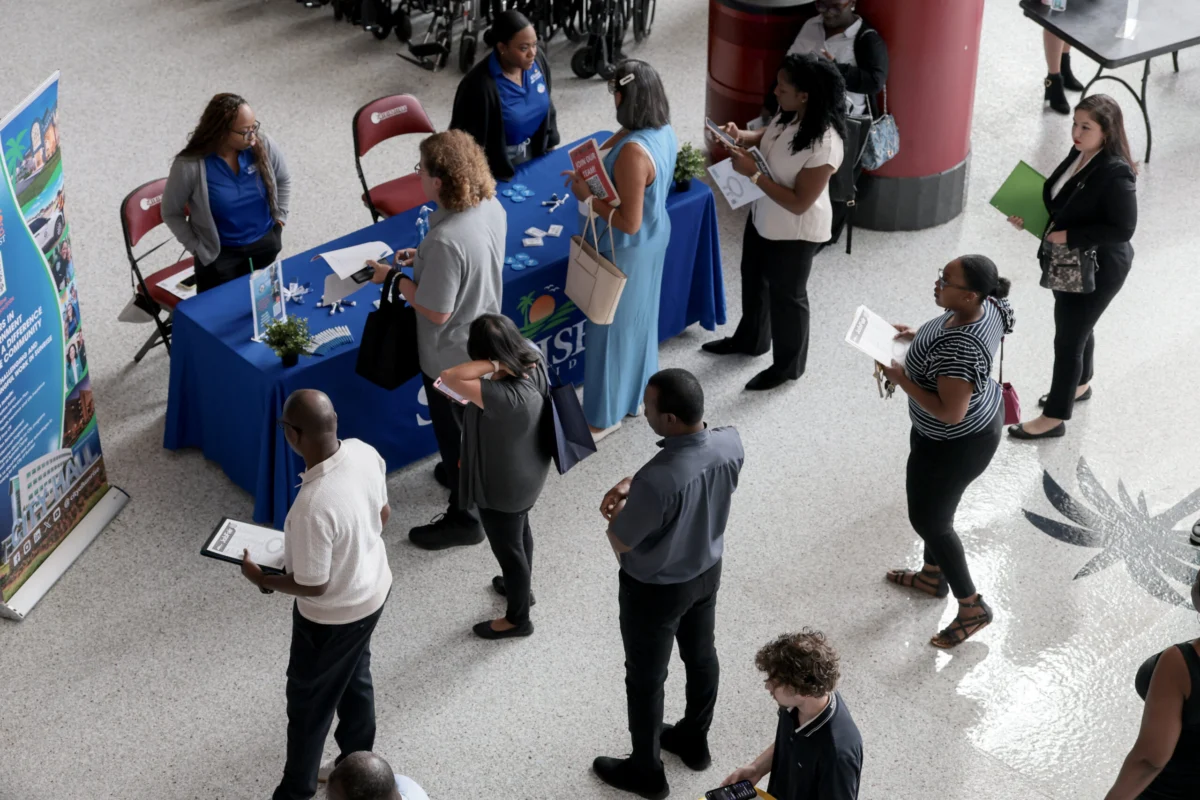
The U.S. labor market demonstrated a degree of resilience in April, exceeding modest expectations for job creation, yet simultaneously signaling a potential slowdown for the remainder of the year. The Bureau of Labor Statistics reported Friday that nonfarm payrolls rose by a seasonally adjusted 115,000, a notable deceleration from the unusually robust 185,000 jobs added in March, but comfortably surpassing the 55,000 forecast by Dow Jones consensus estimates. This figure, while indicating continued, albeit slower, employment growth, is being closely scrutinized by economists and policymakers for signs of underlying weakness.
The unemployment rate remained steady at 4.3%. This stability, coupled with minimal growth in the labor force, suggests that the current pace of job creation is sufficient to absorb new entrants and those re-entering the workforce, maintaining a relatively low jobless rate. However, this equilibrium also points to a maturing labor market where significant job gains are no longer necessary to keep unemployment in check, a dynamic that could precede a period of stagnation.
Key Metrics Reveal a Shifting Landscape
Beyond headline job numbers, several other crucial indicators from the April report paint a nuanced picture of the labor market’s health. Average hourly earnings, a closely watched measure of wage inflation and worker purchasing power, saw a more subdued increase than anticipated. Earnings grew by 0.2% for the month and 3.6% on an annual basis, falling short of the projected 0.3% monthly and 3.8% annual gains. This moderation in wage growth could be a positive development for the Federal Reserve, which is keenly focused on controlling inflation, but it also raises questions about consumer spending power in the coming months.
Further complicating the outlook is a continued decline in the labor force participation rate and a contraction in tech-related employment. This trend in the information sector, which has seen a significant jobs deficit since late 2022, is increasingly being linked to the rapid advancements and adoption of artificial intelligence. Since November 2022, the information services sector has shed approximately 342,000 jobs, representing an 11% decline in employment within that category. This suggests a structural shift in certain industries, with AI potentially displacing human workers at an accelerating rate.

Expert Analysis: Stability Without Robust Growth
Economists and analysts offered a range of interpretations of the April jobs report, with many highlighting the labor market’s persistent stability while acknowledging the absence of strong momentum. Austan Goolsbee, President of the Federal Reserve Bank of Chicago, commented in a CNBC interview that the labor market has been "pretty much stable for a year, year and a half." He characterized this stability as "without being good," noting that the unemployment rate, hiring rate, layoff rate, and vacancy rate have all remained consistent. "So, I still think there’s not a lot of evidence that the job market is falling apart," Goolsbee added, suggesting that while the rapid hiring of previous years has ended, a significant downturn is not yet evident.
Scott Clemons, Chief Investment Strategist at Brown Brothers Harriman, echoed this sentiment, describing the report as "evidence of the underlying resilience of this economy and of this labor market, despite all of the slings and arrows of outrageous concerns about the Middle East and unemployment and inflation and the Fed." However, he cautioned against drawing definitive conclusions from a single month’s data, emphasizing that "one month does not a new trend establish." Clemons pointed to the "month to month volatility in the jobs market over the past year" and expressed that he would feel more comfortable if "another two or three months of solid job gains" were observed.
Dan North, Senior Economist for North America at Allianz, found the report to be "fairly bulletproof this month," despite acknowledging that the overall numbers are "not impressive." He stated, "I think that they’re still pointing towards a softening job market, but certainly not a collapse." This perspective suggests a gradual cooling rather than an abrupt contraction.
Sectoral Performance: A Mixed Bag
Sectoral analysis reveals a varied performance across the U.S. economy. Healthcare continued to be a primary driver of job growth, adding 37,000 new positions in April. This sustained strength in the healthcare sector is often attributed to demographic trends, an aging population, and the ongoing demand for medical services, making it a relatively recession-proof industry.
Other sectors also contributed positively to the employment figures. Transportation and warehousing saw an increase of 30,000 jobs, reflecting continued demand in logistics and e-commerce fulfillment. Retail employment rose by 22,000, indicating some recovery or sustained activity in the consumer goods sector. Social assistance also added 17,000 jobs, pointing to ongoing needs within community and support services.

Broader Measures and Potential Concerns
While the headline unemployment rate remained steady, a broader measure of labor underutilization, which includes discouraged workers and those holding part-time jobs for economic reasons, saw an uptick. This U-6 rate rose to 8.2%, an increase of 0.2 percentage points. This rise is largely attributed to a surge in individuals employed part-time for economic reasons, often termed "underemployed." The number of such individuals increased by 445,000, reaching 4.9 million. This suggests that a growing number of people are working fewer hours than they desire, a factor that can constrain consumer spending and economic growth.
The household survey, which the Bureau of Labor Statistics uses to calculate the official unemployment rate, showed a decline of 226,000 workers. This decrease was accompanied by a drop in the labor force participation rate to 61.8%, the lowest level since October 2021. A declining participation rate can mask underlying labor market weakness, as it means fewer people are actively seeking employment, thus not counted among the unemployed.
Revisions and the Federal Reserve’s Dilemma
Revisions to previous months’ data provided further context. The March jobs figure was revised upward by 7,000, while the February number was revised downward by 23,000, resulting in a total loss of 156,000 jobs for February, a significant downward adjustment from the initial report of a 92,000 job loss. These revisions underscore the inherent volatility in monthly labor market data and the challenges in precisely capturing real-time economic activity.
The April jobs report arrives at a critical juncture for the Federal Reserve. The central bank has been grappling with internal disagreements regarding monetary policy, particularly concerning the trajectory of interest rates. Last week’s Federal Open Market Committee (FOMC) meeting saw an unusual level of dissent, with an 8-4 vote to keep the benchmark interest rate steady. The dissenting votes, the highest since 1992, reflected differing views on the future path of monetary policy. While most officials agreed on the need to hold rates, their opinions diverged on how to communicate potential future adjustments, with some advocating for the possibility of further hikes or cuts depending on unfolding economic conditions.
This policy complexity is further compounded by geopolitical tensions, including the ongoing conflict in the Middle East, and the imposition of tariffs, which can influence inflation and supply chains. The impending confirmation of a new chairman for the Federal Reserve, with former Governor Kevin Warsh awaiting Senate approval, adds another layer of anticipation to the central bank’s future direction.

Market expectations generally lean towards interest rates remaining unchanged throughout the year. This outlook is predicated on the economy’s navigation of persistently high inflation and a labor market that, while no longer experiencing the frenetic hiring pace of earlier years, has demonstrated a notable capacity for resilience. The April jobs report, with its mixed signals, offers neither a clear indication of imminent recession nor a strong case for aggressive monetary tightening, leaving policymakers to carefully weigh incoming data and the evolving economic landscape.
Broader Economic Implications and Future Outlook
The current economic environment is characterized by a delicate balance. On one hand, the labor market’s stability, as evidenced by the persistent low unemployment rate, provides a foundational strength. On the other hand, the deceleration in job growth, the stagnation in wage increases, and the rise in underemployment suggest that the economy is not operating at full capacity.
The ongoing debate within the Federal Reserve highlights the difficulty in calibrating monetary policy when faced with conflicting economic signals. While inflation remains a concern, the cooling labor market could necessitate a shift in focus towards supporting economic growth. The impact of technological advancements, particularly AI, on employment patterns is another significant factor that will likely shape labor market dynamics for years to come, necessitating proactive strategies for workforce adaptation and reskilling.
The coming months will be crucial in determining whether the April report represents a temporary dip in momentum or the beginning of a sustained slowdown. Continued monitoring of key labor market indicators, alongside inflation data and global economic developments, will be essential for understanding the path ahead and for informing the Federal Reserve’s policy decisions. The resilience observed in the April jobs report, while encouraging, underscores the need for vigilance and adaptability in navigating a complex and evolving economic landscape.
