

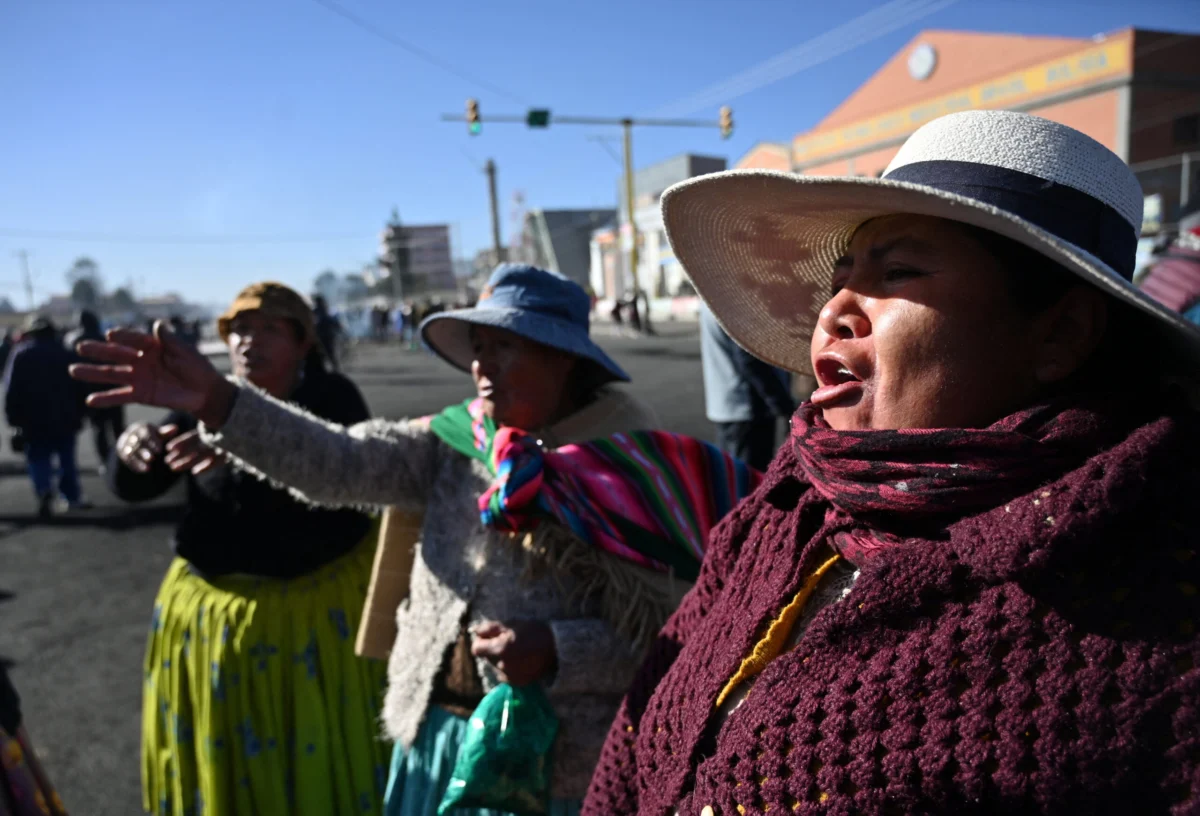
Bolivian security forces, comprising approximately 3,500 soldiers and police officers, executed a massive coordinated operation in the early hours of Saturday to dismantle dozens of roadblocks that have paralyzed the nation’s infrastructure. The intervention, centered primarily on the strategic outskirts of La Paz, marks a significant escalation in the confrontation between the fledgling administration of President Rodrigo Paz and a diverse coalition of protesters. According to the national citizens’ rights ombudsman’s office, the operation resulted in at least 57 arrests as authorities utilized heavy machinery and riot control tactics to disperse demonstrators who have occupied key transit arteries for weeks.
The crackdown follows nearly a month of intensifying civil unrest driven by a catastrophic economic downturn, which many analysts describe as the most severe financial crisis the South American nation has faced in nearly forty years. The protesters—a broad alliance including miners, schoolteachers, Indigenous organizations, and powerful labor unions—have expressed profound outrage over the government’s recent fiscal policies and the soaring cost of living. As the military moved to reopen the highways, the atmosphere remained volatile, with reports of clashes in several sectors where demonstrators attempted to maintain their positions against the advance of security personnel.
The Economic Context: From Energy Exporter to Fuel Importer
To understand the current volatility in Bolivia, one must examine the rapid deterioration of the country’s macroeconomic foundation. For nearly two decades, Bolivia was often cited as an example of unconventional economic success in the region, driven largely by the "gas phenomenon." In the late 20th and early 21st centuries, the discovery of massive natural gas reserves allowed the state to fund extensive social programs and maintain a stable exchange rate. At its peak, Bolivia was a primary energy supplier to industrial giants like Brazil and Argentina.
However, the tide turned decisively in 2022. A combination of aging fields, a lack of investment in new exploration, and systemic mismanagement of the state-owned energy firm, YPFB, led to a sharp decline in production. By the time President Rodrigo Paz took office in October, the dynamic had inverted: Bolivia, once an energy powerhouse, had become a net importer of liquid fuels. This shift has placed an unbearable strain on the national treasury.
The government’s foreign currency reserves have plummeted to critical levels, leaving the Central Bank with limited capacity to defend the national currency or pay for essential imports. Consequently, the country has been gripped by a severe shortage of US dollars, leading to a burgeoning black market and a spike in the cost of imported goods. In many cities, citizens now face grueling lines at gas stations that stretch for blocks, while grocery store shelves are increasingly empty of basic staples like flour, rice, and cooking oil.
The Rise of President Rodrigo Paz and the End of the MAS Era
The election of Rodrigo Paz in October represented a tectonic shift in Bolivian politics. His victory brought an end to nearly twenty years of governance by the Movement for Socialism (MAS), the party of former President Evo Morales and his successor Luis Arce. Paz, a center-right politician, campaigned on a platform of "economic realism" and "national restoration," promising to fix the fiscal imbalances left by his predecessors.
However, the transition from a socialist-oriented economy to a market-driven one has been fraught with social friction. Upon taking office, Paz moved quickly to implement "shock therapy" measures. Key among these was the controversial decision to end a twenty-year-old fuel subsidy. While economists argued the subsidy was fiscally unsustainable—costing the state billions of dollars annually—the immediate result was a dramatic increase in transportation and food costs, hitting the country’s poorest populations the hardest.
Furthermore, Paz’s push to privatize several state-owned companies, which were seen as symbols of national sovereignty under the MAS government, has galvanized the opposition. Labor unions and Indigenous groups view these moves as a betrayal of the working class and an invitation for foreign exploitation.
Timeline of the Escalation: A Month of Gridlock
The path to Saturday’s military intervention was paved by a series of failed negotiations and legislative retreats.
- Early February: Initial protests broke out following the announcement of the subsidy removal. Small-scale demonstrations were reported in Potosí and Oruro.
- Mid-February: The protest movement expanded as the "Pact of Unity," an influential coalition of Indigenous groups, joined the miners and teachers. Roadblocks began appearing on the "central axis" highway connecting Santa Cruz, Cochabamba, and La Paz.
- Early March: In an attempt to quell the rising tide of dissent, the Paz administration was forced to repeal Law 1720. This land reform measure had become a flashpoint for rural communities, who claimed the law would allow the government to dispossess small landowners in favor of large-scale agribusiness interests. While the repeal was a victory for the protesters, it did not stop the movement; instead, the demands shifted toward the total resignation of the President and his cabinet.
- Late March: The number of roadblocks reached a peak of 22 major sites across the country. The city of La Paz, the seat of government, began experiencing severe shortages of meat and poultry, as supply trucks from the lowlands were unable to pass the blockades.
- Saturday, March 30: The government launched "Operation Humanitarian Flow," deploying 3,500 personnel to clear the routes.
Official Responses and the "Humanitarian Corridor"
Presidential spokesperson Jose Luis Galvez defended the Saturday crackdown as a necessary measure to prevent a humanitarian catastrophe. "We cannot allow the entire nation to be held hostage by political interests that seek to destabilize a democratically elected government," Galvez stated during a press briefing. He emphasized that the primary goal of the security forces was to create a "humanitarian corridor" to ensure that medical supplies, oxygen, and food could reach hospitals and markets in La Paz and El Alto.
The government has also pointed to the human cost of the blockades. Health officials claim that at least three people have died in recent weeks because ambulances were unable to navigate the debris and crowds at the roadblock sites. Furthermore, the Ministry of Economy estimated that the protests have cost the country upwards of $120 million in lost productivity and damaged infrastructure.
In a move that highlights the shifting geopolitical alliances in the region, President Paz sought and received support from neighboring Argentina. Earlier this week, the administration of Javier Milei, Argentina’s libertarian president, dispatched humanitarian assistance to Bolivia, including food and medical kits.
President Paz expressed his gratitude on social media, noting that the gesture "strengthens the historic bonds of brotherhood between our nations" and provides "vital relief" during a period of extreme need. President Milei responded with a staunch defense of the Paz administration, characterizing the protesters as "anti-democratic" actors who seek to "obstruct the path toward freedom and progress."
Social and Political Implications: A Divided Nation
The use of the military to clear protesters has drawn sharp criticism from human rights organizations and opposition leaders. The citizens’ rights ombudsman’s office has called for an immediate cessation of violence and a return to dialogue, warning that the use of force may only deepen the resolve of the demonstrators.
Indigenous leaders have vowed to return to the streets, claiming that the government’s actions are a return to the "repressive tactics of the neoliberal past." For many in the rural highlands, the struggle is not merely about fuel prices but about the preservation of a political identity that was fostered during the MAS era.
The situation presents a precarious challenge for President Paz. While he has succeeded in temporarily reopening some roads, the underlying causes of the unrest—inflation, currency shortages, and deep-seated political polarization—remain unresolved. His administration is walking a tightrope between the need for fiscal discipline demanded by international lenders and the social stability required to govern a diverse and historically activist populace.
Broader Regional Impact
The crisis in Bolivia is being closely watched by neighboring countries and international markets. As a country that sits at the heart of South America, instability in Bolivia can have a ripple effect on regional trade and energy security. The shift in Bolivia’s leadership from the socialist bloc to a more conservative, market-friendly alignment has also altered the balance of power within regional organizations like MERCOSUR and the Andean Community.
The support from Argentina’s Milei suggests the emergence of a new conservative axis in the Southern Cone, focused on austerity and the dismantling of state-led economic models. However, the success of this model in Bolivia remains to be seen. If the Paz administration cannot stabilize the economy and provide relief to its citizens, the current unrest may be only the beginning of a prolonged period of instability.
As the sun set on Saturday, the highways leading into La Paz were largely clear, but the presence of armored vehicles and heavily armed police served as a stark reminder of the tension simmering beneath the surface. The government has signaled that it will maintain a security presence at key junctions indefinitely to prevent the re-establishment of the blocks. Meanwhile, protest leaders are reportedly meeting in secret to coordinate their next move, suggesting that the battle for Bolivia’s economic and political future is far from over.
