

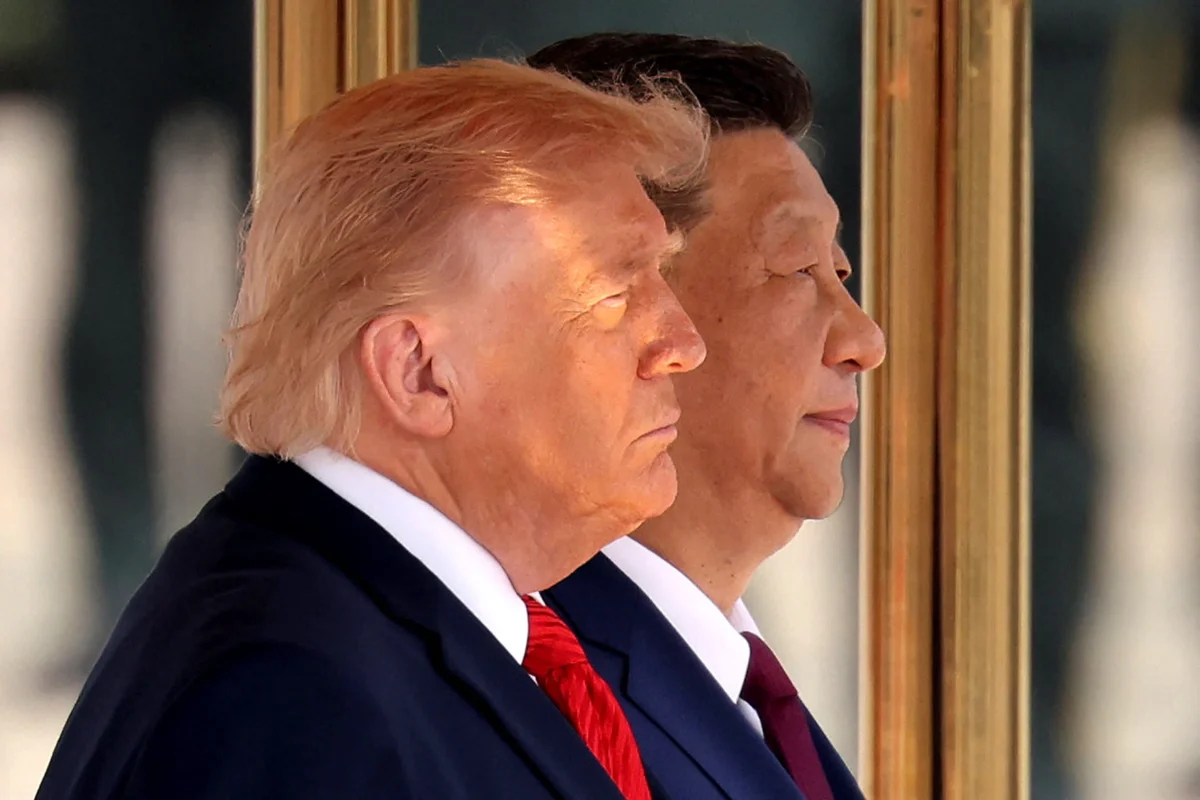
The arrival of Air Force One in Beijing this week marked a pivotal moment in the complex geopolitical relationship between the United States and China, underscored by a high-powered delegation of American technology executives who accompanied President Donald Trump on the 20-hour journey from Alaska. The presence of industry leaders such as Nvidia’s Jensen Huang, Tesla’s Elon Musk, and Apple’s Tim Cook signaled that the future of high-tech commerce and artificial intelligence remains the central pillar of the bilateral agenda. As the two heads of state convened at the Great Hall of the People, the focus shifted from broad diplomatic overtures to the granular realities of semiconductor export licenses, the stability of critical mineral supply chains, and the burgeoning race for AI supremacy.
The summit began with a significant rhetorical shift from the Chinese side. President Xi Jinping, during a series of meetings on Thursday, assured the assembled American CEOs that China’s door to international business would "open wider." This statement, reported by the state-backed Xinhua News Agency, was viewed as an attempt to de-escalate the tensions that have defined the last several years of trade relations. However, the optimism of the boardroom was tempered by the strategic caution of the U.S. Trade Representative’s office and the persistent skepticism of Congressional hawks in Washington.
The Strategic Importance of the Corporate Delegation
The composition of the American delegation was a deliberate display of U.S. economic leverage and technological prowess. Beyond the headline-grabbing presence of Huang, Musk, and Cook, the group included senior executives from Meta, Micron, Qualcomm, and Coherent. Each of these companies represents a critical node in the global technology ecosystem—from the social media and AI infrastructure of Meta to the memory chip dominance of Micron and the essential telecommunications intellectual property of Qualcomm.
The inclusion of Nvidia’s Jensen Huang was particularly noteworthy. As the manufacturer of the world’s most advanced AI training chips, Nvidia sits at the center of the current technological "cold war." For President Trump, bringing these executives on the flight served a dual purpose: providing the presidents with direct access to the private sector’s primary stakeholders and demonstrating to Beijing that American innovation remains the primary engine of global digital transformation. According to U.S. Trade Representative Jamieson Greer, the executives were granted the rare opportunity to pitch their corporate visions directly to President Xi and President Trump during a joint session on Wednesday, an event Greer described as a vital exchange of perspectives.
The AI Chip Export Conundrum: Nvidia’s H200
While the summit was characterized by a spirit of "opening up," the underlying friction regarding semiconductor technology remained palpable. One of the most sensitive topics on the table was the potential licensing of Nvidia’s H200 AI chips for the Chinese market. Earlier in the week, analysts had warned that any formal agreement to ease export controls on these high-end processors would be "politically explosive" in Washington. Heidi Crebo-Rediker, a senior fellow at the Council on Foreign Relations, noted that such a move would likely trigger a "fierce backlash" from a bipartisan coalition of China hawks in Congress who view AI capabilities as a direct national security concern.
Despite the official silence on chip export controls during the bilateral meetings—a fact confirmed by Jamieson Greer in a Friday interview with Bloomberg TV—reports surfaced that Washington may be moving toward a more nuanced approach. Sources familiar with the matter indicated that the U.S. government has quietly cleared the sale of Nvidia’s H200 chips to several major Chinese technology firms. This suggests a "carve-out" strategy where specific, vetted entities are allowed access to high-performance hardware under strict monitoring, even as broader restrictions remain in place.
However, the appetite for American chips in China is no longer a given. Beijing has intensified its "Buy China" initiative, encouraging domestic tech giants to pivot toward local alternatives like Huawei’s Ascend processors. Greer observed that Chinese officials often view U.S. high-tech dominance as a "threat" to their own developmental autonomy. "They’re very committed to domestic production," Greer stated, adding that Chinese leaders fear American leads in AI hardware could be used to throttle China’s economic growth.
The Critical Minerals Standoff and the 2025 Trade Truce
The second major flashpoint of the Beijing summit involved the supply of critical and rare earth minerals. China currently controls the vast majority of the global market for these materials, which are essential for everything from electric vehicle batteries to advanced missile guidance systems. The current landscape is shaped by the fallout of the 2025 trade hostilities, during which Beijing retaliated against U.S. tariffs by curbing the export of key minerals.
A temporary trade truce, established in late 2025, has stabilized the flow of these materials, but the agreement is set to expire this autumn. The uncertainty surrounding its extension was a shadow over the summit. Greer described the current truce as "solid" but remained non-committal about its future, stating, "We’ll see about that." While there is a stated willingness on both sides to maintain the flow of rare earths, the U.S. has noted that shipments from China have been inconsistent, with Greer characterizing the recovery of supply levels as "slow."
Industry experts argue that the U.S. has little choice but to negotiate. According to Crebo-Rediker, an extension of the current mineral agreement is the "best-case outcome" for the United States. She emphasized that the U.S. and its Western allies cannot "out-mine, out-process, or out-spend" China in the near term to build the necessary resilience and independence in the supply chain. Consequently, negotiations regarding these minerals are expected to continue through the summer, likely culminating in further discussions during President Xi’s planned return visit to the United States in September.
Chronology of Recent Developments in the Global Tech Landscape
To understand the stakes of the Trump-Xi summit, it is necessary to look at the broader context of the technology sector in early 2026. The week of the summit saw several major developments that highlight the rapid pace of change and the increasing intersection of tech, defense, and regulation:
- Defense Tech Surge: On Wednesday, the defense technology startup Anduril announced a massive $5 billion funding round. This investment, led by Thrive Capital and Andreessen Horowitz, doubled the company’s valuation to $61 billion. The funding highlights a significant shift in venture capital toward "hard tech" and defense applications, driven by global instability and the need for AI-driven autonomous systems.
- Autonomous Vehicle Safety: Waymo, the autonomous driving unit of Alphabet, issued a recall for approximately 3,800 robotaxis in the U.S. this week. The recall was prompted by software issues that could lead vehicles to drive onto flooded roadways. The incident underscores the ongoing regulatory and safety hurdles facing the mass adoption of self-driving technology.
- AI and Cybersecurity: Google’s Threat Intelligence Group reported on Monday that it successfully thwarted a major operation by a hacker group attempting to use AI models for mass vulnerability exploitation. This event serves as a reminder that while AI offers immense benefits for business, it also provides sophisticated new tools for state-sponsored and criminal cyber actors.
- European Regulatory Friction: OpenAI announced it would grant the European Union access to its latest cyber-focused AI model. However, Anthropic remains in a standoff with EU regulators, holding out on the release of its "Mythos" model to the bloc. This highlights the diverging regulatory environments between the U.S., the EU, and China.
- Semiconductor Market Resilience: Cerebras Systems made a blockbuster debut on Wall Street this week. The chip company, which specializes in massive processors designed specifically for AI workloads, ended its first day of trading with a market capitalization of nearly $100 billion, signaling intense investor appetite for AI infrastructure.
Analysis: Implications for the Future of U.S.-China Relations
The Beijing summit has clarified the "new normal" of U.S.-China relations: a state of "competitive interdependence." While President Trump’s administration continues to push for American dominance in the AI sector, the presence of CEOs like Tim Cook and Elon Musk serves as a reminder of how deeply integrated the two economies remain. Apple continues to rely on Chinese manufacturing for the majority of its hardware, and Tesla’s Giga Shanghai remains a cornerstone of its global production strategy.
For China, the summit was an opportunity to project an image of stability and openness to the global investment community. By hosting the U.S. delegation at the Great Hall of the People, President Xi signaled that China is not yet ready to fully decouple from American technology, despite its aggressive push for domestic self-reliance.
The "music to the ears" of the executives—Xi’s promise of a wider door—will be tested in the coming months. The true measure of the summit’s success will not be found in the joint communiqués or the photo opportunities, but in the specific licensing decisions regarding Nvidia’s chips and the concrete terms of the rare earth mineral extension. As the delegation prepares for the return leg of the journey, the tech world remains in a state of watchful waiting, cognizant that in the 2026 landscape, trade policy and technology are one and the same.
