

BEIJING – U.S. President Donald Trump’s high-stakes visit to China this week has culminated in significant diplomatic achievements, stabilizing a delicate trade truce and offering a much-needed respite in the bilateral relationship. The two-day summit, which concluded on Friday, May 15, 2026, laid the groundwork for future dialogue, despite being overshadowed by the ongoing Iran war and persistent geopolitical fault lines. The visit, originally slated for an earlier date but postponed due to the escalating conflict in the Middle East, saw President Trump and Chinese President Xi Jinping engage in comprehensive discussions spanning trade, energy, and regional security, signaling a mutual desire to de-escalate tensions and foster a degree of "strategic stability."
The summit’s outcomes, while not fully detailed in terms of specific agreements, underscore a concerted effort by both global powers to navigate a complex international landscape fraught with economic uncertainties and regional conflicts. Key takeaways include commitments to further discussions, a potential softening of U.S. tech export controls, and new pledges for U.S. energy purchases by China, all against the backdrop of an assertive warning from Beijing regarding Taiwan.
Background and Context: A Relationship Under Strain
The backdrop to the May 2026 summit was one of considerable tension and intermittent cooperation. The U.S.-China relationship had been particularly strained throughout early 2025, marked by an escalation of trade disputes. This period saw the imposition of new tariffs by both nations, alongside China’s restrictions on rare earths exports, vital for numerous high-tech industries. These actions threatened to plunge the global economy into further uncertainty, disrupting supply chains and dampening international trade.
Recognizing the detrimental impact of a full-blown trade war, both sides had, in October 2025, agreed to a one-year trade truce. This agreement involved a reciprocal lowering of tariffs on various goods and a rollback of the rare earths restrictions, providing a temporary detente. The truce was set to expire in October 2026, adding a layer of urgency to the May summit to ensure its continuity or progression.
Compounding these trade complexities was the escalating Iran war, which began to significantly impact global stability and, critically, energy markets in early 2026. The conflict led to considerable disruptions in oil supply routes, driving up crude oil prices and introducing volatility to an already fragile global economy. The war’s intensity was such that it necessitated the postponement of President Trump’s initial travel plans to Beijing, underscoring its profound influence on international diplomacy and the strategic calculations of major powers. The delay highlighted how intertwined global energy security and geopolitical stability had become, forcing leaders to adapt their agendas to address immediate crises.
The Beijing Summit: A Diplomatic Overture
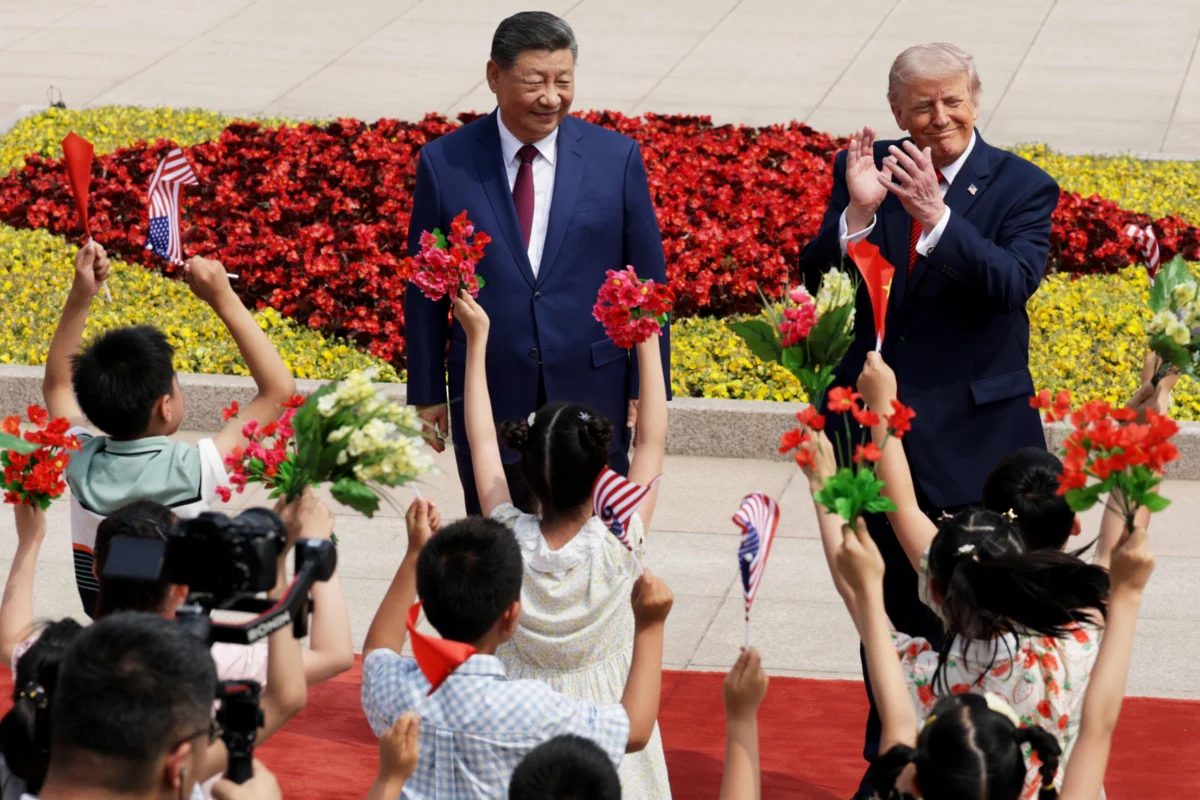
The much-anticipated summit officially commenced on May 14, 2026, with a grand welcome ceremony at the Great Hall of the People in Beijing, attended by President Trump and President Xi. The imagery of the two leaders, captured by Alex Wong for Getty Images, underscored the ceremonial weight of the occasion, designed to project an air of cooperation and mutual respect despite underlying tensions. The discussions, spanning two intensive days, were broad-ranging, covering the fragile trade truce, the pressing issue of the Iran war, and sensitive geopolitical matters like Taiwan.
The core objective of the summit, as articulated by officials from both sides, was to strengthen the U.S.-China relationship and inject greater predictability into their interactions. For the U.S., a primary goal was to secure China’s cooperation on easing the global energy crisis fueled by the Iran conflict and to protect American economic interests. For China, the emphasis was on maintaining stable bilateral ties, ensuring market access for its goods, and reinforcing its stance on its core national interests. The summit’s conclusion on Friday, May 15, set the stage for a follow-up meeting in the fall, indicating a commitment to sustained high-level engagement.
Geopolitical Realignment: Taiwan, Iran, and Energy Diplomacy
A central theme dominating the initial talks was China’s unequivocal warning regarding Taiwan. According to official English-language state media, President Xi explicitly cautioned President Trump that "mishandling Taiwan would put the U.S.-China relationship into ‘great jeopardy.’" This statement, widely reported, underscored Beijing’s firm stance on Taiwan as a red-line issue, reflecting its "One-China" principle and its long-standing opposition to any perceived external interference in what it considers an internal affair. The warning served as a stark reminder of the potential for the Taiwan question to destabilize the broader U.S.-China relationship, despite the immediate focus on economic and energy issues. Historically, U.S. policy toward Taiwan has involved "strategic ambiguity," providing defensive capabilities while not explicitly guaranteeing intervention in a cross-strait conflict, a stance Beijing views with deep suspicion. The U.S. government remained notably silent on Taiwan following Xi’s direct warning, a silence interpreted by some as a strategic de-escalation tactic during the summit.
The Iran war and its reverberations across global energy markets also featured prominently in the discussions. President Trump, in a prerecorded interview with Fox News, announced that China had agreed to purchase U.S. oil and would assist in negotiations related to the Iran conflict. This commitment, if fully realized, could represent a significant shift in global energy dynamics. China, as the world’s largest crude oil importer, has historically relied on a diversified portfolio of energy suppliers, including Iran. The Iran war had disrupted a substantial portion of global oil supplies, leading to a surge in prices and creating an urgent need for stable alternative sources. The U.S., having become a major global oil producer, stood poised to fill some of this demand. However, specifics regarding the volume and timeline of these U.S. oil purchases remain unconfirmed by Beijing, and Washington has yet to elaborate on the nature of China’s proposed assistance in Iran negotiations.
Yue Su, principal economist for China at the Economist Intelligence Unit, noted the delicate balance in these discussions. "I do think each side has delivered. There was no substantive discussion on Taiwan, though, which is not surprising," Su observed. "More discussion on Iran highlighted that they do have common ground. The fact that both sides want to describe the meeting as a win shows goodwill, at least." She added a pragmatic note regarding China’s leverage in the Middle East: "There are limits to what China can realistically do, as the Iranian regime is operating in survival mode and will prioritize its own interests and agenda above all else." This sentiment suggests that while China may offer diplomatic assistance, its capacity to fundamentally alter Iran’s actions might be constrained.
Bolstering the Trade Truce and Strategic Stability
The existing one-year trade truce, set to expire in October 2026, was a critical point of discussion. While no comprehensive new trade agreements were announced, President Trump’s invitation to President Xi to visit the U.S. on September 24, 2026, signals a strong intent to continue high-level dialogue before the truce’s expiration. This upcoming meeting offers a crucial window for the two leaders to discuss the future of their trade relations, potentially extending or refining the existing agreement.
President Xi, through state media, indicated that the U.S. and China had agreed to a framework of constructive "strategic stability" for the next three years. This framework, if formalized, would aim to provide a more predictable and stable foundation for U.S.-China relations, moving beyond the transactional nature that has often characterized their interactions. Jack Lee, an analyst at China Macro Group, highlighted the strategic importance of this development. "Strategically, Beijing appears to be trying to turn Trump’s transactional willingness to stabilize ties into a longer-term operating framework for U.S.-China relations," Lee commented, suggesting that such a framework could establish a baseline for dealing with Beijing, potentially influencing future U.S. administrations.
The continuation of the trade truce, even in its current fragile state, offers significant benefits to the global economy. It reduces tariff uncertainties, allows businesses to plan with greater confidence, and helps stabilize global supply chains that have been repeatedly disrupted by geopolitical tensions. Maintaining this economic stability is particularly vital given the added pressures from the Iran war.
Tangible Business Outcomes and Market Reactions
Beyond the high-level diplomatic and geopolitical discussions, the summit also yielded some tangible business outcomes, particularly in the aviation and technology sectors. President Trump announced that China would place an order for 200 Boeing jets, a figure he claimed exceeded Boeing’s internal expectations of 150 units. While a significant order for the American aerospace giant, this number fell short of the 500 planes that many analysts and industry observers had initially anticipated, reflecting perhaps a more cautious approach from Beijing. For Boeing, which has faced challenges ranging from the 737 MAX grounding to intense competition from Airbus and China’s own COMAC, securing such a large order from a crucial market like China provides a much-needed boost to its order book and reinforces its position as a key U.S. exporter.
In the technology sector, the summit brought positive news for Nvidia, a leading designer of graphics processing units. Reports indicated that Nvidia had received the green light from the U.S. government to sell its advanced H200 chips to major Chinese companies. This development is particularly significant given the stringent U.S. export controls previously imposed on high-end AI chips to China, aimed at curbing Beijing’s technological advancements. The H200 chip is critical for artificial intelligence development, and its availability to Chinese firms could accelerate their AI research and deployment. The news immediately sent tech stocks higher, with Nvidia’s shares experiencing a notable rally, indicating investor optimism about a potential easing of U.S.-China tech restrictions.
The U.S. business delegation accompanying President Trump to Beijing included prominent figures such as Boeing CEO Kelly Ortberg, Nvidia CEO Jensen Huang, Apple CEO Tim Cook, and Tesla CEO Elon Musk. These executives, along with more than a dozen other U.S. business leaders, participated in a meeting with Chinese Premier Li Qiang on Thursday. While opening remarks and readouts from this meeting offered no specific details beyond China’s standing pledge to further open its market to foreign businesses—a process that has been gradual over recent decades—the presence of such high-profile executives underscored the commercial stakes of the summit.
Gary Dvorchak, managing director at Blueshirt Group, offered insights into the strategic intent behind the business delegation. "I don’t think the purpose was to have every CEO sign a deal," he stated. "I think the purpose was just to kind of flex America’s muscles and just show from an economic standpoint what a powerhouse we are." Dvorchak also emphasized the symbolic unity: "It also shows a high level of unity amongst the American government and private sectors." Notably, the U.S. business delegation was considerably smaller than the more than 30 leaders who had joined President Trump on his trip to Saudi Arabia the previous year, suggesting a more focused, perhaps less ceremonial, approach to the economic discussions in Beijing.
Chronology of Key Events Leading to and During the Summit
- Early 2025: U.S.-China trade tensions escalate significantly, with both nations implementing new tariffs and China imposing restrictions on rare earths exports, raising concerns about a full-blown trade war.
- October 2025: Following intense negotiations, the U.S. and China agree to a one-year trade truce, which includes a reciprocal lowering of tariffs and a rollback of rare earths restrictions, aiming to stabilize bilateral economic relations. The truce is set to expire in October 2026.
- Early 2026: The Iran war intensifies, leading to widespread disruptions in global oil supply and a significant increase in crude oil prices, creating an urgent international energy crisis.
- March-April 2026: Due to the escalating Iran war and its impact on global stability and President Trump’s immediate foreign policy priorities, his planned state visit to Beijing is postponed.
- May 14, 2026: U.S. President Donald Trump arrives in Beijing for the rescheduled summit. He attends a formal welcome ceremony at the Great Hall of the People and commences high-level talks with Chinese President Xi Jinping. Discussions focus on trade, the Iran war, and geopolitical stability.
- May 15, 2026: The two-day summit concludes. Key announcements include China’s agreement to buy U.S. oil, an order for 200 Boeing jets, and the approval for Nvidia to sell H200 chips to Chinese companies. President Trump extends an invitation for President Xi to visit the U.S. in the fall.
- September 24, 2026: Proposed date for President Xi Jinping’s return visit to the U.S., providing an opportunity for further discussions before the trade truce expires.
- October 2026: The one-year U.S.-China trade truce officially set to expire, necessitating further diplomatic engagement to avoid renewed trade tensions.
Official and Expert Reactions
Following the summit, official readouts from both the U.S. and Chinese governments emphasized the positive aspects of the engagement. The Chinese Foreign Ministry highlighted the importance of dialogue and mutual respect, underscoring the agreement on "strategic stability" as a framework for managing differences. While Beijing did not immediately confirm the specific details of the U.S. oil purchases or the Boeing order, state media reports generally painted the summit as a constructive step forward. The U.S. White House also issued statements stressing the productive nature of the talks and the importance of continued high-level engagement, particularly in addressing the Iran crisis and ensuring stable trade relations.
Economists and geopolitical analysts provided varied perspectives. While acknowledging the positive momentum, many cautioned against overstating the breakthroughs. "The ‘win-win’ narrative is strong, but the underlying structural issues in the U.S.-China relationship remain," commented Dr. Emily Thorne, a professor of international relations at Georgetown University. "Taiwan is a perennial flashpoint, and the technological rivalry, while momentarily eased by the Nvidia decision, is far from resolved." Trade experts noted that the absence of a comprehensive new trade deal meant the existing truce remained fragile, making the September 24 meeting critically important. The stock markets reacted positively, particularly in the tech sector, reflecting investor relief over perceived de-escalation of tensions and the potential for increased business opportunities.
Broader Implications and the Road Ahead
The Beijing summit of May 2026 carries significant implications for the global economy, geopolitical stability, and the future trajectory of U.S.-China relations. For the global economy, the stability offered by the continued trade truce, however tenuous, provides a much-needed boost to investor confidence and helps mitigate the severe economic disruptions stemming from the Iran war. The prospect of China purchasing U.S. oil could help stabilize energy markets, although the full impact will depend on the volume and consistency of these purchases and the evolving situation in the Middle East.
Geopolitically, the summit underscored the delicate balance both nations must maintain. China’s firm warning on Taiwan reiterates its core national interests, while the U.S. appears to be seeking pragmatic cooperation on issues like Iran, where common ground can be found. The proposed "strategic stability" framework suggests a desire for a more predictable and less volatile relationship, which could have broader implications for regional security in the Indo-Pacific.
In the realm of technological competition, the Nvidia decision could signal a nuanced approach from the U.S., balancing national security concerns with the economic benefits of trade. However, the underlying competition for technological supremacy, particularly in critical areas like AI, quantum computing, and semiconductors, is expected to persist.
The road ahead remains challenging. Persistent structural issues in trade, human rights concerns, and divergent geopolitical interests will continue to test the relationship. However, the commitment to further high-level dialogue, epitomized by President Xi’s planned visit to the U.S. in September, offers a crucial avenue for managing these complexities. This upcoming meeting, occurring just weeks before the current trade truce expires, will be pivotal in determining whether the momentum gained in Beijing can be sustained, transforming a fragile truce into a more enduring framework for cooperation and competition between the world’s two largest economies. The success of these ongoing diplomatic efforts will undoubtedly shape the contours of global politics and economics for years to come.
