

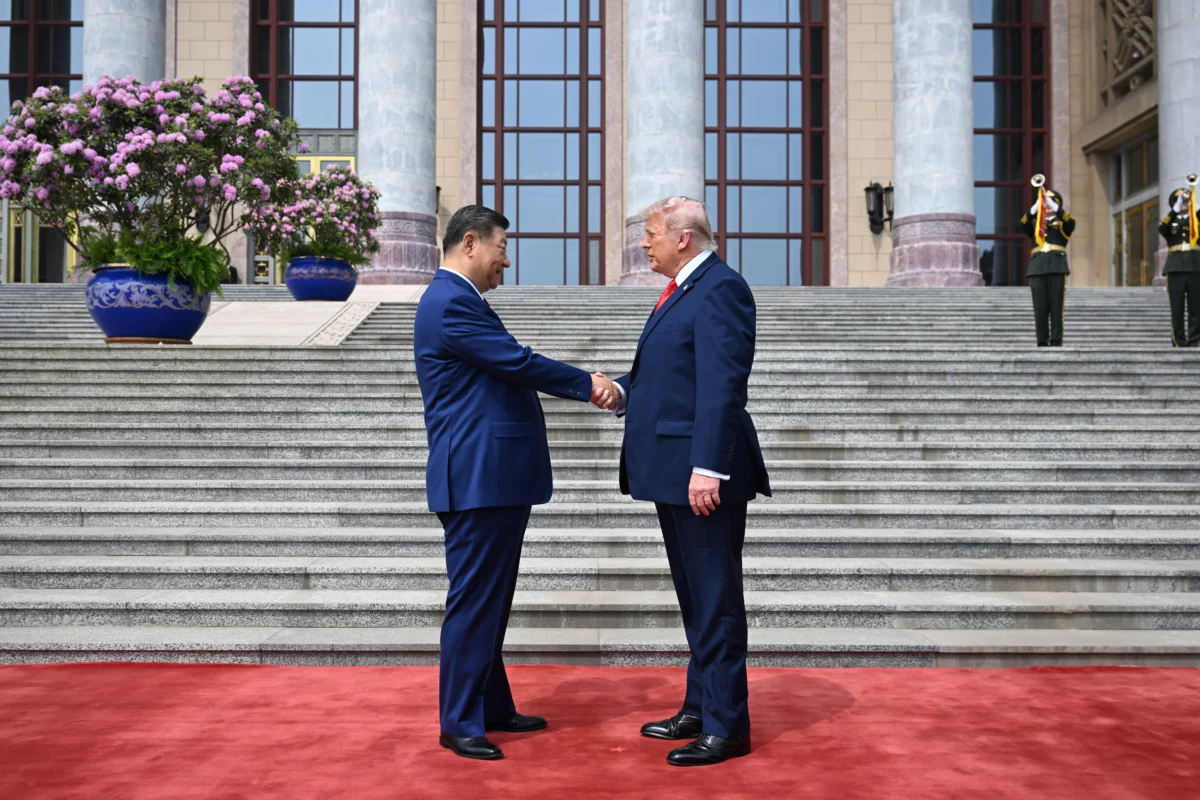
BEIJING, China – U.S. President Donald Trump and Chinese President Xi Jinping commenced a pivotal two-day summit in Beijing on Thursday morning, May 14, 2026, marking the first visit by a sitting American president to China in nearly a decade. The highly anticipated meeting, held at the majestic Great Hall of the People, is poised to address a complex web of contentious issues, including the lingering trade disputes, escalating tariffs, regional security concerns, and the deeply sensitive issue of Taiwan. Both leaders underscored the global significance of their discussions, acknowledging the precarious state of bilateral relations and the imperative for cooperation.
Upon President Trump’s arrival, he was greeted by President Xi with a handshake that resonated with diplomatic formality and palpable tension, captured by official broadcast footage. The U.S. delegation, including Secretary of State Marco Rubio and Secretary of War Pete Hegseth, alongside prominent American business leaders such as Tesla’s Elon Musk, Apple’s Tim Cook, and Nvidia’s Jensen Huang, were also present for the initial formalities, reflecting the broad scope of the talks. Chinese officials, including top diplomat Wang Yi and Zheng Shanjie, head of the economic planning agency, represented Beijing.
Opening Remarks Set a Delicately Balanced Tone
In their opening remarks, both leaders articulated their visions for the relationship, simultaneously highlighting challenges and opportunities. President Trump expressed optimism, stating that the relationship between the two global powers was poised to be "better than ever before," a sentiment that echoed his previous encounters with Xi. He drew on their extensive personal history, noting that they had known each other longer than any other U.S. or Chinese president, a nod to their prior interactions during his first term in office, which included a state visit to China in 2017.
President Xi, speaking just ahead of his American counterpart, brought a more philosophical and pointed perspective to the fore. Acknowledging the intense global scrutiny surrounding their meeting, Xi posed a profound rhetorical question: could the two nations avoid the "Thucydides Trap"? This historical concept, popularized by Harvard professor Graham Allison, describes the inherent danger of war when a rising power challenges a ruling one. Xi’s invocation of this theory underscored the deep-seated anxieties within Beijing regarding the trajectory of U.S.-China relations and the potential for conflict stemming from geopolitical competition. An official English translation of his remarks, broadcast by CCTV, further emphasized his concern about the world’s stability.
Beyond the "Thucydides Trap," Xi also challenged both countries to collaboratively address major global challenges and work towards "a brighter future for humanity," framing the summit as a critical juncture not just for bilateral ties, but for global stability and progress.
Taiwan: A Geopolitical Fault Line
A particularly sharp point of contention was immediately highlighted by President Xi, who unequivocally stated that Taiwan remained the "most important issue" in U.S.-China relations. According to state media reports, Xi warned that if this issue was not handled with extreme care, it could push the bilateral relationship into a "dangerous" territory. Beijing staunchly views Taiwan, a democratically self-governed island, as an integral part of its sovereign territory, a claim vehemently rejected by Taiwan’s ruling party. This stark difference in perspective on Taiwan continues to be a primary geopolitical flashpoint, with U.S. arms sales and diplomatic engagement with the island consistently drawing strong condemnations from Beijing. The presence of Secretary of War Pete Hegseth in the U.S. delegation, a figure often associated with a hawkish stance on foreign policy, further amplified the undercurrent of military and security considerations in the discussions.
The Shadow of a Renewed Trade War
While trade talks have been a recurring feature of U.S.-China engagement, the context for this summit is particularly fraught. The last significant interaction, a "trade truce" reached in South Korea in the fall of 2025, temporarily de-escalated a renewed period of economic friction. This truce came after a period of intense pressure, including the U.S.’s "Liberation Day" tariffs implemented in April 2025, which saw China, as the first major economy, retaliate with its own tariffs of 84% on various U.S. goods. Professor Allison, a keen observer of U.S.-China dynamics, expressed cautious optimism to CNBC’s "Squawk Box Asia" that the South Korea trade truce could evolve into a formal, comprehensive agreement during the Beijing summit.
However, the path to a lasting trade resolution remains complex. The initial trade war during Trump’s first term saw hundreds of billions of dollars in tariffs imposed by both sides, disrupting global supply chains and impacting industries from agriculture to technology. While a "Phase One" deal was signed in early 2020, its implementation was incomplete, and underlying structural issues, such as intellectual property theft, forced technology transfer, and market access barriers, largely persisted. The "Liberation Day" tariffs of 2025 suggest these issues had resurfaced with renewed intensity, perhaps fueled by a desire to re-shore critical manufacturing or to address perceived imbalances in the bilateral trade deficit, which had continued to fluctuate despite previous tariff actions.

Technology Restrictions and the Decoupling Debate
Beyond traditional trade, the summit is also expected to delve deeply into the contentious area of technology. U.S. restrictions on Chinese technology companies, particularly in critical sectors like semiconductors, artificial intelligence, and telecommunications, have been a defining feature of bilateral relations since 2018. These restrictions, often justified on national security grounds, have aimed to curb China’s technological advancement and prevent the diversion of sensitive American technology for military applications.
The presence of tech titans like Elon Musk (Tesla), Tim Cook (Apple), and Jensen Huang (Nvidia) in the U.S. delegation underscores the critical role of technology and corporate interests in these high-level discussions. U.S. companies operating in China face increasing scrutiny and regulatory challenges, while Chinese tech giants continue to grapple with export controls and investment restrictions. Beijing views these measures as an attempt to stifle its economic growth and maintain U.S. technological hegemony. The summit is likely to feature intense discussions on these restrictions, with the U.S. potentially seeking assurances on intellectual property protection and market access, while China may push for the lifting of export controls and a more predictable regulatory environment for its tech companies. The concept of "decoupling" – the severing of economic and technological ties – while often debated, has seen partial implementation in certain strategic sectors, making any agreements on technology particularly impactful.
A Packed Schedule and Broader Implications
Thursday morning’s high-level meeting was merely the commencement of a tightly packed diplomatic agenda. President Trump is scheduled to visit the Temple of Heaven, a historic landmark symbolizing imperial China’s connection to the divine, in the afternoon. The day will conclude with a lavish state banquet, a traditional display of diplomatic hospitality. The two leaders are slated for multiple rounds of discussions extending through midday Friday, allowing for in-depth engagement on the myriad issues.
Scott Kennedy, senior adviser and trustee chair in Chinese Business and Economics at the Center for Strategic and International Studies, offered valuable context on the shifting power dynamics. "China comes into this meeting far more confident than in 2017, when it feared even a small rise in U.S. tariffs," Kennedy observed. "In the last year, Xi has been able to push back and neutralize much of Trump’s actions." This assessment suggests a more assertive China, less willing to concede on core interests, which could make reaching comprehensive agreements even more challenging. Kennedy further emphasized the summit’s global significance: "Although expectations are low and no grand bargain is likely, the welcoming ceremony and initial remarks at the opening session highlight how truly consequential this relationship is for the world. That’s why everyone is paying close attention and waiting to find out what they discuss and decide on issues of commerce and security."
Regional Security and Global Stability
Beyond Taiwan, "regional security" encompasses a range of other critical concerns. The South China Sea, where China has significantly expanded its military presence and asserted expansive territorial claims, remains a hotbed of tension with implications for international shipping lanes and regional stability. U.S. freedom of navigation operations in the area are often met with strong warnings from Beijing, contributing to a sense of militarization in a vital global waterway. While not explicitly mentioned in the initial readouts, discussions on regional security could also touch upon the Korean Peninsula, particularly given North Korea’s ongoing nuclear and missile programs, and the roles both Washington and Beijing play in managing denuclearization efforts and maintaining stability in Northeast Asia. The broader context of competition for influence in the Indo-Pacific region, including through initiatives like the Quad (Quadrilateral Security Dialogue) and AUKUS (Australia, U.K., U.S. security pact), further underscores the strategic depth of the regional security dialogue between the two powers.
The Road Ahead: A Continuous Dialogue
Looking beyond this summit, the frequency of engagement between the two leaders is expected to increase. President Xi is anticipated to reciprocate President Trump’s visit with a trip to the United States. Furthermore, both leaders are likely to convene again at multilateral forums later in the year, such as the Asia-Pacific Economic Cooperation (APEC) summit, potentially hosted in China, and the G20 Leaders’ Summit, which could be held in the U.S. These future interactions will provide additional opportunities to build on any progress made in Beijing and address outstanding issues.
The stakes of the Beijing summit are undeniably high. The ability of the world’s two largest economies and most powerful military forces to manage their intricate relationship will have profound implications for global trade, technological innovation, regional stability, and the very fabric of international order. As President Xi pondered whether the U.S. and China could avoid the "Thucydides Trap" and instead forge a path towards a brighter future for humanity, the eyes of the world remain fixed on Beijing, awaiting the outcomes of these critical deliberations. The discussions initiated on this Thursday in May 2026 are not merely about bilateral interests; they are about defining the trajectory of the 21st century.
