

By Aaron Vale, CAIA, CFA, MFin, Global Managing Director, Mexico Infrastructure Partners
In recent years, owning a natural gas power plant in the U.S. felt tenuous, a precarious position on the energy landscape. Today, however, these assets are emerging as among the most coveted in private infrastructure portfolios, a dramatic reversal that has significantly rewarded investors who recognized this pivotal shift early. Understanding the trajectory of this transformation requires tracing an arc from a period of robust expansion to one of significant distress, and now, back to a resurgence driven by unprecedented demand.
From Boom to Bust: The Volatile Journey of U.S. Natural Gas Power
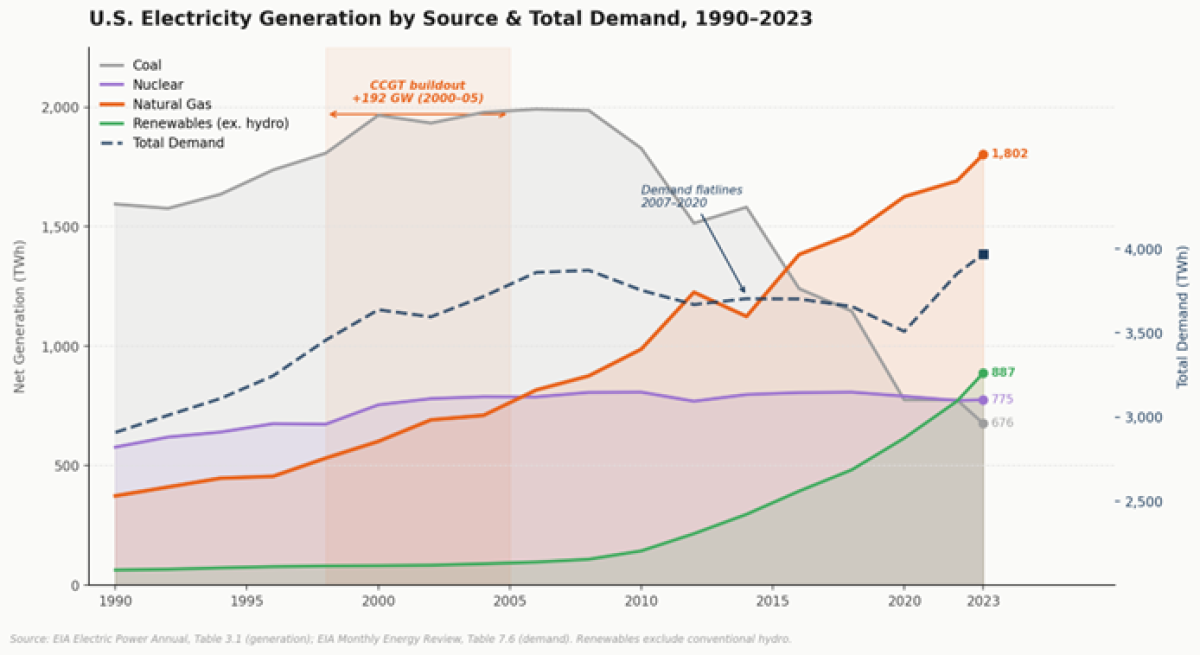
The United States natural gas power sector experienced a golden era in the late 1990s and early 2000s, a period characterized by substantial generation expansion. This boom was fueled by several converging factors: the deregulation of electricity markets, the increasing availability of cheaper natural gas, and a consistent rise in power demand. These conditions spurred a massive buildout of highly efficient combined cycle gas turbines (CCGTs), which rapidly became indispensable components of the American power grid. Independent power producers and infrastructure sponsors collectively raised billions of dollars to finance the construction and operation of these vital facilities.
However, by approximately 2007, the landscape began to shift dramatically. Electricity demand growth, which had been a steady driver, started to flatten. Simultaneously, the renewable energy sector, propelled by generous tax credits and rapidly declining installation costs, began to attract significant investor capital. This influx of investment into renewables coincided with a precipitous decline in the role of coal-fired power generation. Despite these profound changes, natural gas generation continued to expand, eventually solidifying its position as the dominant source of electricity generation in the U.S.
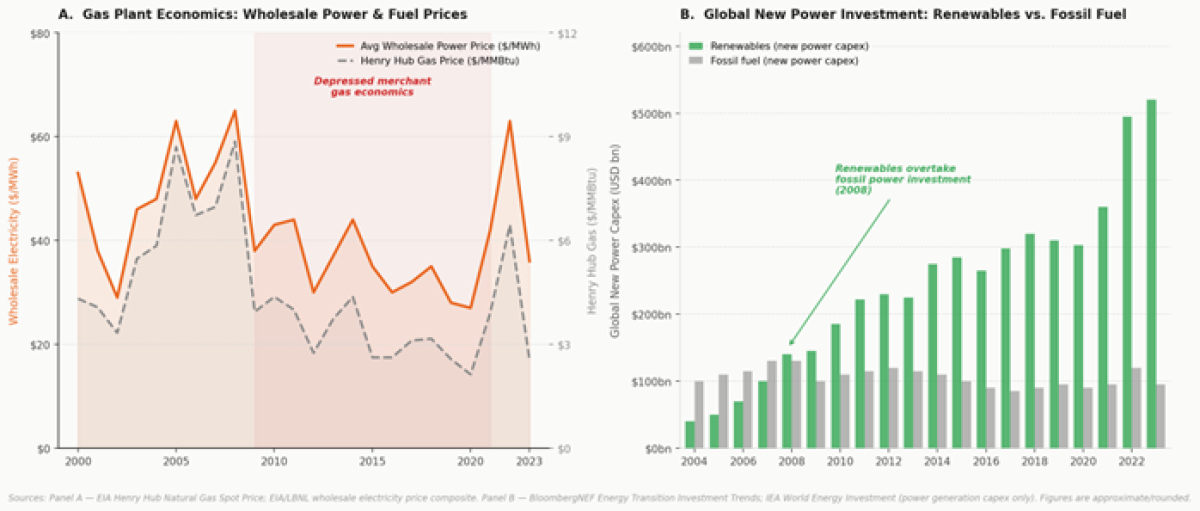
The period of growth and perceived stability began to erode in the early 2020s. Merchant gas plants, those that sell electricity into the wholesale market without the security of long-term contracts, found their cash flows significantly diminished. A decade of persistently low electricity and natural gas prices, coupled with increasing operational costs and competition from renewables, squeezed their profitability. This financial pressure led to a wave of bankruptcies and distressed sales as numerous projects struggled to meet their debt obligations. The message from the capital markets was clear: infrastructure investors, who had previously poured billions into gas generation, were now shifting their focus, viewing natural gas as a legacy asset while prioritizing renewables as the present and future of energy investment.
This shift can be visualized by examining key industry trends. Data from 1999 to 2023 illustrates the fluctuating dominance of different energy sources. Initially, natural gas saw significant growth, surpassing other sources to become the leading generator. However, the chart depicting wholesale power and fuel prices alongside global new power investment trends highlights the economic pressures on gas plants. As renewable energy investment surged and fossil fuel investment waned, the financial viability of many gas-fired power assets came under severe scrutiny.
The Demand Shock: AI and Electrification Ignite a New Era
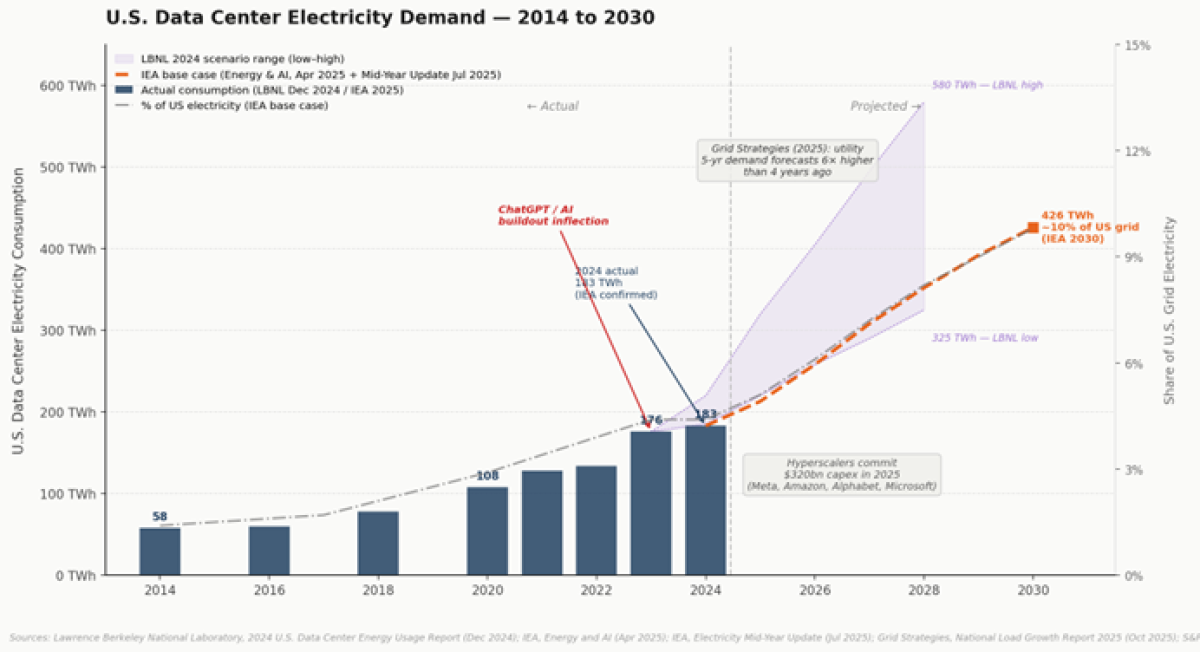
A powerful and unexpected reversal began to take shape in 2023, largely driven by the explosive emergence of artificial intelligence (AI). The burgeoning demand from data centers, which are the physical infrastructure underpinning AI development and deployment, has become a primary catalyst for this resurgence. In 2023, data centers accounted for approximately 4% of total U.S. electricity consumption. However, projections indicate a dramatic escalation, with this share anticipated to reach between 10% and 12% by 2028. This surge is directly attributable to the massive compute power required by hyperscalers for training and inference workloads associated with large language models (LLMs). The power requirements of these advanced AI applications are orders of magnitude greater than those of traditional enterprise computing, and this demand is not only accelerating but showing no signs of deceleration.
The implications of this AI-driven demand are profound for the energy sector. The projected growth in data center electricity consumption paints a stark picture of an unprecedented strain on the existing power grid. Industry analysts and grid operators have begun to issue warnings about the potential for significant energy shortages and increased price volatility if supply cannot keep pace with this rapid increase in demand.
However, data centers are not the sole drivers of this renewed demand. A confluence of other electrification trends is simultaneously straining the grid. The widespread adoption of electric vehicles (EVs) is increasing the load on the power system, as are efforts to electrify industrial processes and the broader trend of reshoring domestic manufacturing. These initiatives are adding new, substantial demand onto a grid that, in many regions, has experienced minimal net additions of dispatchable generation capacity over the past decade. Consequently, grid operators are now projecting sustained tightening of reserve margins, a situation not seen in a generation, signaling potential reliability challenges.
The role of renewable energy, while crucial for decarbonization, cannot single-handedly address this escalating demand for reliable power. Wind and solar energy sources remain intermittent, their output dependent on weather conditions. While battery storage technologies are advancing, current capabilities primarily offer backup power for several hours, not the continuous reliability required to meet the baseload and peak demands of a rapidly expanding economy. When the grid requires power consistently and reliably, especially during periods of high demand or when renewable sources are unavailable, natural gas plants are the assets that are called upon. This operational reality, often downplayed in policy discussions focused on renewable deployment, is now becoming impossible to ignore.
The U.S. Structural Advantage: Abundant and Affordable Natural Gas
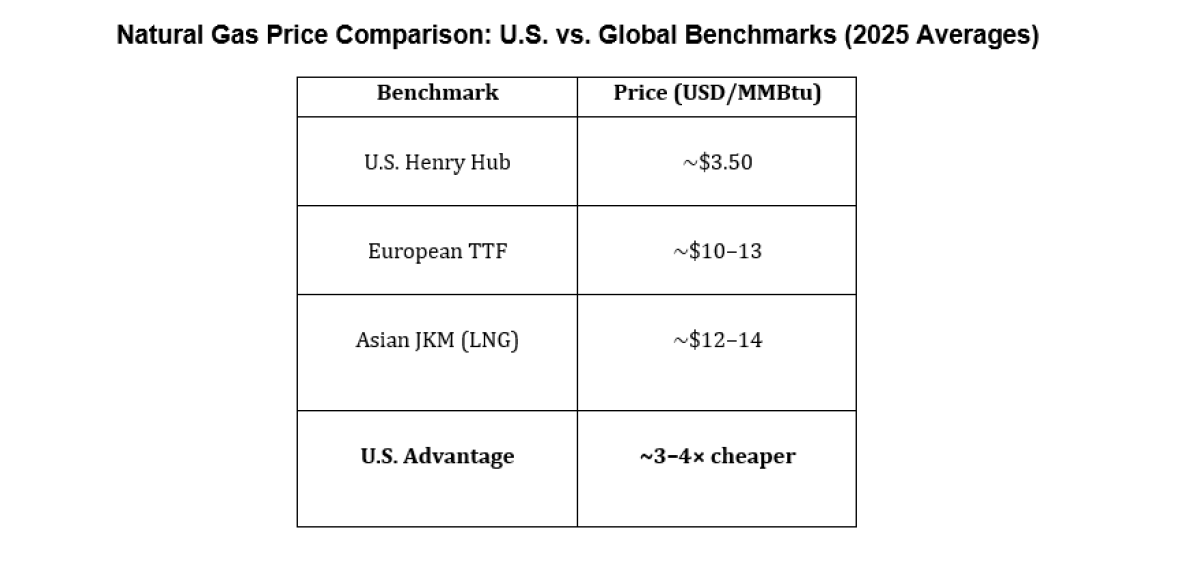
A key feature underpinning the renewed attractiveness of U.S. natural gas power plants is the inherent cost advantage of domestic natural gas. Production forecasts indicate that U.S. natural gas output is set to reach record highs, projected to be between 120 and 122 billion cubic feet per day through 2026-2027. This sustained high level of domestic production is expected to keep U.S. natural gas prices structurally below those of European and Asian import benchmarks. For natural gas-fired generators, the cost of feedstock is the primary variable expense. Therefore, well-positioned U.S. plants benefit significantly from their proximity to abundant and low-cost natural gas supplies. This fundamental advantage has been further reinforced by recent geopolitical conflicts, notably in Ukraine and the Middle East, which have placed additional pressure on global natural gas import prices, widening the cost differential for U.S. producers and consumers.
This price advantage is a critical factor for investors. The stability and predictability of feedstock costs are essential for long-term project economics, particularly for assets that are expected to operate for decades. The graphic illustrating natural gas price comparisons between the U.S. and global benchmarks for projected 2025 averages clearly demonstrates this significant and persistent differential. This economic moat provides a substantial competitive edge for U.S. gas-fired power generation.
Capital Markets Respond: A Surge in Investment and Shifting Valuations
The capital markets have responded swiftly and decisively to these evolving fundamentals. Energy sector Mergers and Acquisitions (M&A) activity surged, totaling nearly $142 billion in the twelve months ending November 2025, a dramatic increase from under $28 billion in the preceding year. This surge in deal-making reflects a renewed investor confidence in the sector. Consequently, deal multiples have expanded sharply, with recent private market transactions for gas power assets clearing at Enterprise Value to Earnings Before Interest, Taxes, Depreciation, and Amortization (EV/EBITDA) ratios of 7-8 times or higher. The landmark acquisition of Calpine by Constellation Energy, valued at $26.6 billion, stands as the largest private power transaction in U.S. history, underscoring the scale of this market reawakening.
Despite this heightened activity and expanding multiples, valuations for operating natural gas power plants remain below their replacement costs. The cost of constructing new greenfield CCGT facilities is estimated to range between $2,200 and $3,000 per kilowatt. In contrast, operating brownfield assets are currently trading in the market at prices between $700 and $1,350 per kilowatt. This significant discount offers investors a meaningful margin of safety. It also reflects a hard structural reality: the rapid deployment of new generation capacity through greenfield development faces considerable hurdles. These include extensive interconnection backlogs with grid operators, permitting timelines that can stretch for years, and extended delivery queues for new gas turbines, with some manufacturers projecting delivery dates extending into 2030.
The data on U.S. power sector trends further contextualizes this situation. The graphic likely illustrates metrics such as new capacity additions, grid congestion, and the growing gap between projected demand and available dispatchable supply. This information supports the assertion that the existing infrastructure is under strain and that new construction faces significant lead times.
Navigating Risk: Greenfield Development vs. Brownfield Acquisitions
For institutional investors, the decision between acquiring existing operating plants (brownfield) and undertaking new construction projects (greenfield) represents a critical risk assessment.
Brownfield acquisitions currently dominate deal activity, and for good reason. Operating plants begin generating cash flows immediately upon acquisition, possess established grid connections, and have operating histories that facilitate rigorous due diligence and underwriting. While risks such as future power price volatility and exposure to regulatory changes remain, these are generally considered analytically forecastable, albeit with inherent uncertainty. The immediate revenue generation and established operational track record make brownfield assets a more predictable investment.
Greenfield development, conversely, is a more complex undertaking. The multi-year processes of obtaining permits, navigating interconnection queues, and securing essential equipment in a constrained supply chain significantly compound execution risk. However, this avenue can become more compelling for developers who can secure long-term contracts for the power generated before commencing construction. A prime example of this strategy is the development of data center co-location facilities. In this model, new generation capacity is constructed adjacent to a hyperscaler’s data center and contracted directly to provide dedicated, behind-the-meter power. This approach mitigates off-take risk and can offer attractive, long-term revenue streams.
The Opportunity: A "Thermal Renaissance" for Investors
The current market environment presents a significant opportunity for institutional allocators. The U.S. natural gas power sector is a large and liquid market, offering diverse risk profiles that have been repricing in real time. The fundamental question is no longer whether gas generation is attractive in principle, as its supply, demand, and pricing fundamentals appear robust and durable. The U.S. natural gas generation sector has indeed journeyed from boom to bust, and is now experiencing a pronounced resurgence. This period of renewed growth and investment in thermal power assets can aptly be described as the "Thermal Renaissance."
The implications for investors are substantial. The demand shock from AI and electrification, coupled with the structural cost advantage of U.S. natural gas and the lead times for new renewable and nuclear capacity, creates a compelling environment for existing and new natural gas power plants. Investors who can strategically navigate the risks associated with brownfield acquisitions or innovative greenfield developments, particularly those tied to high-demand sectors like data centers, are well-positioned to benefit from this significant market shift. The challenges of grid modernization and meeting escalating energy needs have created a space where dispatchable, cost-effective natural gas power generation is once again poised to play a critical role.
To learn more about CAIA Association and how to become part of a professional network shaping the future of investing, please visit https://caia.org/.
