

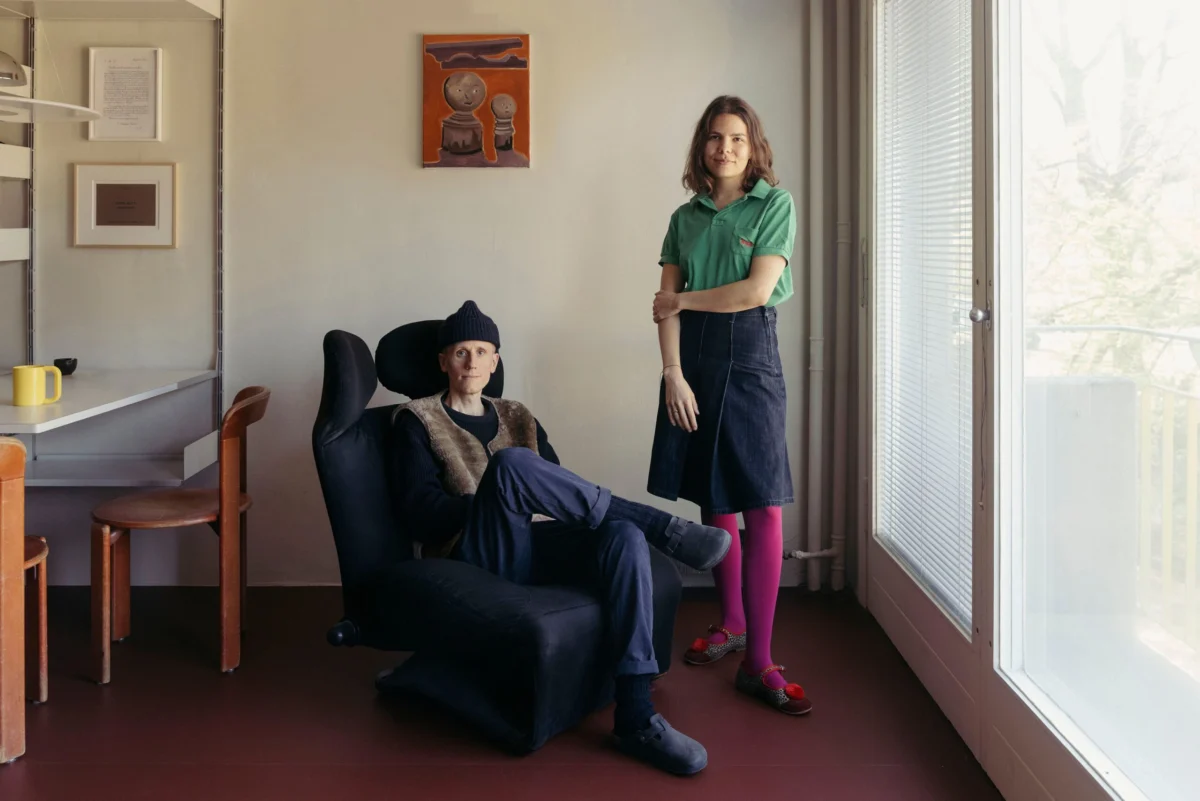
In the heart of Berlin’s Hansaviertel, a district renowned for its concentration of modernist architecture, a 355-square-foot studio apartment has become the center of a unique urban experiment. Leonie Herweg and Simon Freund, a creative couple with backgrounds in the international art world, have transformed a neglected 1950s residence into a masterclass in small-space efficiency and community engagement. What began as a personal renovation project in a historic building has evolved into a broader mission to revitalize one of Berlin’s most architecturally significant but historically "sleepy" neighborhoods. By stripping the apartment to its core and launching local ventures like Café Tiergarten and the Grotto art gallery, the pair has demonstrated how micro-living can serve as a catalyst for neighborhood rejuvenation.

The Historical Context of the Hansaviertel and the Giraffe House
To understand the significance of the studio, one must first look at the history of its surroundings. The Hansaviertel neighborhood was the site of the 1957 International Building Exhibition, known as Interbau. This event was a pivotal moment in post-war urban planning, designed to showcase the "city of tomorrow" in West Berlin. It was a direct ideological response to the monumental Socialist Realism of the Stalinallee in East Berlin. Interbau invited the world’s leading modernist architects—including Le Corbusier, Walter Gropius, and Oscar Niemeyer—to design residential buildings that prioritized light, air, and functionalism.
The building inhabited by Herweg and Freund is the "Giraffe-Hochhaus," or Giraffe House. Completed in 1957 by architects Klaus Müller-Rehm and Gerhard Siegmann, the 17-story tower was a radical experiment in housing for single people and small households. The structure is famous for its narrow profile and its unique internal organization. In a curious nod to 1950s social norms, the building was divided into gendered sides: the west-facing "men’s side" featured studio apartments with small kitchenettes, while the east-facing "women’s side" offered separated kitchens, based on the assumption that women were more industrious and would appreciate the morning sun. Herweg and Freund’s studio is located on the "men’s side," a detail that highlights the rigid, albeit eccentric, planning of the mid-century era.

A Legacy Purchase and the Philosophy of Downsizing
The couple’s journey to the Hansaviertel was not entirely accidental. The studio was purchased from Herweg’s great-uncle, Klaus, who had moved into the building at the age of 80. Klaus had relocated from Bremen to Berlin specifically because he "still wanted to experience life," viewing the modernist district as a place of intellectual and social vitality. After Herweg and Freund returned to Germany following a period in Cairo, Egypt, and nearly 14 years for Herweg in Switzerland, the studio became their home base.
Transitioning to a 355-square-foot space required a radical approach to possessions. While Freund arrived with only a suitcase and two boxes, Herweg faced the challenge of winnowing down a decade and a half of accumulated belongings from her time in Switzerland. The couple adopted a philosophy of "ruthless" downsizing, selling or donating the majority of their furniture and objects. This process, they noted, was not an act of deprivation but one of liberation. By reducing their physical footprint, they were able to focus on the architectural quality of their living environment rather than the quantity of their belongings.

Chronology of a Radical Renovation
Upon taking possession of the studio, the couple found that while the previous owner had kept the unit in "ready-to-move-in" condition, the aesthetic was trapped in a 1990s time warp that obscured the building’s original character. On the very first day of their residency, they began a demolition process that would last over a year.
The renovation involved stripping away seven layers of wallpaper and removing salmon-colored vinyl flooring. The goal was to rediscover the "original" spirit of the 1957 design while introducing contemporary high-quality materials. For the floors, they selected a dark red linoleum, a material famously utilized in the Bauhaus library in Dessau, providing a durable and historically resonant foundation for the space.

One of the most striking decisions made during the renovation was the removal of the bathroom door. In a space this small, doors are often viewed as obstacles to light and flow. To maintain a sense of privacy without sacrificing the open layout, the couple replaced the door with a custom chainmail curtain. This choice exemplifies their design ethos: using industrial or unexpected materials to solve spatial problems with elegance.
The kitchen was also entirely reimagined. The couple commissioned a custom stainless-steel kitchenette, designed to be both functional and visually unobtrusive. During the year-long construction period, they relied on a mobile electric stove from the 1970s that had belonged to Herweg’s great-grandparents—a piece of functional history they continue to use today.

Design Details and Functional Minimalism
In a micro-apartment, every object must justify its existence. Herweg and Freund utilized the Vitsœ shelving system, designed by Dieter Rams, to provide modular storage that adapts to their needs. The system incorporates a dining table, allowing the main living area to transition seamlessly from a workspace to a social hub.
The furniture and art reflect a curated mix of the personal and the professional. Dining chairs by Bruno Rey, discovered in a barn in the Swiss Bernese Oberland, sit alongside contemporary art pieces by Katrin Plavcak, Sunah Choi, and Isabella Ducrot. The couple’s background in the art world is evident in how they treat their walls; rather than cluttering them, they select pieces that interact with the changing light of the Hansaviertel.

A large window front leads to a narrow balcony that can be opened completely, effectively doubling the perceived size of the room during Berlin’s summer months. From this vantage point, the couple can observe the parkland of the Tiergarten, noting that the presence of nature in the center of a dense city is one of the Hansaviertel’s greatest achievements.
From Private Living to Public Community Building
The couple’s investment in the Hansaviertel extends beyond the walls of their studio. Upon moving in, they noticed that many of the neighborhood’s commercial storefronts were vacant, leaving the area in what they described as a "slumber." Drawing on their experience in the arts, they decided to take an active role in the community’s revitalization.

They opened Café Tiergarten and the art gallery Grotto, which they describe as a "love letter" to the neighborhood. These ventures have transformed the local social landscape, drawing visitors back to the Hansaviertel and providing a gathering place for long-time residents. Herweg and Freund apply the "broken-windows theory" in reverse: they believe that by meticulously caring for their environment and opening high-quality public spaces, they can trigger a positive chain reaction of community involvement.
"Building a community requires effort," Herweg noted during an interview with AD Germany. "It starts with small acts—the way you meet your neighbors, spending the elevator ride in conversation rather than silence." This philosophy has turned their small living space into a hub for a much larger "figurative" home that encompasses the entire neighborhood.

Supporting Data and Urban Implications
The trend toward micro-living in Berlin is supported by shifting demographic data. According to the Berlin-Brandenburg Statistics Office, nearly 50% of households in Berlin are now single-person residences. As housing prices in the German capital continue to rise—with average rents increasing by over 40% in the last decade—the demand for efficient, well-designed small spaces has surged.
The Hansaviertel, with its high density of studio apartments, offers a historical model for modern urban challenges. The "Giraffe House" demonstrates that high-density living does not have to come at the expense of architectural integrity or access to green space. The district’s layout, which Herweg jokingly refers to as a "modern-day Disneyland" for its self-contained variety of services (kiosks, pharmacies, and markets), represents the "15-minute city" concept decades before the term was popularized.

Broader Impact and the Future of the Modernist Island
The work of Leonie Herweg and Simon Freund serves as a case study for the preservation of modernist heritage through active use. Rather than treating the Hansaviertel as a museum, they have integrated its principles into a contemporary lifestyle that balances minimalism with social responsibility.
Their renovation proves that even the most "impractical" historical spaces can be adapted for modern life if approached with a clear vision. By removing the physical and metaphorical doors between their private lives and the public sphere, they have helped reawaken a dormant architectural gem. As Berlin continues to grapple with housing shortages and urban sprawl, the lessons learned in the 355-square-foot studio in the Giraffe House offer a compelling argument for the enduring relevance of mid-century functionalism. For Herweg and Freund, the apartment is more than just a home; it is a platform for experiencing the city and a testament to the idea that life, no matter how small the square footage, can be lived with grand intention.
