

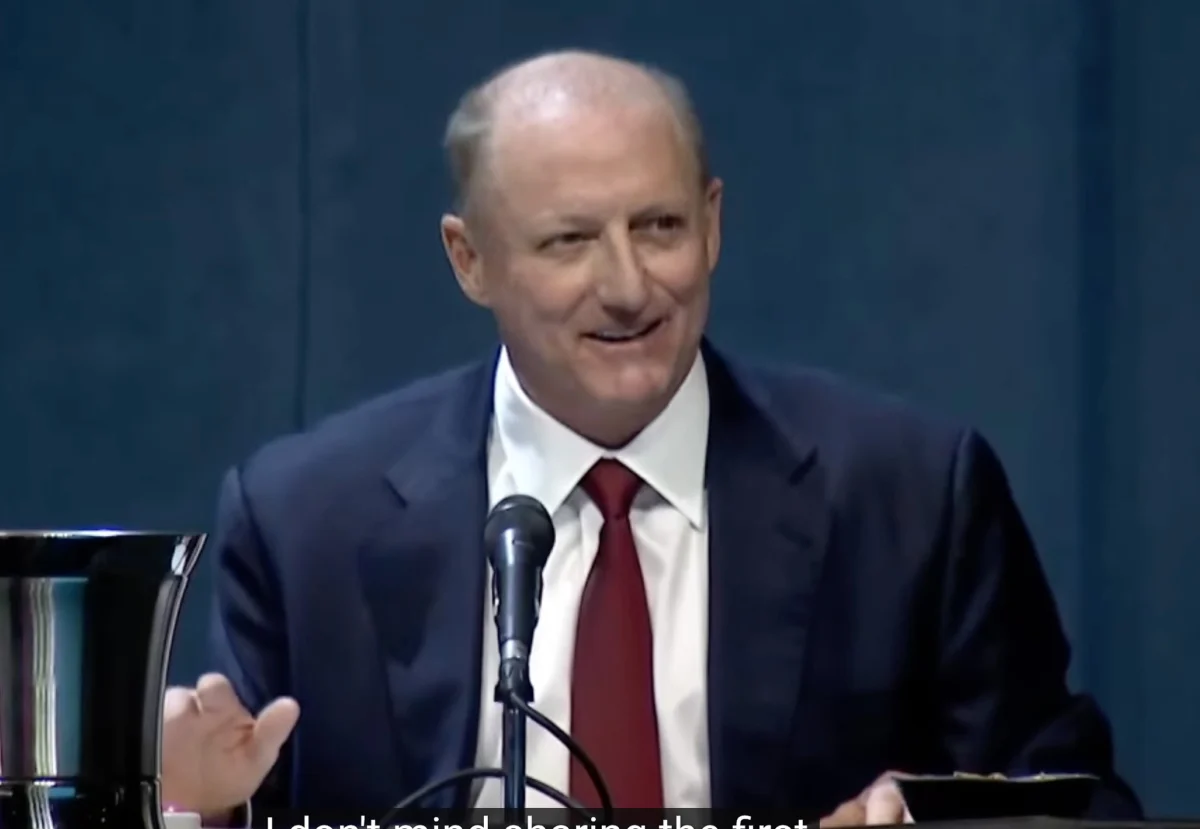
The recent Berkshire Hathaway annual shareholders meeting in Omaha marked a pivotal moment for the conglomerate, as Greg Abel, the designated successor, stepped into the spotlight as CEO for his first annual meeting, drawing mixed reviews from analysts and investors alike. While the absence of legendary co-founder Charlie Munger, who passed away in late 2023, and a more subdued role for Warren Buffett, now chairman emeritus, underscored a significant transition, the event provided crucial insights into Berkshire’s current strategy, financial health, and the broader economic outlook through Buffett’s enduring wisdom.
A New Era: Greg Abel’s Debut as CEO
The CHI Health Center arena in Omaha, traditionally packed to the rafters for the "Woodstock for Capitalists," saw a noticeably smaller crowd, estimated at just over half-full. This reduced turnout was perhaps an inevitable consequence of the leadership transition, as the magnetic draw of Buffett and Munger’s decades-long, often humorous, exchanges on stage began to recede. Despite the lighter attendance, the numbers still far surpassed those of typical corporate annual meetings, testifying to the enduring mystique of Berkshire Hathaway.
Greg Abel, who took over as CEO in 2025 following Buffett’s stepping down from the chief executive role, received a generally "solid" if not "spectacular" performance assessment. Analysts praised Abel’s deep and detailed knowledge of Berkshire’s diverse operating businesses, showcasing his command over the conglomerate’s vast industrial empire. Steve Check of Check Capital Management, as quoted by CNBC.com’s Yun Li, remarked, "Very solid. No misspoke words. Thorough answers. Nice guy, but we sure don’t have the laughs that we had with Warren and Charlie."
However, Abel’s debut was not without criticism. Andrew Bary, a seasoned Berkshire observer for Barron’s, awarded Abel a "B-plus" but pointed to areas for improvement, particularly his "delivery — too many rambling answers — and on capital allocation messaging." This sentiment was echoed by CFRA Research analyst Cathy Seifer, who called Abel’s performance "okay," acknowledging he has "big shoes to fill" but emphasizing Berkshire’s need to "do a better job articulating to investors what the plan is to manage the investment portfolios."
Some shareholders, like Xiao Zhang, articulated a disappointment that transcended the technicalities of business insights. "In previous years, Warren Buffett and Charlie Munger sat on the stage, sharing their investing experiences and also life experiences and philosophies. This year, I didn’t hear something like that," Zhang told Reuters. Another shareholder, Sophia Deng, lamented the shift, stating, "Most people are here for investing knowledge and life philosophies… With Greg Abel, the emphasis was very, very different. It (became) more of an operational excellence conference, and it’s not what I’m interested in as much." This feedback highlights the unique blend of business acumen and philosophical discourse that defined the Buffett-Munger era, a challenging legacy for any successor to uphold.
University of Maryland finance professor David Kass offered a more balanced view, telling Fortune that Abel "demonstrated his knowledge of and passion for" Berkshire’s businesses and investments. Kass acknowledged Abel’s more serious demeanor but predicted his ability to "respond well to all shareholder questions and discuss the past performance and outlook for all of Berkshire’s businesses," albeit with less humor. Shareholder Tilman Versch went further, calling it "definitely the meeting with the deepest insights into Berkshire’s businesses in the last decade," suggesting a trade-off where deeper operational understanding replaced the charismatic storytelling of previous years.
The Capital Allocation Conundrum
A recurring theme of concern for analysts and investors was Berkshire’s substantial cash pile and the relatively low level of stock repurchases. As of March 31, Berkshire’s cash holdings stood at an staggering $397.4 billion, a 6.5% increase from December 31. Even after excluding rail cash and subtracting T-Bills payable, the "true" cash figure was approximately $380.2 billion, up 3.0% from the previous quarter. This immense liquidity presents a significant challenge and opportunity for management.
Despite a March announcement that buybacks had "resumed," Berkshire repurchased a mere $234 million of its shares in the first quarter of 2026. This figure was widely regarded as "trivial" by observers like Andrew Bary, particularly given the size of the cash reserves. Cathy Seifer’s blunt question, "If Berkshire isn’t buying back their stock, why should you?", encapsulated the frustration felt by some who believe Berkshire should be more aggressive in returning capital to shareholders, especially when the company itself deems its stock undervalued, the typical trigger for repurchases. The lack of clear communication on the future strategy for deploying this cash, whether through significant acquisitions, increased buybacks, or new equity investments, emerged as a notable negative from Abel’s first solo outing.
Buffett’s Enduring Wisdom: Patience in a "Casino" Market
In an exclusive interview with Becky Quick, Warren Buffett, observing the meeting from the audience for the first time in 60 years, offered his perspective on Abel’s leadership and the broader market environment. Despite the criticisms leveled at Abel, Buffett remained unequivocally supportive. "It’s all working," he affirmed, adding, "We got the right management, we got the right arrangement." He praised Abel’s intelligence, stating he is "very, very, very smart about businesses."
Buffett acknowledged the current challenge in deploying Berkshire’s vast cash reserves. He described the present "surrounding area" as "not ideal" for finding attractive investments. His long-held philosophy of patience and discipline was evident as he reiterated that "prices are too high" for many businesses that Berkshire would typically consider. He candidly admitted, "I understand fewer of the businesses, as a percentage of the whole, than I did ten years ago. I have not learned new industries for some years… I’m not going to have an edge on… a whole bunch of younger people that have actually grown up with it."
Reflecting on the broader market, Buffett painted a vivid picture: "I’ve compared the markets to a church with a casino attached. And people can move between the church and casino. And I would say there are more people in the church and more people in the casino. But the casino has gotten very attractive to people, you know." He specifically criticized the proliferation of "one-day options," dismissing them as pure "gambling" rather than investing or even speculating. This "gambling mood," he noted, has led to "prices for an awful lot of things will look very silly."
For Buffett, a "juicy year" of significant investment opportunities typically arises not from careful planning but from unforeseen market dislocations or "panic." He described these opportunities as often arriving via "a phone call" or emerging from "something that comes out of the blue." He warned against predicting such events: "If you saw them, they wouldn’t happen… You don’t worry about what people are talking about can happen. It’s something that comes out of the blue." This perspective underscores Berkshire’s strategic readiness to deploy capital rapidly when others are fearful, a hallmark of its success over decades.
Macroeconomic Headwinds and Leadership Transitions
Buffett also shared his macro thoughts, particularly on inflation. While distinguishing current inflation from "runaway inflation," he expressed deep concern about its potential long-term effects. Recalling the "cash is trash" era before Paul Volcker’s decisive action in the late 1970s and early 1980s, Buffett highlighted the tragic consequences of people losing faith in their currency, citing examples of farmers in Nebraska who bought land beyond its earning power, only to collapse when interest rates soared. He reiterated his admiration for outgoing Fed Chair Jay Powell, stating, "I’ll feel better when he’s there than when he’s not," drawing a parallel to his trust in Volcker. Buffett criticized economists for often missing the "most important economic development," emphasizing that "it’s what you don’t think of that does all the damage."
The discussion also touched upon leadership changes within Berkshire’s major holdings. With CEOs like Apple’s Tim Cook, Coca-Cola’s James Quincey, and Occidental Petroleum’s Vicki Hollub either stepping down or announcing retirement, a new generation of leaders is emerging in companies where Berkshire holds significant stakes. Buffett acknowledged the challenges these transitions can pose, even for strong companies, stating, "You have the most problems with… a really good company, because it’ll… continue. I mean, if you’re selling some product that people are buying every day, you can make the wrong decision for a long time." While he praised Tim Cook’s performance, he humorously admitted, "I haven’t met the old managers," underscoring his trust in the underlying businesses and the decentralized management philosophy of Berkshire.
Buffett also voiced his long-standing concerns about deepfakes and artificial intelligence, calling the technology "scary." He highlighted the potential for misuse, particularly in political contexts, referencing the infamous War of the Worlds radio broadcast that caused widespread panic. The ability to convincingly imitate voices and images, he warned, could be used to manipulate and deceive on a grand scale, posing unprecedented societal risks.
Key Portfolio Moves and Executive Changes
Beyond the annual meeting’s main stage, several significant developments were announced or clarified.
DaVita Divestment: Berkshire Hathaway sold almost $183 million of DaVita shares at just under $150 each on May 1. This divestment was not a reflection of a change in Berkshire’s view of DaVita, but a forced move. Under a 2024 agreement with DaVita, Berkshire was required to cut its stake to 45%. This marked the sixth consecutive quarter Berkshire has had to sell DaVita shares, primarily because DaVita’s aggressive share buyback program reduced its outstanding shares, thereby increasing Berkshire’s percentage ownership. The irony was not lost on observers; Berkshire, a proponent of buybacks, was compelled to sell a holding precisely because of another company’s buybacks. The situation was further complicated by DaVita’s stock rally of 31% in the week of the meeting, closing at $198.65 after exceeding Wall Street’s first-quarter earnings expectations and raising its profit forecast. Berkshire would almost certainly have preferred to retain its shares, missing out on substantial gains.
Japanese Trading Houses: In contrast to the DaVita situation, Berkshire continued to increase its stakes in its highly successful Japanese "sogo shosha" (trading house) investments. Filings revealed that Berkshire’s stake in Marubeni increased from 9.3% to 10.1%, and its ownership of Sumitomo shares also grew to almost 10.1% from 9.3% as of the beginning of May. These increases underscore Berkshire’s continued confidence in these diversified conglomerates, which have been a significant source of capital gains and dividends for the company since Buffett initiated the positions in 2020. This long-term, patient investment in high-quality, undervalued international companies stands in stark contrast to the domestic market’s current "casino" tendencies.
CFO Transition: A notable executive change was the retirement of long-serving CFO Marc D. Hamburg, effective June 1. Hamburg, who maintained a low profile throughout his tenure, will receive a generous post-retirement benefit: up to 30 flight hours per year on a mid-sized NetJets aircraft until 2037, along with funds to cover associated taxes. This perk is estimated to cost around $490,000 annually. Succeeding Hamburg is Charles Chang, who will receive an $8 million annual cash salary, a significant increase from Hamburg’s total compensation of $4.3 million in the prior year, reflecting the expanding scale and complexity of Berkshire’s financial operations.
The "Special Sauce" of America and The Golden Rule
In a deeply personal moment during his interview, Buffett revealed that Greg Abel was in the final stages of becoming a U.S. citizen. Buffett expressed his profound respect for Abel’s decision, noting the pride and effort involved in the process. This led Buffett to a philosophical reflection on what he termed "America’s special sauce" – the intangible qualities that have made the nation a "miracle" for over 200 years, attracting immigrants despite its inherent inequities. "America is special. And it’s a miracle what America’s accomplished," Buffett mused, highlighting the enduring appeal of the nation. He emphasized that this "secret sauce" cannot be bought or marketed but is deeply ingrained in the country’s fabric.
Finally, asked for a message to the thousands of shareholders who have followed him for decades, Buffett, a self-proclaimed non-religious person, offered the timeless wisdom of the Golden Rule: "Do unto others as you would have them do unto you." He posited this simple principle as the most enduring and universally beneficial guide for human conduct, arguing that living by it not only fosters a more wonderful society but also brings personal contentment. "I’ve never seen anybody that’s unhappy that behaves that way," he concluded, offering a final, profound piece of life advice from the Oracle of Omaha.
Financial Snapshot and Outlook
As Berkshire Hathaway navigates this significant transition, its financial strength remains undeniable.
- BRK.A stock price: $717,386.81
- BRK.B stock price: $475.94
- BRK.B P/E (TTM): 14.17
- Berkshire market capitalization: $1,028,317,207,249
- Berkshire Cash as of March 31: $397.4 billion (Up 6.5% from Dec. 31)
- Excluding Rail Cash and Subtracting T-Bills Payable: $380.2 billion (Up 3.0% from Dec. 31)
- Berkshire repurchased $234 million of its shares in Q1 2026.
(All figures are as of the date of publication, unless otherwise indicated)
The shift from the Buffett-Munger era to Greg Abel’s leadership marks a new chapter for Berkshire Hathaway. While Abel demonstrates strong operational acumen, the immediate challenges lie in effectively communicating capital allocation strategies and addressing investor expectations for growth and shareholder returns amidst a cautious market outlook from Buffett himself. The conglomerate’s robust cash position, strategic international investments, and patient philosophy are foundational strengths, but the coming years will test how effectively the new leadership can adapt these principles to a dynamic and increasingly complex global economy.
