

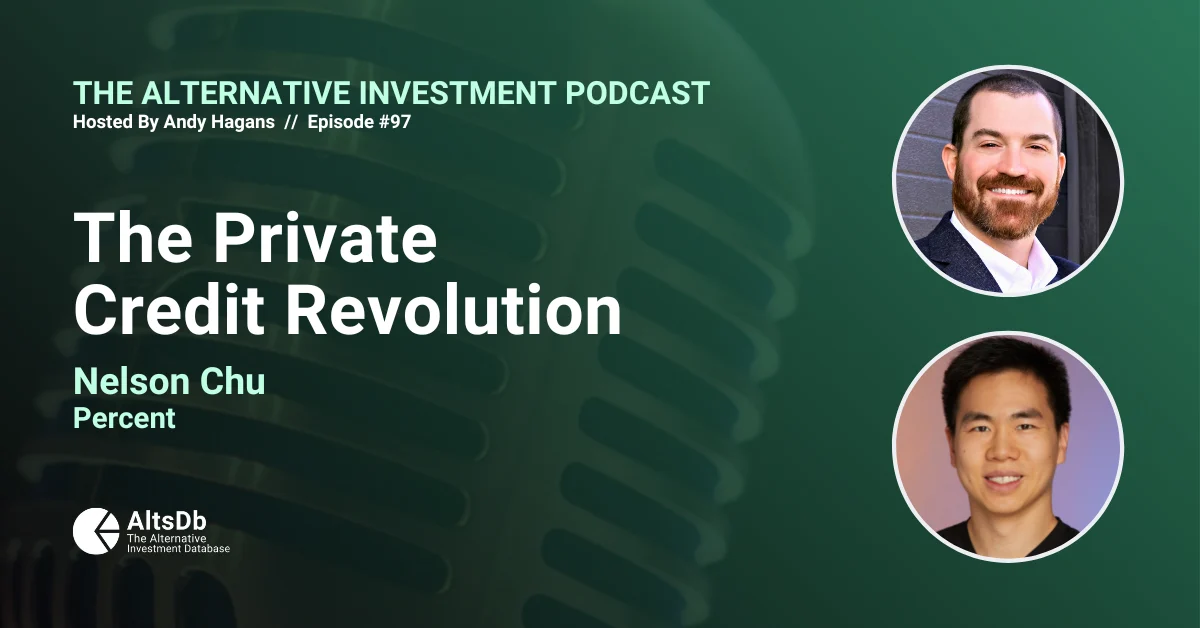
The alternative investment landscape is experiencing a significant surge, with private equity often capturing the spotlight. However, private credit is emerging as a formidable growth story in its own right, offering attractive opportunities for sophisticated investors. In a recent interview on the Alternative Investment Podcast, Nelson Chu, founder and CEO of Percent, shared valuable insights into the burgeoning private credit market and how individual high-net-worth (HNW) investors and registered investment advisors (RIAs) can leverage this asset class.
Understanding the Private Credit Boom
The conversation began with an exploration of the current economic climate, particularly high inflation. Host Andy Hagans highlighted the corrosive effect of inflation on stagnant capital, noting that even seemingly attractive yields from Certificates of Deposit (CDs) and Treasuries of 4-6% are insufficient to outpace inflation, especially after considering taxes. Nelson Chu concurred, suggesting that the Consumer Price Index (CPI) may even understate the true inflation rate. This environment underscores the critical need for investors to seek strategies that offer real returns, a need that private credit is increasingly fulfilling.
Nelson Chu’s Entrepreneurial Journey into Finance
Chu’s path to the helm of Percent is marked by a distinct entrepreneurial spirit. He described himself as a rebellious child who eschewed the traditional academic and career paths favored by his parents, such as attending an Ivy League school or pursuing a career in medicine, law, or traditional finance. While his early experiences in traditional finance were not financially lucrative, he gained invaluable insights into corporate operations, bureaucracy, and professionalism. This foundation, coupled with his entrepreneurial drive, led him to establish a consulting company focused on helping founders build their businesses.
Unexpectedly, his consulting work attracted a significant number of fintech clients, drawing him back into the financial sector. Despite attempts to steer clear of finance, he found himself repeatedly drawn to its complexities and opportunities. This recurring theme culminated in his departure from his last traditional finance role in 2013, with a firm resolve to avoid the industry. However, as he humorously recounted, these were "very, very famous last words," as he soon found himself deeply involved in building a complex platform within fintech and finance – Percent.
The Genesis of Percent: Bridging the Gap in Private Credit
The idea for Percent emerged in 2017-2018, driven by Chu’s observation of a significant market gap. He identified a tremendous opportunity to make private credit and alternative investments more accessible to a broader range of investors. The platform was designed to offer shorter durations, lower minimum investment thresholds, and attractive yields, making private credit a more palatable option than it had been historically.
This timing proved prescient. As interest rates began to rise, the risk of remaining on the sidelines and losing purchasing power due to inflation became more pronounced. This environment naturally created a more receptive audience for investments offering robust, risk-adjusted returns, particularly in private credit, which many investors might not have previously considered when equity markets were delivering exceptional performance.
The Case for Private Credit as an Asset Class
Chu argues that private credit, while a relatively recent phenomenon gaining prominence after the 2008 Global Financial Crisis, deserves a prominent place in modern portfolios. The crisis spurred a contraction in bank lending, creating space for non-bank lenders to emerge and finance economic growth. These entities, often fueled by venture capital, rely on credit funds and asset managers to provide the capital necessary for their lending operations.
The 60/40 portfolio model, long a staple of traditional investing, is increasingly being questioned. Chu suggests that the sheer number of investable alternative assets now available makes it difficult to rely solely on this traditional allocation. While real estate is often viewed as the primary alternative to stocks and bonds, many investors are now exploring other avenues, including private credit. He estimates that while many sophisticated investors might have indirect exposure to private credit through diversified funds, they may not fully understand its intricacies.
Deconstructing Private Credit: Two Key Arms
Chu elaborated on the two primary components of private credit:
- Asset-Backed Securities (ABS): This segment involves securitizing cash flows generated from interest-bearing assets, most notably loans. Non-bank lenders, whether in consumer or small business financing, can pool numerous loans to create a structured product. The principle is often protected by advancing a certain percentage of the total loan value, with additional risk mitigation measures in place to address potential defaults. Examples include financing for consumer lenders like SoFi and Affirm, as well as newer entities like Capchase and Wayflyer.
- Corporate Debt: This segment entails lending to or financing individual companies. The risk here is concentrated on a single counterparty. Investment in corporate debt can be predicated on the long-term growth prospects of a venture-backed company or the predictable cash flows and EBITDA a more established business generates.
Chu noted that the ABS segment has seen significant growth recently, largely due to the proliferation of non-bank lenders. He suggested that being an investor in private credit is generally more advantageous than being a borrower, as the primary goal is to generate returns rather than disburse capital.
Navigating the Risk-Return Spectrum
The risk and return profiles within private credit vary considerably. Chu explained that on the asset-backed side, a securitization of loans from an early-stage lender with limited track record might command a higher yield than a large-scale securitization for a company nearing an Initial Public Offering (IPO), which might attract a lower cost of capital.
Similarly, in corporate debt, venture debt for companies with uncertain profitability, but backed by significant venture capital, carries higher risk but potentially higher risk-adjusted upside, often including warrants. In contrast, middle-market lending to established companies with strong cash flows generally presents a lower risk profile. This demonstrates that private credit spans a spectrum from high-yield to investment-grade opportunities.
The Illiquidity Premium: What Investors Can Expect
When comparing private credit to liquid credit products like corporate or junk bond funds, investors often expect a premium for the added illiquidity. Chu estimated this premium typically ranges from 50 to 150 basis points for investment-grade equivalents, potentially widening further for higher-yield, less-investment-grade opportunities. The exact premium depends on factors such as deal structure, borrower sophistication, and maturity.
Institutional vs. Individual Investor Approaches
The investment strategies of institutional investors and individual accredited investors in private credit often differ. Percent’s platform accommodates deals ranging from $50,000 to $144 million, catering to a broad spectrum of investors.
Accredited investors, Chu observed, often seek higher-yielding products, looking for returns in the mid-teens and above, to supplement gains from other asset classes. However, he noted a recent shift towards a "flight to quality" even within private credit. Deals offering sub-10% yields, perceived as lower risk and backed by hard assets, have seen oversubscription. This indicates a growing maturity in risk management among credit investors, who are now more willing to consider lower-return, structurally sound investments.
Institutional investors, on the other hand, typically deploy larger sums and operate within strict investment mandates. Their allocations are more defined by predefined thresholds for high-yield and investment-grade sectors. While they generally have lower APY expectations due to their own capital sources, they still seek to meet specific allocation targets. Chu shared an anecdote where a double-B rated private credit opportunity with a modest yield struggled to attract demand from retail investors, who gravitated towards higher-yielding, shorter-duration international consumer lending opportunities. This highlights the distinct risk-return appetites and preferences between retail and institutional participants.

Categorizing Private Credit: Alt or Fixed Income Substitute?
A common point of discussion among RIAs and HNW investors is how to classify private credit within a portfolio: as an alternative investment or a fixed-income substitute. Chu believes that due to its relatively nascent status, it is currently categorized as an alternative. However, as the asset class matures and becomes more understood, it is likely to be increasingly viewed as a pure-play credit allocation strategy, akin to fixed income.
He pointed to the future of alternatives encompassing more niche areas like collectibles and cryptocurrency, which are distinct from private credit. While private credit may not constitute an entire fixed-income portfolio for most individuals, its role is expected to grow, especially considering the meager yields offered by public market fixed income during periods of low interest rates.
The Percent Platform: Transparency and Choice
Chu lauded his team’s efforts in creating an exceptional user experience for the Percent platform, emphasizing its intuitive design and clear messaging. The platform offers a straightforward sign-up process, including identity and accreditation verification, typically completed within a day.
To cater to diverse investor needs and risk appetites, Percent offers several investment options:
- Individual Deals: Investors can select specific deals, often with low minimums ($500) and short durations (sub-nine months), allowing for a "try-before-you-buy" approach. This provides a tangible experience of how private credit investments function and how capital is returned.
- Blended Notes: For investors seeking a more diversified and "set-it-and-forget-it" approach, Percent offers Blended Notes. These are essentially diversified baskets of investments themed around specific strategies, such as total market, U.S. only, short duration, or high yield. These notes algorithmically allocate capital across numerous opportunities, simplifying portfolio management.
Underwriting and Due Diligence: Ensuring Quality
The integrity of any investment platform hinges on its underwriting and due diligence processes. Chu explained that for the initial three and a half to four years, he personally served as the sole underwriter for Percent. This hands-on experience was crucial for establishing robust standards and gaining a deep understanding of the private credit market.
He highlighted the historical opacity of private credit, where investors often lack detailed insight into the underlying investments. Percent aims to counteract this by creating market standards for transparency. This includes providing granular data on deal structures, obligor counts, expected default rates, advance rates, and currency hedging for non-U.S. deals. Investors are encouraged to compare deals on a granular level, fostering an educated decision-making process.
Empowering Investors Through Data and Execution
Percent distinguishes itself by providing an unprecedented level of transparency in private credit. The platform offers standardized reporting that allows investors to compare the asset performance of different borrowers side-by-side, using consistent metrics like over-collateralization, days past due, and collection analysis.
Furthermore, Percent has adopted a public market-style execution process for its deals. Investors are given a defined period (two to three weeks) to conduct due diligence and place orders, similar to limit orders in equity markets. These orders specify minimum investment amounts, maximum investment interest, and minimum acceptable APY. This real-time order book build provides underwriters and borrowers with valuable market feedback on pricing and demand, enabling them to set clearing rates that align with investor expectations. This approach not only benefits investors by allowing more time for review but also provides valuable market intelligence for deal origination.
Impact Investing and Emerging Markets
While yield remains a primary driver for many investors on the Percent platform, Chu also noted a growing interest in impact-driven investments. He acknowledged the complexities surrounding the term "ESG" but emphasized that many investors seek to "do good for the world."
The platform’s diverse range of sectors and geographies allows investors to align their investments with specific theses. For instance, during the COVID-19 pandemic, there was a surge in demand for e-commerce and mobile gaming finance, as these sectors experienced significant growth. Conversely, small business lending saw increased yield expectations due to the pandemic’s direct impact.
Chu also highlighted the growing interest in international deals, particularly in emerging markets. Investors are increasingly focusing on providing credit to under-banked populations and supporting lenders who offer financial services to these underserved communities. This trend underscores the dual opportunity in emerging markets: providing essential financial infrastructure while achieving attractive returns.
The Outlook for Private Credit in 2023 and Beyond
Looking ahead, projections suggest a strong year for private credit. Chu anticipates that the asset class will continue to perform well, benefiting investors across various sectors, including asset-backed securities and venture debt.
In the venture debt space, with venture capital funding becoming more challenging to secure, companies are increasingly turning to venture debt as a bridge to the next equity financing round. This creates ongoing opportunities for investors. Chu also noted that companies that successfully raised capital in late 2021 and early 2022 might face a tougher market in 2023-2024, while those capable of raising capital in the current environment are likely better positioned to weather economic downturns.
On the asset-backed side, both consumer and small business lending remain critical. While consumer credit may face increased risk due to rising credit card debt in developed economies, Chu suggested that consumer credit will likely be priced higher, offering investors a compensatory yield. In emerging markets, the demand for consumer and small business credit solutions remains robust, driven by a fundamental need for financial services.
Chu emphasized that the credit markets, unlike equity markets, tend to remain liquid, with always a price at which transactions can occur. Percent addresses the traditional illiquidity of private credit by focusing on shorter refinancing cycles, providing investors with inherent liquidity rather than relying on a secondary market. Blended notes, with longer maturities, offer diversified exposure and amortization payments, mitigating risk.
Conclusion: A Structural Need in Emerging Markets
The conversation concluded with a recognition that while private credit offers attractive income opportunities in the U.S., it represents a structural necessity in emerging markets. For entrepreneurs and small businesses in these regions, access to credit is not merely a "nice-to-have" but a vital component of economic infrastructure. Percent’s platform, by offering transparency, choice, and access, is empowering investors to participate in this crucial financing gap, enabling them to "do well by doing good." Nelson Chu’s vision for Percent is to provide investors with the tools and information necessary to navigate the evolving private credit landscape, offering both compelling returns and the opportunity to support global economic development.
For more information on Percent and its offerings, investors can visit Percent.com.
