

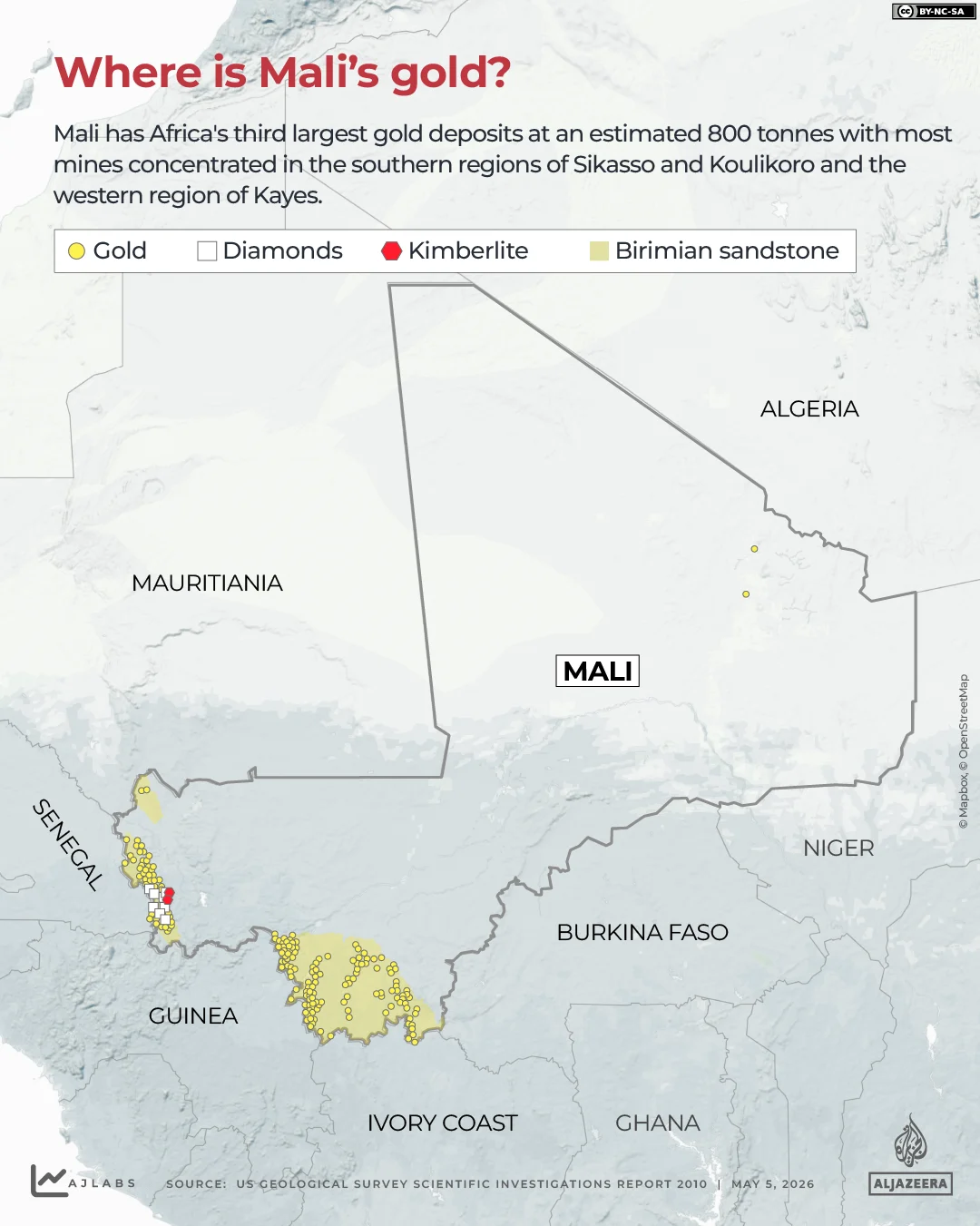
The West African nation of Mali, home to Africa’s third-largest gold reserves and significant deposits of strategically vital lithium and uranium, finds itself in the grip of escalating political instability and a profound security crisis. The recent, dramatic events of April 25, 2026, underscore the precarious balance between Mali’s immense natural wealth and its persistent internal turmoil, raising critical questions about resource governance, regional security, and the future of its 24 million citizens.
The Unfolding Crisis: A Capital Under Siege
The latest chapter in Mali’s protracted crisis unfolded with alarming speed and coordination on April 25, 2026. An al-Qaeda-linked armed group, identified by security analysts as elements from Jama’at Nusrat al-Islam wal Muslimeen (JNIM), launched a series of simultaneous, multi-pronged attacks across the country. These assaults were notably executed in concert with Tuareg separatists, indicating a worrying convergence of interests between disparate armed factions against the Malian state. The coordinated offensive targeted key installations and personnel, culminating in the assassination of Defence Minister Sadio Camara. Following these audacious attacks, the emboldened armed groups declared a siege on Bamako, the capital, signaling a direct challenge to the authority of the transitional government and plunging the nation into an even deeper state of uncertainty.
This coordinated offensive represents a significant escalation, moving beyond the traditional insurgent tactics often confined to the country’s vast, ungoverned northern and central regions. The ability of these groups to strike at the heart of the state and declare a siege on the capital highlights the severe erosion of governmental control and the pervasive nature of the security threat. Such actions not only undermine the already fragile peace but also jeopardize the country’s economic backbone, particularly its vital mining sector, which is predominantly concentrated in the more stable southern and western regions.
A Decade of Instability: A Chronology of Crisis
Mali’s current predicament is not an isolated event but rather the culmination of over a decade of interconnected crises rooted in political fragility, ethnic tensions, and the proliferation of armed groups.
- 2012 Coup and Northern Rebellion: The crisis began in earnest in March 2012 with a military coup d’état that overthrew President Amadou Toumani Touré. This internal upheaval provided a vacuum that allowed a Tuareg rebellion, spearheaded by the National Movement for the Liberation of Azawad (MNLA), to seize control of the northern half of the country. Islamist militant groups, including Ansar Dine and al-Qaeda in the Islamic Maghreb (AQIM), swiftly capitalized on the chaos, sidelining the MNLA and imposing a strict interpretation of Sharia law.
- French Intervention (Operation Serval): In January 2013, faced with the Islamist advance towards the capital, France launched Operation Serval, swiftly dislodging the jihadists from major northern cities like Gao, Timbuktu, and Kidal. This intervention prevented the collapse of the Malian state but did not eradicate the underlying insurgency.
- MINUSMA Deployment: The United Nations Multidimensional Integrated Stabilization Mission in Mali (MINUSMA) was established in April 2013, tasked with stabilizing the country, protecting civilians, and supporting the political process. Despite a robust mandate and significant troop numbers, MINUSMA struggled to contain the evolving and adaptable insurgency.
- Algiers Accord (2015): A peace agreement was signed in Algiers in June 2015 between the Malian government and various Tuareg rebel groups. While initially offering hope, its implementation has been painstakingly slow and fraught with challenges, largely failing to bring lasting peace or address the root causes of disaffection.
- Expansion of Insurgency: From 2015 onwards, Islamist militant groups, including new affiliates of ISIS (Islamic State in the Greater Sahara – ISGS), expanded their operations from the north into central Mali, exploiting ethnic grievances between sedentary farmers and nomadic pastoralists. This led to a surge in intercommunal violence and further destabilized the country.
- August 2020 Coup: Frustration over the government’s handling of the security crisis, perceived corruption, and disputed legislative elections culminated in another military coup in August 2020, led by Colonel Assimi Goïta. President Ibrahim Boubacar Keïta was overthrown.
- May 2021 Coup: Just nine months later, in May 2021, Colonel Goïta orchestrated a second coup, removing the transitional president and prime minister who had been appointed after the 2020 coup. This cemented military control over the transitional government.
- Deterioration of Relations with France and Western Allies: Following the 2021 coup, relations between Mali and its traditional Western partners, particularly France, deteriorated sharply. This was fueled by delays in returning to civilian rule, accusations of human rights abuses, and the Malian junta’s decision to forge closer ties with Russia, including the deployment of Wagner Group mercenaries (now rebranded as Africa Corps).
- Withdrawal of International Forces: This breakdown in relations led to the withdrawal of French Barkhane forces in 2022 and the subsequent request by the Malian government for MINUSMA to depart, with the mission completing its withdrawal by December 2023. This created a significant security vacuum, which the Malian armed forces, supported by Russian personnel, have struggled to fill.
- April 2026 Attacks: The recent coordinated attacks by al-Qaeda-linked groups and Tuareg separatists, culminating in the siege of Bamako, illustrate the severe security challenges and the increasing brazenness of non-state armed actors in the post-MINUSMA landscape.
Mali’s Golden Paradox: Vast Reserves Amidst Volatility
Beneath the surface of this turmoil lies Mali’s most significant economic asset: gold. The country holds Africa’s third-largest proven gold reserves, estimated at approximately 800 tonnes. This places it behind only South Africa (with an estimated 5,000 tonnes) and Ghana (around 1,000 tonnes). Furthermore, the Malian government has ambitiously claimed that the nation’s geological gold potential could be as high as 2,000 tonnes, suggesting vast, untapped resources awaiting exploration and extraction.
In 2024, Mali was a formidable force in global gold production. According to World Gold Council estimates, the country produced about 100 tonnes of gold, including both industrial and artisanal output. This figure positions Mali as Africa’s second-largest producer, narrowly surpassing South Africa (98.9 tonnes) and trailing only Ghana (140.6 tonnes). However, this impressive production figure starkly contrasts with Mali’s official annual output of roughly 57 tonnes. The substantial gap of approximately 43 tonnes is largely attributed to widespread smuggling and underreported artisanal mining, a persistent challenge that deprives the state of crucial revenue and fuels illicit networks.
Gold is undeniably the bedrock of Mali’s economy. It accounts for nearly 80 percent of the country’s total exports, generating an estimated $4.3 billion in 2024, according to data from the United States Department of Commerce and the International Monetary Fund. This overwhelming dependence on a single commodity makes Mali’s economy highly vulnerable to fluctuations in global gold prices and disruptions in production due to insecurity. Beyond gold, Mali’s export portfolio includes raw cotton, refined petroleum, oily seeds, and iron ore, as highlighted by the Observatory of Economic Complexity, but these pale in comparison to the value derived from its precious metal.
The mining sector is a critical employer, providing income for over two million people. The majority of Mali’s large-scale gold mines are concentrated along the Birimian volcanic belt in the southern regions of Sikasso and Koulikoro, and the western region of Kayes. These regions, while historically more stable than the north, are not immune to the spillover effects of the broader security crisis.
Beyond Gold: The Strategic Importance of Lithium and Uranium
Mali’s mineral wealth extends far beyond gold, encompassing a diverse array of resources that hold significant strategic importance in the global market. The country possesses substantial deposits of lithium, uranium, phosphates, iron ore, manganese, and diamonds. Much of this vast mineral potential, particularly in the northern regions where instability is most pronounced, remains underexplored and untapped, representing both a missed economic opportunity and a potential flashpoint for future resource conflicts.
Lithium, often dubbed "white gold," has become a critical mineral in the global transition to green energy, essential for electric vehicle batteries and renewable energy storage. Mali is home to one of Africa’s largest lithium deposits, with the Goulamina project in the southern part of the country estimated to contain over 200 million tonnes of lithium-bearing resources. This project is majority-owned by China’s Ganfeng Lithium, a global leader in the sector, with a significant stake held by Australia’s Leo Lithium. The Malian state retains a smaller, but still significant, minority share. The development of Goulamina highlights the increasing international interest in Mali’s critical minerals and the geopolitical competition for access to these resources.
Uranium, another strategically vital mineral, has seen exploration efforts focused primarily in the Kidal and Falea regions. While its extraction has not reached the scale of gold or lithium, the presence of these reserves adds another layer of complexity to Mali’s resource landscape, especially given the global demand for nuclear energy. Diamond deposits have also been identified along parts of the Niger River basin, further diversifying the country’s mineral endowment. According to the National Directorate for Geology and Mines, as of 2022, Mali’s estimated mineral resources included: Gold (proven: 800 tonnes, potential: 2,000 tonnes), Lithium (over 200 million tonnes of ore at Goulamina), Uranium (undetermined, but significant deposits in Kidal and Falea), Iron Ore (hundreds of millions of tonnes), Phosphates (tens of millions of tonnes), Bauxite (millions of tonnes), and other industrial minerals.

The Mining Landscape: Foreign Dominance and Evolving State Control
Historically, Mali’s mining sector has been characterized by significant foreign investment and operational control, primarily by Canadian and Australian firms, with a rapidly growing presence from Chinese companies. These multinational corporations bring the necessary capital, technology, and expertise to undertake large-scale mining operations. Canadian giants like Barrick Gold operate major complexes, such as Loulo-Gounkoto in western Mali, which has been a significant producer since 2005. Other prominent mines include Fekola, Syama, and Sadiola Hill, representing substantial foreign investments.
However, the transitional military government, which came to power in August 2020, has moved to assert greater national control over these strategic assets. In 2023, a new mining code was introduced, a landmark piece of legislation designed to increase the state’s share in mining operations to up to 35 percent. This move, coupled with stricter tax enforcement mechanisms, aims to maximize national revenue from foreign operators and ensure that Malians derive greater benefits from their own resources. This shift reflects a broader trend across Africa, where resource-rich nations are seeking to renegotiate terms with foreign companies to secure more equitable partnerships. While the new code has been welcomed by some as a step towards resource nationalism, it also introduces an element of uncertainty for foreign investors, who might view increased state intervention as a potential risk.
Economic Reliance and Smuggling Challenges
The profound reliance on gold exports, accounting for nearly 80% of Mali’s total exports, creates both opportunity and vulnerability. While it generates substantial foreign exchange, it also exposes the economy to the inherent volatility of global commodity markets. Furthermore, the significant discrepancy between official gold production figures and estimated total output underscores the pervasive issue of smuggling and illicit artisanal mining.
Artisanal mining, often conducted under perilous conditions with rudimentary tools, provides a lifeline for millions in rural areas. However, it is largely unregulated, environmentally damaging, and often falls outside the formal economy, making it a prime conduit for illicit trade. Gold smuggled out of Mali often finds its way to neighboring countries like Burkina Faso and Niger, and from there to international markets, depriving the Malian state of taxes and royalties. This illicit trade not only funds armed groups and criminal networks but also exacerbates insecurity by creating parallel economies that undermine state authority. The challenge for the Malian government is to formalize and regulate the artisanal sector, bringing it under state oversight while ensuring sustainable livelihoods for those dependent on it.
International Reactions and Regional Security Concerns
The escalating crisis in Mali has drawn consistent concern from regional and international bodies. The Economic Community of West African States (ECOWAS) has repeatedly condemned the coups and pressed for a swift return to constitutional rule, imposing sanctions at various points to pressure the junta. The African Union and the United Nations have likewise expressed deep apprehension about the deteriorating security situation, the humanitarian impact, and the potential for regional destabilization.
The withdrawal of French and UN forces, coupled with the Malian government’s embrace of Russian military assistance, has fundamentally reshaped the geopolitical landscape of the Sahel. While the Malian authorities assert their sovereign right to choose partners, international observers, particularly Western nations, view the presence of Russian "advisers" (widely understood to be Wagner Group mercenaries) with alarm, citing concerns about human rights abuses, resource exploitation, and the potential for further destabilization. The coordinated attacks and siege on Bamako will likely intensify these international calls for a reassessment of security strategies in the Sahel and renewed diplomatic efforts to address Mali’s multifaceted crisis. The implications for foreign mining companies are also significant, as increased instability directly translates to heightened operational risks and potential disruptions to supply chains.
The Human Cost and Development Hurdles
Beyond the geopolitical and economic dimensions, the ongoing instability exacts a heavy toll on Mali’s population. Millions have been displaced by violence, access to basic services like education and healthcare is severely disrupted, and food insecurity remains a persistent threat. The mining sector, while a source of income, also presents its own challenges, including environmental degradation, land disputes, and social issues in host communities.
The government’s stated aim of increasing national revenue from mining, while commendable, must be balanced against the immediate humanitarian needs and the long-term imperative of sustainable development. Without a stable security environment and robust governance, the vast mineral wealth risks becoming a curse rather than a blessing, perpetuating cycles of violence and poverty.
Future Outlook and Policy Imperatives
Mali stands at a critical juncture. Its immense natural resources, particularly gold, lithium, and uranium, offer a pathway to prosperity, but this potential remains largely unfulfilled amidst chronic instability. The recent siege on Bamako underscores the urgent need for a comprehensive approach that tackles the root causes of the crisis: weak governance, ethnic grievances, socioeconomic marginalization, and the pervasive threat of armed groups.
For the Malian transitional government, prioritizing security, fostering inclusive dialogue, and ensuring transparent and equitable management of its mineral wealth are paramount. For the international community, a renewed and coordinated strategy, focusing on diplomatic engagement, humanitarian assistance, and targeted development aid, is essential to prevent further deterioration and regional spillover. The future of Mali, and indeed the wider Sahel region, hinges on whether the nation can harness its subterranean riches to build a foundation of peace and stability, rather than allowing them to fuel further conflict.
