

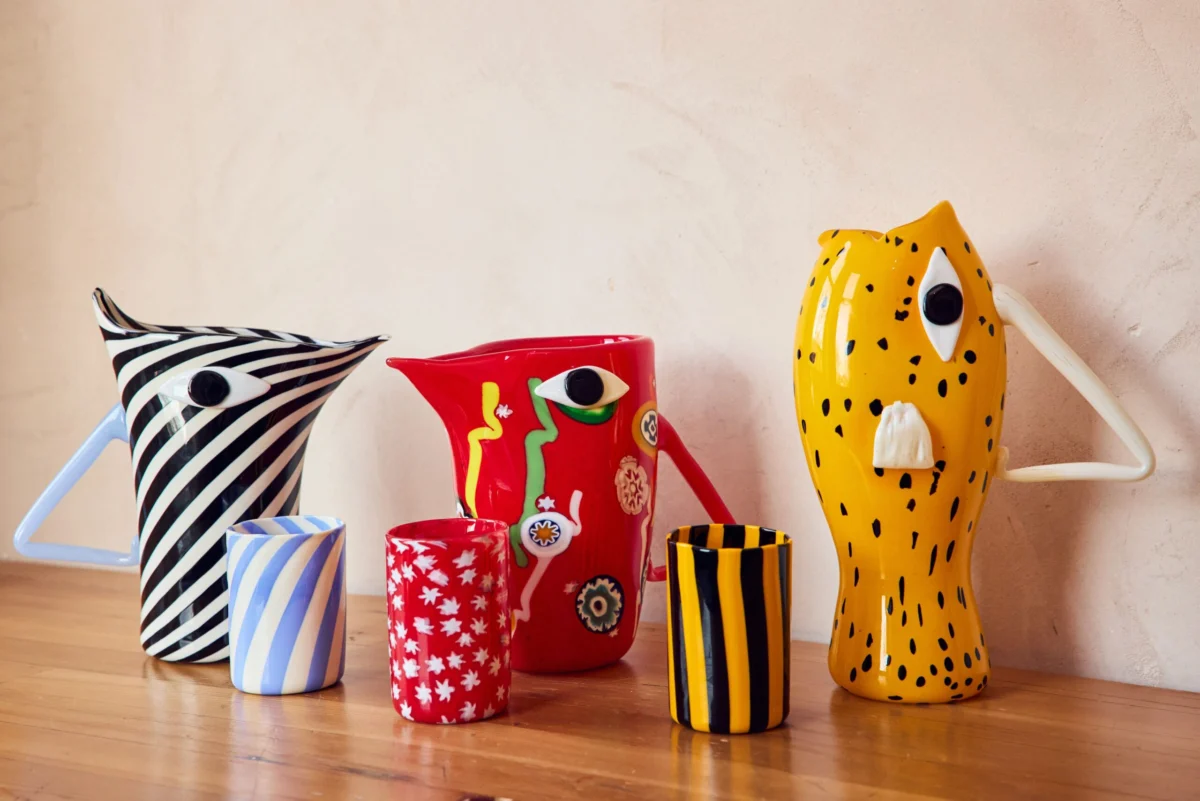
The intersection of contemporary American textile design and centuries-old Italian craftsmanship has culminated in a new partnership between Brooklyn-based designer Ellen Van Dusen and the esteemed Murano glassware brand Laguna~B. This collaboration, characterized by a series of anthropomorphic pitchers and matching drinking vessels, represents a significant departure from standard commercial home goods, leaning instead into the realm of collectible functional art. The collection features three distinct animal motifs—a zebra, a parrot, and a fish—each rendered through the complex, layered techniques synonymous with Venetian glassmaking. For Van Dusen, the founder of the design studio Dusen Dusen, the project was deeply personal, informed by her recent transition into motherhood and a desire to explore the "parent-child" dynamic through physical objects.
The Catalyst of Motherhood and Creative Autonomy
The genesis of the collaboration began when Laguna~B approached Van Dusen with an offer of total creative freedom. Unlike traditional corporate partnerships that often operate under rigid brand guidelines and extensive marketing decks, this project allowed Van Dusen to delve into Laguna~B’s extensive archives in Venice. The timing of the offer coincided with Van Dusen becoming a new mother, a life event that she notes shifted her focus toward the nurturing relationships between parents and children. This theme became the central pillar of the collection, where each large handled pitcher—the "parent"—is paired with a smaller drinking glass—the "child."
The aesthetic synergy between the two brands was immediate. Dusen Dusen is widely recognized for its bold use of stripes, geometric patterns, and vibrant color palettes, elements that align naturally with Laguna~B’s maximalist approach to glassware. Caterina Capelli, head of communications for Laguna~B, observed that the project was not merely a transposition of Dusen Dusen’s existing textile patterns onto glass, but rather an expansion of the designer’s "universe" into a three-dimensional medium.

Technical Precision and the Agency of Murano Glass
The transition from textiles to glass presented a unique set of technical challenges. In textile design, Van Dusen typically works with structured, geometric patterns where the final product closely mirrors the initial technical drawing. Glass, however, introduces a level of unpredictability. The hand-blowing process in Murano is an artisanal craft where the material possesses what Capelli describes as its own "agency." Because each piece is hand-formed, no two items in the collection are identical. This inherent variation is a hallmark of high-end Murano production, adding to the collectible value of the pieces.
The Laguna~B artisans had to innovate to bring Van Dusen’s anthropomorphic visions to life. According to the designer, the team had never previously applied "eyes" to their glassware, a signature element of the Dusen Dusen brand. The construction of the animal silhouettes required meticulous attention to detail, particularly in the shaping of the pouring lips and handles.
- The Zebra Pitcher: This piece features a sharp point at both ends of the rim, designed to mimic the distinctive mohawk of a zebra. It utilizes high-contrast black and white glasswork to replicate the animal’s natural camouflage.
- The Fish Pitcher: In contrast to the zebra, the fish pitcher is softer in its geometry, featuring a shallow, rounded spout and a spotted pattern achieved through a sophisticated layering technique.
- The Bird (Parrot) Pitcher: This vessel is the most traditionally aligned with Laguna~B’s historical "Goto" style. It utilizes a solid red background layered with glass canes and remnants to create an irregular, star-spangled effect.
A Chronology of the Partnership
The development of the Laguna~B x Dusen Dusen collection followed a structured timeline that bridged the gap between New York design and Italian production:
- Initial Outreach: Laguna~B contacted Ellen Van Dusen, offering her an open-ended invitation to collaborate using their Murano facilities.
- Archive Research: Van Dusen conducted a "crash course" in glassmaking history, utilizing Laguna~B’s archives to understand the technical limitations and possibilities of the medium.
- Design Phase: Van Dusen developed technical drawings that incorporated her signature "hand-on-hip" handle motifs and anthropomorphic faces, themes previously seen in her successful line of face clocks and serving utensils.
- Prototyping: The artisans at Laguna~B experimented with layering techniques, specifically the use of glass canes to create patterns that mimicked Dusen Dusen’s textile prints.
- Production and Launch: The final collection was produced in limited quantities, reflecting the labor-intensive nature of Murano glass blowing.
Market Positioning and Pricing Data
The collection is positioned within the luxury "collectible design" market, a segment that has seen significant growth as consumers increasingly seek unique, artisan-made objects for the home. The pricing reflects the high cost of Murano labor and the prestige associated with both brands:

| Item | Price (USD) |
|---|---|
| Zebra Pitcher | $1,650 |
| Fish Pitcher | $1,650 |
| Bird Pitcher & Cup Set | $2,000 |
| Individual Zebra Glass | $250 |
Van Dusen acknowledged that this price point reaches a different demographic than her usual textile and home goods line. However, she emphasized that the lack of "price engineering" constraints allowed for a higher level of artistic experimentation. By removing the pressure to create a mass-market product, the collaboration was able to prioritize material quality and complex construction techniques that are often discarded in traditional retail manufacturing.
Broader Implications for the Murano Glass Industry
This collaboration is part of a larger trend of Murano-based companies partnering with contemporary international designers to revitalize the traditional glassmaking industry. For decades, Murano glass faced challenges from cheaper, mass-produced imitations and a declining number of young artisans entering the trade. Brands like Laguna~B have been at the forefront of modernizing the island’s image by integrating modern aesthetics—such as Van Dusen’s Brooklyn-born maximalism—with ancient techniques.
The "mini-me" concept also taps into a broader cultural trend in the luxury market where "whimsical" or "playful" designs are increasingly valued. The anthropomorphic nature of the pitchers—giving inanimate objects human or animal traits—creates an emotional connection with the user, a strategy often used in high-end "kidult" branding. This approach challenges the notion that luxury glassware must be austere or overly formal.
Official Responses and Design Philosophy
Caterina Capelli noted that the project was a success because it respected the traditions of Murano while allowing for a "transposition" of a different creative universe. "We always say that Murano has its own agency," Capelli stated, highlighting the collaboration’s respect for the organic nature of the material.

Van Dusen expressed satisfaction with the functional aspect of the collection. Despite the high price point and the artistry involved, she intends for the pieces to be "tabletop staples" rather than items kept purely for display. "I like the idea that these pieces are collectible, but also able to be used in an everyday way," she remarked. This philosophy aligns with the broader movement toward "functional art," where the value of an object is derived from both its aesthetic merit and its utility in daily life.
Analysis of the Design Impact
The use of the "hand-on-hip" handle is perhaps the most significant design bridge in the collection. This motif has become a recognizable hallmark of the Dusen Dusen brand, appearing on various products from clocks to kitchenware. By successfully translating this motif into glass—a much more fragile and difficult material than the plastics or woods used in her previous products—Van Dusen has demonstrated the versatility of her design language.
Furthermore, the collaboration highlights the importance of the "archive" in modern design. By allowing Van Dusen access to historical patterns like the "Goto," Laguna~B ensured that the new collection remained rooted in Venetian history even as it embraced a contemporary New York aesthetic. The resulting products are a hybrid of two distinct geographic and cultural identities: the historical, craftsmanship-heavy world of Venice and the fast-paced, pattern-obsessed world of Brooklyn.
As the market for artisanal homewares continues to expand, collaborations such as this one provide a blueprint for how traditional industries can remain relevant. By leaning into the unpredictability of the material and the personal narratives of the designers, brands can create products that offer more than just functionality—they offer a story of heritage, parenthood, and creative evolution. The Laguna~B x Dusen Dusen collection stands as a testament to the enduring appeal of the handmade in an increasingly digital and mass-produced world.
