

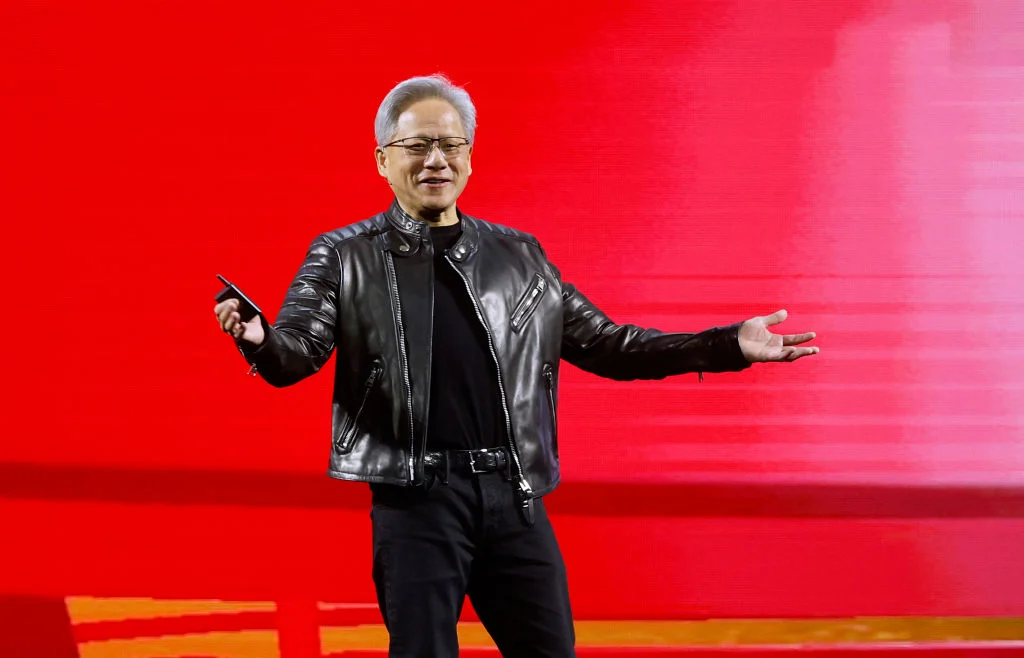
Addressing a high-level gathering of global leaders and economic policy experts at the Milken Institute’s 27th Annual Global Conference in Los Angeles, Nvidia CEO Jensen Huang offered a robust defense of artificial intelligence, characterizing the technology as a transformative engine for job growth rather than a threat to the global workforce. During a keynote conversation with MSNBC’s Becky Quick, Huang dismissed the "doomsday" scenarios frequently associated with AI-driven automation, arguing instead that the technology represents the most significant opportunity for the United States to re-industrialize its economy and enhance productivity across every sector.
The dialogue comes at a pivotal moment for the technology industry, as the rapid proliferation of generative AI tools has sparked intense debate among economists, policymakers, and labor advocates. While many fear that AI will render millions of roles obsolete, Huang presented a counter-narrative centered on the creation of new industries and the evolution of existing professional functions.
The Vision of AI-Driven Re-industrialization
A central pillar of Huang’s argument is the concept of the "AI factory." He posited that the current technological shift is moving the global economy away from traditional software development toward a new model of industrial production. In this framework, data centers are no longer just storage hubs; they are factories producing intelligence.
Huang explained that these "AI factories" represent a fundamental shift in how value is created. Just as the first Industrial Revolution utilized steam and electricity to power physical manufacturing, the current era utilizes massive computational power—driven largely by Nvidia’s specialized hardware—to produce digital intelligence. This shift, according to Huang, necessitates a massive expansion of physical infrastructure, including the construction of advanced data centers and the manufacturing of sophisticated semiconductors, all of which require a robust human workforce to design, build, and maintain.
"AI is the United States’ best opportunity to re-industrialize," Huang stated, emphasizing that the infrastructure required to support the AI economy will bring high-tech manufacturing and engineering jobs back to the forefront of the American labor market. By positioning AI as a tool for industrial-scale production, Huang suggested that the technology would catalyze a domestic manufacturing renaissance, reducing reliance on offshore supply chains for critical intelligence infrastructure.
Distinguishing Between Tasks and Jobs
During the conversation, Becky Quick raised the pressing concern of economic dislocation, asking whether the speed of AI adoption might lead to unprecedented levels of inequality. Huang responded by challenging the fundamental premise that automating a task is equivalent to replacing a job.
He argued that a professional role is composed of a diverse array of tasks, many of which are repetitive or administrative. By delegating these discrete tasks to AI, workers are not eliminated; rather, they are liberated to focus on the higher-level "purpose" of their roles. "People misunderstand that the purpose of a job and the task of a job are related, but they are not the same thing," Huang noted.
This perspective aligns with a growing school of thought among productivity experts who suggest that AI will act as a "co-pilot" for the workforce. For instance, in software engineering, AI can generate boilerplate code, allowing the developer to focus on system architecture and creative problem-solving. In healthcare, AI can analyze thousands of medical images for anomalies, enabling physicians to spend more time on patient care and complex diagnoses. Huang’s contention is that this augmentation will lead to more fulfilling employment and higher overall economic output.
Challenging the "AI Doomer" Narrative
Huang was particularly critical of the rhetoric surrounding "AI doomerism"—the belief that artificial intelligence will eventually surpass human control or lead to the mass extinction of job categories. He expressed concern that such "science fiction stories" are creating a climate of fear that could hinder the adoption of the technology in the United States.
"My greatest concern is that we scare people to the point where AI is so unpopular, or people are so afraid of it, that they don’t actually engage it," Huang said. He argued that if the U.S. retreats from AI due to societal anxiety, it risks losing its competitive edge to global adversaries who are aggressively pursuing the technology.
Interestingly, Huang’s comments touch upon a paradox within the industry. Much of the existential dread surrounding AI has been fueled by tech leaders themselves, often as a way to underscore the power and significance of their products. Critics have long maintained that "doomer" rhetoric serves as a sophisticated marketing tool, creating a sense of awe and inevitability around AI capabilities that may not yet exist. Huang’s stance appears to be a strategic pivot away from this sensationalism, focusing instead on the pragmatic economic benefits of the technology.
The Economic Context: Projections and Data
While Huang maintains an optimistic outlook, several major financial and academic institutions provide a more nuanced, and sometimes sobering, view of the transition.
Data from the McKinsey Global Institute suggests that generative AI could add between $2.6 trillion and $4.4 trillion annually to the global economy. However, this productivity surge comes with significant labor shifts. McKinsey estimates that by 2030, activities that currently account for up to 30% of hours worked across the U.S. economy could be automated.
Similarly, a report by the Boston Consulting Group (BCG) indicates that while AI will reshape more jobs than it replaces, approximately 15% of current roles in the United States could be eliminated over the next decade. The International Monetary Fund (IMF) has also warned that nearly 40% of global employment is exposed to AI, with advanced economies facing both the greatest risks and the greatest opportunities for productivity gains.
Goldman Sachs has projected that AI could automate the equivalent of 300 million full-time jobs globally. However, their analysts also note that technological displacement is historically offset by the creation of new occupations. For example, the rise of the internet destroyed roles in traditional media and retail but gave birth to entire industries in web development, digital marketing, and e-commerce that did not exist 30 years ago.
Reactions from Labor and Industry
The response to Huang’s comments has been mixed across the socio-economic spectrum. Industry leaders, particularly those in the hardware and cloud computing sectors, have largely echoed his sentiment. Microsoft CEO Satya Nadella and Alphabet’s Sundar Pichai have both emphasized the "democratization of expertise" that AI provides, suggesting that the technology will lower the barrier to entry for high-skilled work.
Conversely, labor unions and advocacy groups remain skeptical. The recent strikes by the Writers Guild of America (WGA) and SAG-AFTRA highlighted deep-seated anxieties regarding the use of AI to replicate human creativity and labor without fair compensation. These groups argue that without robust regulatory frameworks and "human-in-the-loop" protections, the benefits of AI-driven productivity will accrue primarily to capital owners and tech giants, rather than the workers whose tasks are being automated.
Economists like Daron Acemoglu of MIT have also cautioned against "so-so automation"—technologies that are just good enough to replace human labor but not good enough to create significant productivity growth. Acemoglu argues that if AI is used primarily to cut costs rather than innovate, the result could be a net loss for the middle class.
Analysis of Implications
The "Huang Doctrine"—the idea that AI is an industrial job creator—rests on the assumption that the demand for intelligence is effectively infinite. If AI makes intelligence cheaper and more accessible, companies will not simply do the same amount of work with fewer people; they will do vastly more work, exploring new frontiers in drug discovery, renewable energy, and materials science that were previously computationally impossible.
However, the transition period remains the primary point of friction. Even if AI creates more jobs than it destroys in the long run, the skills required for the new "AI factory" jobs are vastly different from those required in the traditional service or manufacturing sectors. This suggests that the real challenge for the United States is not the total number of jobs, but the speed and efficacy of worker reskilling programs.
Furthermore, Nvidia’s position as the primary provider of the "shovels" for the AI gold rush gives Huang a unique perspective. Nvidia’s H100 and upcoming Blackwell chips are the fundamental units of the AI economy. From his vantage point, the demand for hardware is insatiable, which translates to a massive, ongoing industrial project. Whether this translates to a broad-based increase in employment for the average American worker remains the central question of the next decade.
Conclusion
Jensen Huang’s remarks at the Milken Institute serve as a high-stakes rebuttal to the prevailing narrative of technological unemployment. By framing AI as a tool for re-industrialization and distinguishing between task automation and job elimination, Huang is attempting to steer the national conversation toward a more optimistic, growth-oriented trajectory.
As the AI industry continues to evolve at a breakneck pace, the tension between Huang’s vision of a rejuvenated industrial America and the data-driven warnings of job displacement will likely define the political and economic landscape. The success of this transition will depend not only on the capabilities of the hardware produced in Nvidia’s "factories" but also on the ability of society to adapt its labor structures to a world where human intelligence is permanently augmented by the machine.
