

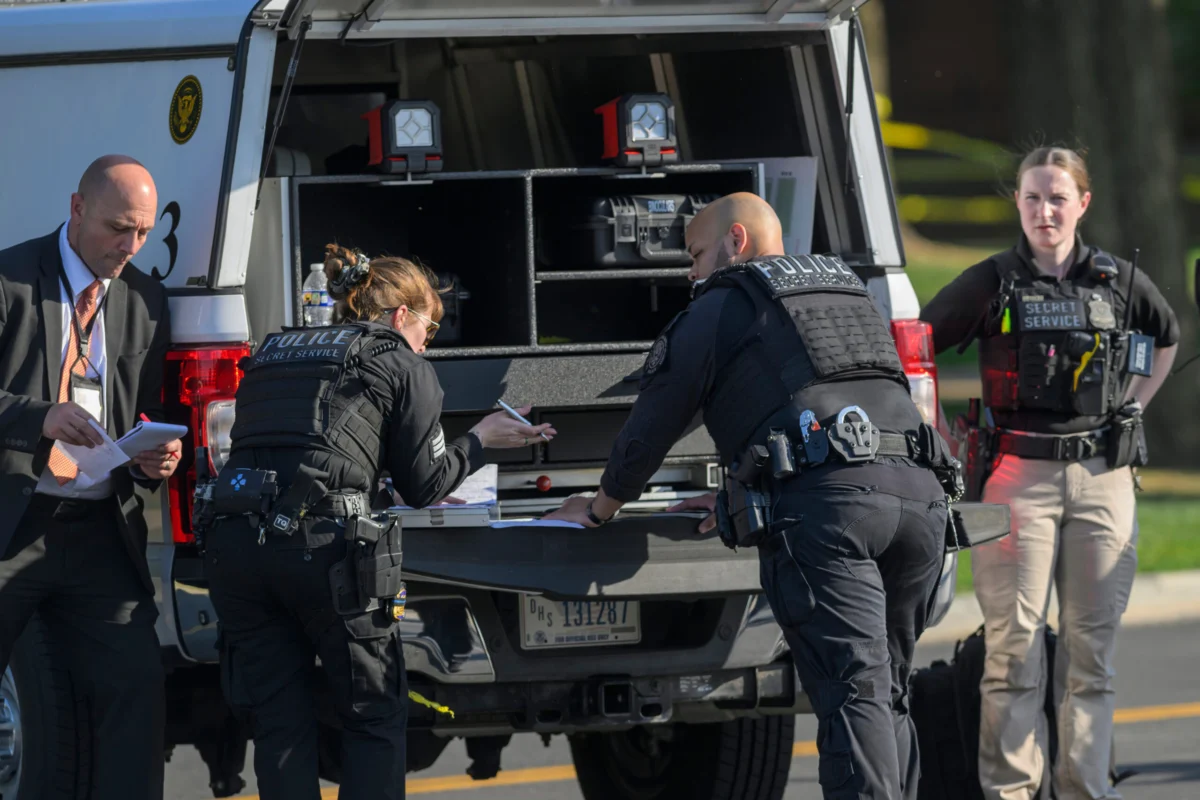
United States Secret Service agents opened fire on an armed individual in the vicinity of the White House on Monday, wounding the suspect and triggering a temporary security lockdown of the executive mansion and its surrounding perimeter. The incident, which unfolded in broad daylight, marks a significant escalation in the security challenges facing federal law enforcement in the nation’s capital. According to official reports from the Secret Service and the Washington DC Metropolitan Police Department, the suspect was transported to a local area hospital under heavy guard following the exchange of gunfire. While the suspect’s motives remain under investigation, the event has reignited intense scrutiny regarding the safety of high-ranking government officials and the increasing frequency of violent encounters near federal landmarks.
The confrontation began when plainclothes agents, tasked with patrolling the outer rings of the White House security zone, identified a man behaving suspiciously. Secret Service Deputy Director Matthew Quinn confirmed during a press briefing that the agents believed the individual was carrying a concealed firearm. Following standard operating procedures for high-threat environments, the plainclothes agents maintained a discreet distance while requesting immediate assistance from uniformed divisions. When uniformed Secret Service officers arrived on the scene to intercept the individual, the suspect reportedly attempted to flee the area on foot. During the ensuing pursuit, the suspect produced a weapon and opened fire on the responding officers. The agents returned fire, striking the suspect and neutralizing the immediate threat. A firearm was recovered from the scene and has been taken into evidence for ballistic testing.
In a tragic development during the exchange, a child who happened to be in the vicinity was struck by a projectile. Emergency medical services were called to the scene immediately, and the minor was transported to a hospital with injuries that officials have categorized as non-life-threatening. Deputy Director Quinn stated that while the investigation is ongoing, preliminary findings suggest the child was struck by a round fired by the suspect rather than by law enforcement. The incident has caused significant alarm among the public, as the area surrounding the White House is a frequent destination for tourists, families, and local workers. The Metropolitan Police Department has launched a comprehensive investigation into the discharge of weapons, a standard protocol whenever federal agents are involved in a shooting within the District of Columbia.
Chronology of the Security Incident
The timeline of Monday’s events reflects a rapid transition from a routine surveillance operation to a violent confrontation. At approximately 2:15 p.m., the plainclothes detail first flagged the suspect near the northern edge of the Ellipse. For several minutes, the agents monitored the individual’s movements as he appeared to be observing security checkpoints and the movement of official vehicles. By 2:30 p.m., the decision was made to engage the individual for questioning.
As uniformed units moved in, the suspect bypassed a security bollard and began running toward a more crowded pedestrian area. The exchange of fire occurred shortly thereafter, lasting only a few seconds but resulting in multiple shots fired. By 2:45 p.m., the White House was placed under a "red" lockdown status, with staff and members of the press corps instructed to remain indoors and away from windows. This lockdown lasted for approximately one hour while the Secret Service performed a "sweep" of the area to ensure there were no secondary threats or accomplices.
This incident did not occur in a vacuum. It follows a series of high-profile security breaches and threats directed at the executive branch. Specifically, investigators are looking into whether the suspect had knowledge of Vice President JD Vance’s movements. Official reports indicate that the Vice President’s motorcade had passed through the same general area only minutes before the shooting occurred. While the Secret Service currently maintains there is no direct evidence that the suspect intended to target the Vice President’s convoy, the proximity in timing has raised questions about potential reconnaissance efforts by the gunman.
Context of the April 25 Assassination Attempt
The shooting on Monday is the latest in a troubling string of events that have plagued the 2026 political season. Just weeks prior, on April 25, 2026, a major security failure occurred during the White House Correspondents’ Dinner. President Donald Trump and First Lady Melania Trump had to be abruptly evacuated from the ballroom after a gunman, identified as 31-year-old Cole Tomas Allen, allegedly attempted to assassinate the President.
Allen is currently in federal custody facing a litany of charges, including the attempted murder of the President of the United States, discharging a firearm during a crime of violence, and the illegal interstate transportation of firearms and ammunition. Court documents reveal that Allen allegedly fired a shotgun toward the stairs leading to the main ballroom, a location where high-level dignitaries and media figures were gathered. Furthermore, Allen is accused of shooting a Secret Service agent during that incident. The agent survived the encounter, largely credited to the effectiveness of his ballistic vest.
The April 25 incident is officially recognized as the third major assassination attempt against Donald Trump since 2024. These repeated breaches have led to an atmosphere of heightened tension within the Secret Service and have prompted congressional inquiries into the adequacy of the agency’s manpower and technology. The fact that another gunman was able to engage agents so close to the White House on Monday suggests that the "protective bubble" surrounding the presidency is being tested with unprecedented frequency.
Supporting Data and Security Analysis
The statistical reality of threats against federal officials has shown a marked upward trend over the last three years. According to data released by the Department of Homeland Security, threats against "protected persons"—which include the President, Vice President, and their families—have increased by nearly 40% since the beginning of the 2024 election cycle. This rise in volatility is attributed to a combination of extreme political polarization, the proliferation of extremist rhetoric on digital platforms, and the ease of access to high-capacity weaponry.
In response to these trends, the Secret Service has requested a budget increase for the 2027 fiscal year to expand its "Counter-Sniper" and "Uniformed Division" programs. The agency has also increased the use of plainclothes surveillance teams in the Washington DC area, a strategy that was directly responsible for identifying the suspect in Monday’s shooting. Security analysts suggest that while the plainclothes agents successfully identified the threat, the fact that the suspect felt emboldened to open fire on federal officers indicates a breakdown in traditional deterrence.
"We are seeing a shift in the profile of these attackers," said a former high-ranking Secret Service official who spoke on the condition of anonymity. "In previous decades, a perimeter breach was often the result of mental health crises or individuals seeking attention. Now, we are seeing more calculated, armed individuals who are willing to engage in a direct firefight with law enforcement. This requires a fundamental shift in how we secure the ‘outer perimeter’ of the White House."
Official Responses and Political Implications
The political reaction to the shooting was swift. Deputy Director Matthew Quinn emphasized that the agency would leave no stone unturned in determining the suspect’s intent. "Our mission is clear: to protect the integrity of the presidency and those who serve within it," Quinn said. "We will find out whether this individual was targeting the President, the Vice President, or the institution itself. We will also evaluate our protocols to ensure that bystanders, particularly children, are not caught in the crossfire of these dangerous encounters."
Spokespersons for both the White House and the Vice President’s office released statements praising the "heroic and rapid response" of the Secret Service agents on the ground. However, critics in Congress have called for a more aggressive stance on urban security. Some lawmakers are advocating for a permanent expansion of the "no-go" zones around the White House, which would further restrict public access to Lafayette Square and the Ellipse. Proponents of these measures argue they are necessary for safety, while civil liberties groups warn that such moves would further isolate the government from the people it serves.
The Metropolitan Police Department’s involvement is also critical. Because the shooting occurred on public land within the District, the local police have jurisdiction over the criminal investigation of the suspect’s actions against the public and the minor who was injured. This multi-agency cooperation is essential for ensuring a transparent investigation, especially when questions arise regarding the use of force by federal agents in densely populated areas.
Broader Impact on National Security
The implications of Monday’s shooting extend beyond the immediate legal case against the suspect. It highlights a growing concern regarding "copycat" incidents. Following the arrest of Cole Tomas Allen in April, security experts warned that publicized attempts on the President’s life could inspire other radicalized individuals to take similar actions. The proximity of Monday’s shooter to the White House suggests that the symbolic nature of the building continues to make it a primary target for those seeking to disrupt the American political process.
As the investigation continues, the suspect remains in stable condition at the hospital. Once cleared by medical professionals, he is expected to face a battery of federal charges, likely mirroring those brought against Allen. The weapon recovered at the scene—a semi-automatic handgun—is being traced through the Bureau of Alcohol, Tobacco, Firearms and Explosives (ATF) to determine its origin and whether it was obtained legally.
The wounding of a child during the incident has added a layer of public grief and outrage to the event. Community leaders in Washington DC have called for a renewed focus on gun violence and the risks posed by high-stakes security operations in residential and tourist zones. For the Secret Service, the challenge remains the same: balancing the need for an open, democratic capital with the absolute necessity of protecting the nation’s leaders from an increasingly violent and unpredictable threat landscape.
The events of Monday serve as a stark reminder of the dangers inherent in executive protection. As the nation moves closer to the next phase of its political cycle, the pressure on the Secret Service and local law enforcement to maintain order in the face of rising domestic tensions will only intensify. The investigation into the gunman’s motives, his background, and any potential ties to larger extremist groups will be a top priority for federal investigators in the coming weeks. For now, the White House remains under a heightened state of alert, a symbol of a government under pressure in an era of unprecedented security challenges.
