

The landscape of executive compensation disclosure has become increasingly complex, with each regulatory update since 2006 adding layers of information. While the intent has been to enhance transparency and accountability, the current framework often results in repetitive narratives, overlapping tables, and lengthy process descriptions that can obscure the fundamental question: how does a company effectively link executive pay to its strategic objectives and performance outcomes? In response to potential Securities and Exchange Commission (SEC) reforms, Pay Governance LLC, a leading independent compensation consulting firm, has proposed a streamlined approach to executive compensation reporting, advocating for less disclosure but not less crucial information.
Mike Kesner, a Partner at Pay Governance, and Silvana Nuzzo, a Principal at the firm, have outlined their firm’s perspective in a recent memorandum, suggesting a shift from volume to value in proxy statements. This initiative arises from a growing consensus among investors and regulators alike that the current disclosure model, while comprehensive, has become unwieldy and, at times, counterproductive in its mission to inform shareholders.
The Evolving Landscape of Executive Compensation Disclosure
The journey towards more detailed executive compensation disclosures began in earnest with the SEC’s rulemaking in the early 2000s. Following accounting scandals and a perceived disconnect between executive pay and corporate performance, regulators sought to provide investors with a clearer picture of how top executives were compensated and how those compensation packages aligned with shareholder interests. The introduction of the Summary Compensation Table (SCT) and other detailed reporting requirements aimed to achieve this.
Over the years, these requirements have expanded. For instance, the Dodd-Frank Wall Street Reform and Consumer Protection Act of 2010 mandated a "say-on-pay" vote, giving shareholders a non-binding advisory vote on executive compensation. This further fueled the need for detailed disclosures to justify compensation decisions. More recently, the Pay Versus Performance (PVP) disclosure rule, implemented by the SEC in 2022, requires companies to disclose the relationship between their executive compensation and their financial performance over a five-year period. This rule, intended to enhance transparency around the link between pay and performance, has also contributed to the increasing length and complexity of proxy statements.
However, this proliferation of data has not necessarily translated into improved clarity. Many companies find themselves dedicating significant resources to fulfilling these requirements, often resulting in proxy statements that are hundreds of pages long. This volume can overwhelm investors, making it challenging to extract the most critical insights.
Investor Demand for Decision-Useful Information
A recent Pay Governance Viewpoint, "Investor Perspectives on SEC Disclosure Reform," summarized the SEC’s proposals for disclosure reform and highlighted extensive survey findings. These findings indicated a strong investor appetite for retaining executive compensation information that is "decision useful." This means investors are not necessarily calling for less information overall, but rather for information that is presented in a more accessible and relevant manner, allowing them to make informed judgments about the effectiveness of compensation programs and the accountability of the board of directors.

The current proposal by Kesner and Nuzzo builds upon this sentiment, focusing on how companies can achieve this objective by rethinking the very architecture of their disclosure. The core argument is that the focus should be on separating essential information from the "boilerplate" or conventional disclosures that have accumulated over time.
Separating the Essential from the Boilerplate
The Pay Governance proposal identifies a clear distinction between information that is fundamentally essential to investors and elements that could be streamlined or eliminated without sacrificing transparency.
Essential to Investors:
- Pay Levels and Pay Mix: Understanding the total compensation for each Named Executive Officer (NEO) and how that compensation is structured (e.g., base salary, annual bonus, long-term incentives, equity awards) is critical for assessing competitiveness and alignment with company strategy.
- Incentive Metrics, Goals, Actual Results, Payouts, and Material Use of Discretion: This is the heart of performance-based compensation. Investors need to see what metrics were used, what targets were set, what the actual company performance was, how much was paid out, and if and how the compensation committee exercised discretion in adjusting awards. This provides direct insight into the link between pay and performance.
- Rationale for Material Decisions, Special Awards, and Significant Program Changes: Transparency around the "why" behind key compensation decisions is crucial. This includes explaining the rationale for setting specific performance goals, granting special awards (e.g., for retention or extraordinary achievements), or making significant modifications to compensation plans.
- Relationship Between Pay Outcomes and Company and Shareholder Performance: Beyond just disclosing the metrics, investors want to see a clear narrative and quantitative evidence demonstrating how executive pay has tracked with overall company financial performance and shareholder returns.
- Outstanding Equity Value, Vesting Status, and Completed Performance Cycle Outcomes: Understanding the value of unvested equity awards, their vesting schedules, and the outcomes of past performance periods provides a comprehensive view of long-term incentive realization and potential future compensation.
- Stock Ownership, Clawbacks, Risk Oversight, Severance, and Change in Control Economics: These elements speak to governance protections and risk mitigation. Investors want to see that executives have significant stock ownership aligned with shareholders, that clawback policies are in place, how compensation practices are overseen to avoid excessive risk-taking, and what severance or change-in-control payments are structured.
Candidates for Streamlining:
- Generic or Aspirational Descriptions of Compensation Philosophy: While a compensation philosophy sets the tone, overly generic or aspirational language often adds little substantive value and can be repetitive.
- Narrative That Restates Information Already in Tables: Much of the current narrative often simply rephrases data already presented in tables, contributing to length without adding new insights.
- Extended Process Descriptions That Change Little Year-to-Year: Detailed explanations of how compensation decisions are made, especially when these processes are largely consistent, can be significantly condensed.
- Lengthy Pay Versus Performance Narrative and Duplicative Required Measure Lists: The newly mandated PVP disclosure, while intended to be informative, can lead to lengthy and sometimes redundant explanations of performance measures.
- Multiple Equity Tables Presenting the Same Awards from Different Perspectives: The current disclosure rules often require presenting equity awards in several different tables, leading to overlap and redundancy.
- Inactive Plan Tables or Governance Descriptions with No Material Current Year Relevance: Tables related to plans that are no longer active or governance details that have not changed significantly in the current year can be pruned.
The Essential Executive Compensation Dashboard: A Proposed Solution
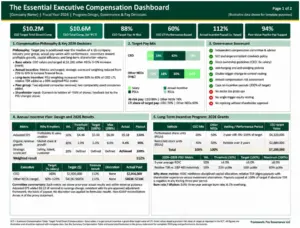
To address these challenges, Pay Governance proposes the creation of a standardized, two-page "Essential Executive Compensation Dashboard." This dashboard is envisioned to accompany the Summary Compensation Table, not to replicate the existing disclosure regime in miniature, but to consolidate the most critical, decision-useful information in a clear, concise, and easily digestible format.
The proposed dashboard aims to:
- Eliminate Overlaps: By consolidating information, the dashboard would reduce the need for multiple tables and lengthy narratives that cover the same ground.
- Integrate Board Judgment with Quantitative Results: It would present the board’s decisions and rationale alongside the actual pay outcomes, making it easier for investors to understand the context and implications of compensation decisions.
- Facilitate Comparability: A common order and terminology across companies would enhance the ability of investors to compare executive compensation practices year-over-year and across peer companies.
- Support Machine-Readable Tagging: A table-based design would lend itself well to data tagging, making the information more accessible for analytical tools and investors who rely on structured data.
The scope of information included in the dashboard, such as specific details on Pay Versus Performance, CEO Pay Ratio, and forward-looking performance share targets, would remain flexible, adapting to company-specific factors like the complexity of incentive plans and the nature of the shareholder base.

Key Features of the Proposed Dashboard
The "Essential Executive Compensation Dashboard" distinguishes itself from the current disclosure framework in several key ways:
- Selectivity, Not Additivity: The dashboard is designed to replace redundant narrative and overlapping tables, acting as a summary of essential information rather than an additional layer of reporting.
- Connection of Design to Outcomes: It would present annual and long-term incentive designs side-by-side with their corresponding goals, actual results, payouts, and any exercise of discretion. This direct linkage makes the compensation committee’s decision-making process more transparent and evaluable.
- Reconciliation of Different Views of Pay: A concise section would bridge the gap between the compensation reported in the Summary Compensation Table (which reflects grant-date fair value) and the "compensation actually paid," helping readers understand how equity award values might change based on subsequent performance and other factors.
- Visibility of Accountability Mechanisms: Key governance elements such as stock ownership requirements, clawback policies, risk oversight responsibilities, severance packages, and change-in-control provisions would be presented in a single, integrated location, rather than being scattered throughout the proxy statement.
- Support for Comparability While Preserving Judgment: Standardized categories would enhance ease of navigation and comparison. Crucially, brief company-specific commentary would be retained to provide context for any unusual decisions or outcomes, preserving the ability of boards to explain unique circumstances.
Implications for Compensation Committees and Boards
The proposed shift to a more streamlined disclosure model carries significant implications for compensation committees and boards of directors.
- Enhanced Focus on Strategic Alignment: The dashboard’s emphasis on linking pay to performance and strategy would encourage compensation committees to more rigorously articulate and document these connections.
- Improved Efficiency and Reduced Compliance Burden: By reducing the need for extensive boilerplate and redundant tables, companies could see a material reduction in the time and resources dedicated to preparing proxy statements. This would allow compensation committees to focus more on strategic compensation design and less on administrative compliance.
- Greater Transparency and Investor Engagement: A clearer, more concise presentation of executive compensation is likely to lead to greater investor understanding and engagement. This could, in turn, improve the quality of say-on-pay votes and foster more constructive dialogue between companies and their shareholders.
- Potential for Regulatory Adoption: If the SEC moves forward with disclosure reforms, proposals like the Pay Governance dashboard could serve as a blueprint for new disclosure requirements, offering a practical and investor-centric approach.
The Path Forward: A Call for Smarter Disclosure
The strongest argument for disclosure reform is not that investors require less information, but rather that they should not have to wade through a deluge of repetitive and boilerplate text to find the truly critical data. The "Essential Executive Compensation Dashboard" offers a pragmatic middle ground. It aims to retain the essential quantitative and company-specific information necessary for evaluating pay-for-performance alignment, while significantly reducing the length, repetition, and compliance-driven narrative that currently characterizes proxy statements.
As the SEC considers potential reforms, companies have an opportunity to move beyond simply reducing disclosure requirements and instead to improve the quality and effectiveness of their reporting. By embracing a concise, standardized, and decision-oriented presentation, companies can lower compliance burdens while simultaneously enhancing transparency and preserving investor confidence. This proactive approach, championed by firms like Pay Governance, could lead to a more effective and efficient executive compensation disclosure regime that truly serves the interests of both companies and their shareholders.
The disclaimer provided by Pay Governance LLC emphasizes that this viewpoint is for informational purposes only and does not constitute legal advice, a standard practice for consulting firms offering analysis on regulatory matters. The images accompanying the original post, depicting charts and data visualizations, likely served to illustrate the proposed dashboard’s structure and content, underscoring the visual and data-driven nature of their recommendation.
