

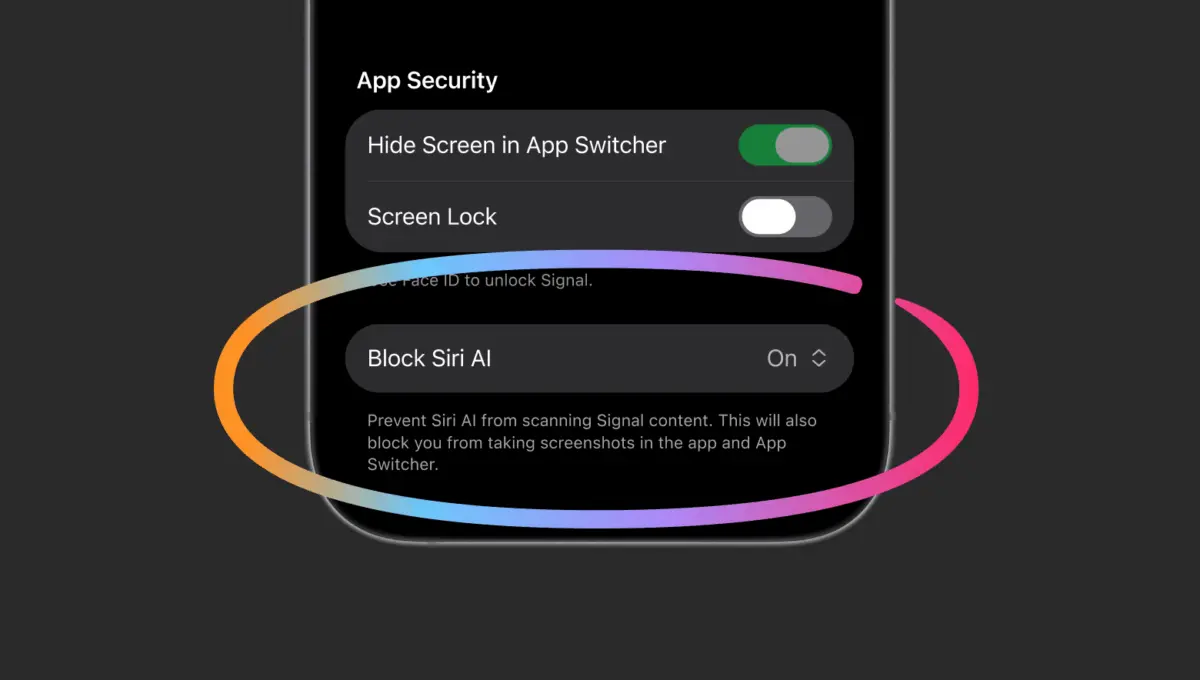
In a significant escalation of the ongoing friction between privacy-focused applications and the rapidly evolving artificial intelligence landscape, the encrypted messaging platform Signal has announced a series of rigorous new protections designed to shield user data from operating system-level AI agents. The company confirmed that it will implement restrictions on screenshotting capabilities within its iOS 27 application and introduce measures to prevent AI assistants from capturing screen data on Android devices. This move, articulated by Signal President Meredith Whittaker in a detailed policy statement, marks a pivotal moment in the industry’s attempt to reconcile end-to-end encryption with the pervasive "onscreen awareness" features being integrated into modern mobile and desktop operating systems.
The decision is primarily a response to the "agentic" features currently being deployed by tech giants like Google and Apple. These features, such as Google’s Gemini Intelligence and Apple’s Siri AI Onscreen Awareness, are designed to observe a user’s screen in real-time to provide context for completing requests. While these companies market these features as tools for enhanced productivity and seamless user experience, Signal argues that they fundamentally compromise the privacy infrastructure that third-party developers have spent years building. By "reading" the screen to understand what a user is looking at, these AI agents effectively bypass the encryption that protects data during transit and at rest, capturing sensitive information at the point of display.
The Technical Conflict: Encryption Versus Onscreen Awareness
Signal’s security model is built on the premise that only the sender and the intended recipient can read a message. However, the rise of OS-level AI introduces a "third party" that resides within the device’s own interface. When an AI agent utilizes onscreen awareness, it captures the visual output of the app. According to Whittaker, this sensitive data is then captured, stored, and made accessible to local databases or remote servers used by the AI agent. Once this data leaves the controlled environment of the Signal app, the company loses all ability to protect it, thereby imperiling the privacy of every participant in a conversation.
This conflict highlights a growing divide in the technology sector. On one side are the operating system providers—Apple, Google, and Microsoft—who control the "pipes" and the interface. On the other are privacy-centric application developers who rely on those platforms to reach users but find the platform’s own features increasingly invasive. The challenge for Signal is that while its encryption remains mathematically sound, it cannot prevent a device’s own operating system from "looking" at the screen unless specific, often restrictive, technical blocks are put in place.
A Chronology of Signal’s Defensive Measures
Signal’s latest move is not an isolated incident but rather the latest chapter in a long-standing effort to thwart automated data scraping. The timeline of these defensive measures reflects the rapid pace at which AI integration has moved from cloud-based chatbots to integrated system tools.
In early 2024, Signal took similar action against Microsoft’s "Recall" feature for Windows 11. Recall was designed to take periodic screenshots of everything a user does on their computer to create a searchable "photographic memory" of their activity. Following intense backlash from security researchers and privacy advocates, including Signal, Microsoft was forced to make the feature "opt-in" and delayed its wider rollout. Signal’s block on Recall was a precursor to the current restrictions on mobile OS agents, signaling that the company viewed system-wide screenshotting as a critical threat to its core mission.
The urgency of these protections was further underscored just last week when researchers at Google DeepMind published a study that formally verified Signal’s code. The research essentially proved that Signal’s encryption protocols are mathematically robust and function as intended. However, as Whittaker pointed out, such high-level security guarantees become functionally meaningless if an AI agent can simply grab the plaintext message directly off the screen before it is even processed or after it is decrypted for the user’s eyes.
The Competitive Landscape of AI Agents
The push toward "agentic" AI is not limited to Apple and Google. The industry is currently in an arms race to develop assistants that can navigate apps and perform tasks on behalf of the user. Samsung is reportedly developing its own agent, internally referred to as "Galaxy Claw," which aims to provide cross-app functionality by observing user behavior. Similarly, Apple is rumored to be developing a more advanced rival to current models like Claude and ChatGPT, focusing on deep device control and browsing capabilities.
These developments suggest a future where the operating system is no longer a passive environment but an active observer. For a privacy app like Signal, this represents a fundamental shift in the threat model. Historically, threats came from external hackers or government surveillance targeting data in transit. Today, the threat includes the very hardware and software the user has purchased to facilitate their communication.

Supporting Data and the Meta Muse Investigation
The risks cited by Signal are not merely theoretical. A recent investigation by Reuters, supported by data from the AI Now Institute, highlighted the potential for "permission creep" in AI agents. The investigation focused on Meta’s "Muse" AI agent, finding that it utilized permissions granted during its initial setup in unexpected ways. In several documented instances, the agent accessed apps and data that a user had not explicitly connected to the service, effectively overstepping the boundaries established by the user.
This investigation provides a factual basis for Signal’s concerns. If an AI agent has the permission to "see" the screen to help a user write an email, there are currently few technical barriers preventing that same agent from "seeing" a private Signal conversation happening in a background window or a split-screen view. Signal’s new restrictions aim to close this loophole by explicitly telling the operating system that the app’s content is "secure" and should not be captured by screenshotting or screen-recording APIs.
Official Responses and Limitations
While Signal is taking a hardline stance, the company acknowledges that its current solutions are not a panacea. Whittaker noted that the screenshot restriction is a necessary but imperfect tool. AI agents can still potentially access app data through other avenues, such as the device’s filesystem, if the operating system provides the agent with high-level administrative permissions.
Furthermore, Signal admitted that these specific protections do not yet function on MacOS. The architectural differences between mobile and desktop operating systems make it more difficult for third-party apps to restrict system-level screen capture on a PC or Mac without significant cooperation from the OS developer—cooperation that is often not forthcoming.
"It is a serious problem that Signal—and application developers beyond—lack robust tools to prevent AI agents from undermining application-level privacy," Whittaker stated. She criticized Google, Apple, and Microsoft for failing to provide developers with easy ways to restrict AI data access without forcing "drastic compromises" to the core user experience.
Broader Impact on the Tech Ecosystem
Signal’s move could set a precedent for other privacy-focused applications, such as WhatsApp or Telegram, to implement similar blocks. If a significant number of high-profile apps begin disabling OS-level AI features, it could force a confrontation with Big Tech over how AI context is gathered.
For users, the impact is twofold. On one hand, they gain a layer of protection against their private thoughts being ingested into an AI’s training data or a corporate database. On the other hand, the "convenience" of AI assistants will be curtailed. A user will no longer be able to ask Siri or Gemini to "summarize the last three messages in my Signal chat" or "find that address my friend sent me in Signal," because the AI will be blind to the app’s content.
Signal has informed users that they can manually disable the screenshot restriction in the app settings if they prefer convenience over privacy. However, the company’s official stance is a strong recommendation against doing so. Disabling the block, the company warns, breaks the privacy guarantees that are the primary reason many users choose Signal in the first place.
Future Implications for Privacy Policy
The tension between Signal and OS providers is likely to attract the attention of regulators, particularly in the European Union under the Digital Markets Act (DMA). The DMA aims to ensure fair competition and prevent "gatekeepers" from using their platform dominance to disadvantage third-party apps. If Apple or Google’s AI agents are seen as a way to bypass app-level security to gain a data advantage, it could lead to new antitrust or privacy probes.
As AI becomes more deeply embedded in the "stack" of personal computing, the definition of privacy is being rewritten. Signal’s proactive stance serves as a reminder that encryption is only one part of the security puzzle. In an era of pervasive digital assistants, the battle for privacy is moving from the network to the screen itself. The outcome of this struggle will determine whether the next generation of mobile devices remains a private tool for the user or becomes a permanent, automated witness for the companies that build them.
