

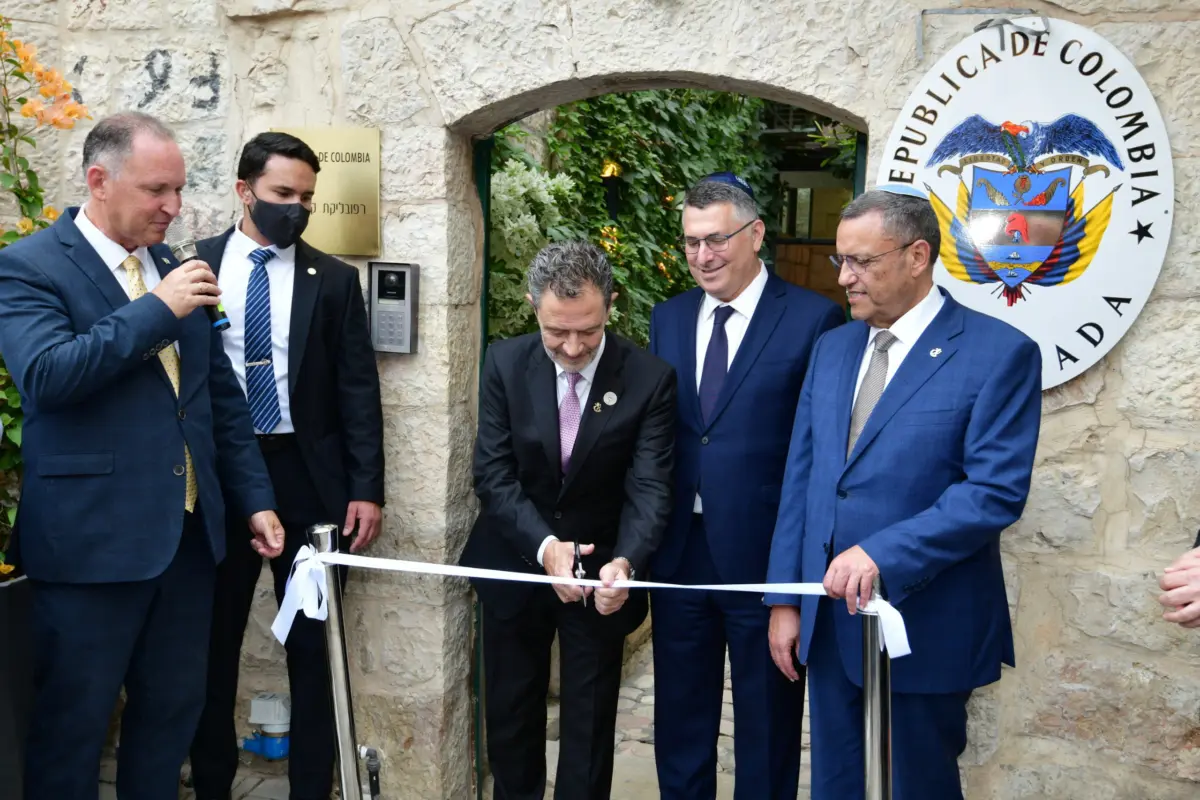
Colombia has officially inaugurated its embassy to Israel in the city of Jerusalem, marking a definitive and controversial pivot in the nation’s foreign policy under the administration of President Abelardo de la Espriella. The move, which took place on Wednesday, distinguishes Colombia as the 10th nation to recognize Jerusalem as the capital of Israel by relocating its primary diplomatic mission from Tel Aviv. This decision represents a stark reversal of the policies enacted by the previous left-wing administration of Gustavo Petro, who had severed all diplomatic ties with the Israeli government in 2024 in protest of the ongoing military operations in the Gaza Strip.
The inauguration ceremony was attended by high-ranking officials from both nations, including Colombian Minister of Foreign Affairs Omar Bula Escobar and Israeli Foreign Minister Gideon Saar. The atmosphere at the event was one of reconciliation and strategic realignment, though it was immediately met with sharp condemnation from Palestinian leaders and several international bodies who view the move as a violation of international law and a setback for the long-stalled peace process in the Middle East.
A Fundamental Shift in Colombian Foreign Policy
The opening of the embassy in Jerusalem is the culmination of a rapid diplomatic overhaul initiated by President Abelardo de la Espriella since his inauguration in August 2026. During his campaign and subsequent swearing-in, De la Espriella vowed to restore what he termed "traditional alliances" and promised a crackdown on domestic armed groups, often linking national security to the need for advanced military and intelligence cooperation with international partners like Israel.
The previous administration under Gustavo Petro had taken a radically different approach. In May 2024, Petro announced the total severance of diplomatic relations with Israel, describing the military campaign in Gaza as "genocidal." Under Petro, Colombia became one of the most vocal critics of Israel in Latin America, joining South Africa’s legal challenge at the International Court of Justice (ICJ). The Petro administration also terminated a long-standing Free Trade Agreement (FTA) with Israel and suspended the purchase of Israeli-made military hardware, which had historically formed the backbone of the Colombian armed forces’ equipment.
However, Minister of Foreign Affairs Omar Bula Escobar stated during Wednesday’s ceremony that the hiatus in relations was a historical error. "Relations between our two countries should never have been broken," Bula Escobar remarked. "Today, Bogota is taking a concrete step towards not just restoring, but elevating our diplomatic standing. Israel is a strategic partner. It always has been, and from now on, it will be an even stronger one."
Restoring Economic and Military Ties
Beyond the symbolic relocation of the embassy, the De la Espriella administration has moved swiftly to repair the economic foundations of the bilateral relationship. A central component of this effort has been the restoration of the Colombia-Israel Free Trade Agreement. The FTA, which originally entered into force in 2020, had significantly boosted Colombian exports of coal, coffee, and flowers, while facilitating the import of Israeli high-tech goods, chemicals, and machinery.
The suspension of the FTA under Petro had caused significant concern within the Colombian business community, particularly among coal exporters who lost a primary market. By reinstating the agreement, the new government aims to stabilize the economy and signal to international investors that Colombia is returning to a more predictable, market-friendly foreign policy.
Furthermore, the restoration of ties is expected to resume military cooperation. Colombia’s military has historically utilized Israeli technology, including Kfir fighter jets, Galil assault rifles, and sophisticated surveillance systems. Military analysts suggest that the renewal of these contracts is a priority for the De la Espriella government as it seeks to modernize its forces to combat internal insurgencies and drug trafficking cartels.
The International Legal Status of Jerusalem
The decision to place an embassy in Jerusalem remains one of the most contentious issues in global diplomacy. The city’s status is a central pillar of the Israeli-Palestinian conflict. Israel claims the entirety of Jerusalem, including the eastern sector it occupied in the 1967 Six-Day War and later annexed, as its "eternal and undivided" capital. This annexation is not recognized by the United Nations or the vast majority of the international community.
Palestinians seek East Jerusalem as the capital of their future independent state. For decades, the international consensus held that the status of the city must be decided through direct negotiations between the two parties. Consequently, most countries maintain their embassies in Tel Aviv to avoid prejudging the outcome of such talks.
The trend of moving embassies to Jerusalem was largely catalyzed by the United States during the first term of President Donald Trump in 2018. Since then, only a small group of nations has followed suit. Colombia now joins a list that includes the United States, Fiji, Guatemala, Honduras, Papua New Guinea, Paraguay, and Nauru. Kosovo and Somaliland have also established missions there, though their international standing as sovereign states remains complex.
Palestinian and International Condemnation
The Palestinian Authority (PA) was swift to denounce Colombia’s move, characterizing it as a flagrant violation of international legitimacy. In a statement released shortly after the ceremony, the PA’s Ministry of Foreign Affairs argued that the relocation undermines "the international consensus on the legal status of the holy city" and emboldens what they described as the "illegal occupation."
Jordan’s Ministry of Foreign Affairs also issued a stern critique, labeling the move a "violation of international law and relevant international resolutions." Jordan, which acts as the custodian of the Al-Aqsa Mosque compound in Jerusalem, has long maintained that any unilateral change to the city’s status is a threat to regional stability.
The move comes at a particularly sensitive time. According to the data provided, the region is grappling with the aftermath of a prolonged conflict in Gaza that has spanned three years. Palestinian health officials report that the death toll has exceeded 74,000 people, with much of the territory’s infrastructure in ruins. Critics of the Colombian government argue that opening the embassy now serves to insulate Israel from the "mounting international pressure" it faces regarding its conduct during the war.
Chronology of the Colombia-Israel Diplomatic Rift and Reconciliation
To understand the gravity of this shift, one must look at the timeline of the past several years:
- August 2020: The Colombia-Israel Free Trade Agreement (FTA) officially enters into force, marking a high point in bilateral relations.
- October 2023: Tensions rise following the outbreak of the war in Gaza. President Gustavo Petro begins a series of public condemnations of Israeli military tactics.
- May 2024: President Petro officially severs diplomatic ties with Israel, citing the humanitarian crisis in Gaza. The embassy in Tel Aviv is closed, and the FTA is suspended.
- Late 2024 – 2025: Colombia joins international legal efforts against Israel, while domestic critics in Bogota warn of the economic and security risks of the rift.
- August 2026: Abelardo de la Espriella is sworn in as President of Colombia. In his inaugural address, he vows to reverse Petro’s foreign policy and "rebuild bridges" with traditional allies.
- September 2026: The Colombian Ministry of Foreign Affairs announces the restoration of the FTA and the intent to not only restore ties with Israel but to move the embassy to Jerusalem.
- October 8, 2026: The Colombian Embassy is officially inaugurated in Jerusalem in the presence of Foreign Ministers from both countries.
Strategic Implications and Regional Impact
The move by Colombia is likely to resonate throughout Latin America, a region that has seen a deep ideological divide regarding the Middle East. While nations like Brazil under Lula da Silva and Chile under Gabriel Boric have maintained a critical stance toward Israel, other nations have trended toward the right, aligning more closely with Israeli and U.S. interests.
For Israel, the addition of a significant regional player like Colombia to the list of countries with embassies in Jerusalem is a major diplomatic victory. It provides a counter-narrative to the "international isolation" often cited by critics. Israeli Foreign Minister Gideon Saar emphasized this during the guest book signing, stating, "This is an important date for the State of Israel. It’s also an important date for the city of Jerusalem."
Colombian Ambassador Tania Gilinski echoed this sentiment, emphasizing that the decision was based on "determination and strength." By positioning itself as a "strategic partner" in the Middle East, the De la Espriella administration is signaling a desire to play a more active role in global geopolitics, moving away from the non-aligned or Global South-centric rhetoric of the Petro era.
However, the domestic implications in Colombia remain to be seen. While the business and military sectors may welcome the return to normalcy and the restoration of trade and security contracts, the move remains polarizing among the Colombian populace. Human rights organizations and left-leaning political factions in Bogota have already begun organizing protests, arguing that the government is prioritizing military and economic gains over international human rights standards and the plight of the Palestinian people.
As the new embassy begins its operations in Jerusalem, the international community will be watching closely to see if this move prompts other nations to reconsider their diplomatic presence in the city, or if it further solidifies the divide between those supporting Israel’s sovereign claims and those advocating for a negotiated two-state solution based on pre-1967 borders. For now, Colombia has firmly placed itself in the former camp, marking a new and uncertain chapter in its diplomatic history.
