

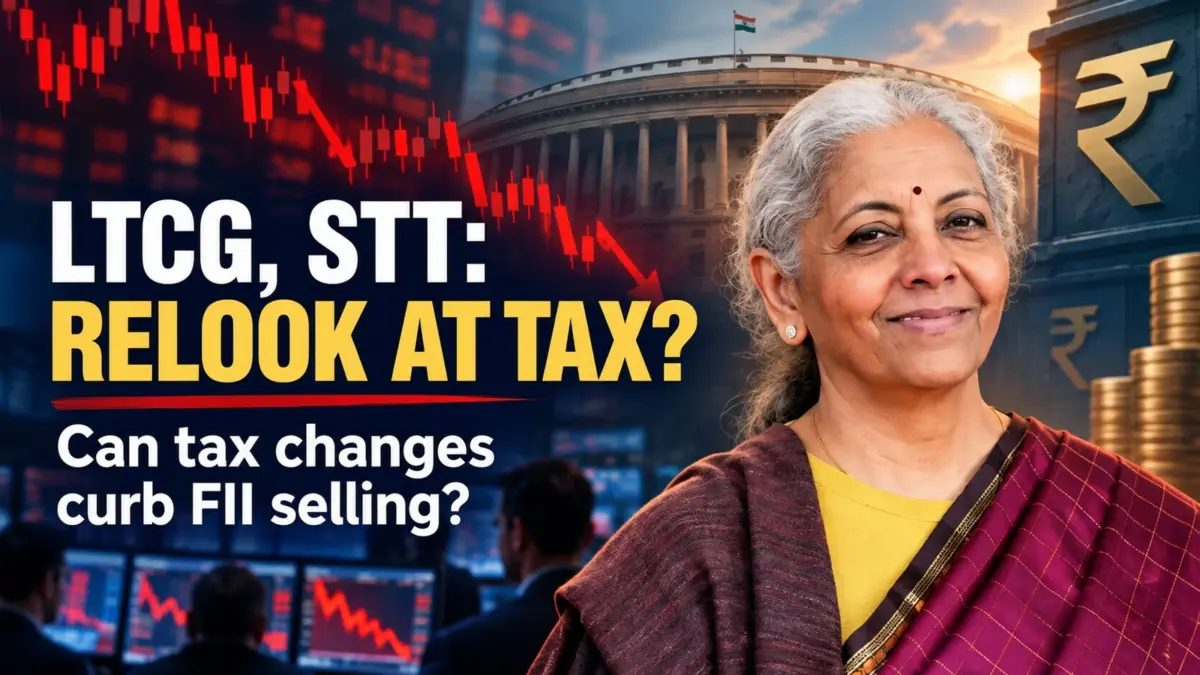
The Indian equity landscape is currently navigating a period of significant volatility, primarily driven by a sustained exodus of Foreign Institutional Investors (FIIs). This capital flight has reignited a critical debate regarding the country’s taxation framework, specifically focusing on Long-Term Capital Gains (LTCG) tax and the Securities Transaction Tax (STT). As the Union Budget 2027 approaches, market participants and economic researchers are closely monitoring signals from the Ministry of Finance. Finance Minister Nirmala Sitharaman recently hinted at a potential receptiveness to these concerns during the Bloomberg New Economy Forum 2026, where she acknowledged the ongoing debate among global and domestic investors regarding the taxation of different asset classes.
The discourse has gained substantial momentum following a provocative report from SBI Research, which suggests that the government must pivot toward structural tax reforms to stabilize the rupee and anchor "hot money" flows. According to the report, titled Ecowrap, traditional monetary and foreign exchange interventions by the Reserve Bank of India (RBI) may no longer suffice to protect the domestic currency against the backdrop of aggressive FII selling. The central recommendation from SBI Research involves a radical restructuring of the equity taxation timeline: extending the definition of "long-term" to a holding period of two to three years while simultaneously abolishing the LTCG tax for equity investments held for that duration.
The Evolution of Equity Taxation in India: A Chronological Perspective
To understand the current friction, it is essential to trace the history of capital gains taxation in India, which has seen several ideological and fiscal shifts over the last two decades. For much of the early 2000s, the Indian market operated under a regime designed to attract aggressive capital inflows.
In 2004, under the UPA-1 government, then-Finance Minister P. Chidambaram made the landmark decision to abolish LTCG tax on equities. To compensate for the loss in revenue, the government introduced the Securities Transaction Tax (STT), a small levy applied to every transaction on the stock exchange. This move was widely credited with fueling a multi-year bull run, as it simplified the tax burden for both Domestic Institutional Investors (DIIs) and FIIs, significantly enhancing the "net alpha" or post-tax returns of Indian portfolios.
This status quo remained largely untouched for fourteen years until the Union Budget 2018. The NDA government, seeking to widen the tax base and address what it perceived as an inequitable tax advantage for equity investors over other asset classes, reintroduced LTCG tax at a rate of 10% for gains exceeding ₹1 lakh, provided the assets were held for more than 12 months. While the market initially reacted with apprehension, the high liquidity environment of the late 2010s allowed the indices to eventually digest the change.
The most recent and controversial adjustments occurred in the July 2024 Union Budget. Finance Minister Sitharaman announced an increase in the LTCG tax rate from 10% to 12.5%. Simultaneously, the Short-Term Capital Gains (STCG) tax was hiked from 15% to 20%. While the exemption limit for LTCG was marginally increased from ₹1 lakh to ₹1.25 lakh, the broader impact was perceived as a significant increase in the cost of doing business in India. Furthermore, the STT on derivatives—specifically futures and options—was hiked, dealing a blow to high-frequency and intraday traders who provide essential liquidity to the market.
SBI Research and the Case for Structural Change
The core argument presented by SBI Research in its Ecowrap report centers on the quality and stability of capital. By proposing an extension of the holding period for LTCG eligibility to two or three years, the research wing of India’s largest bank is advocating for a shift away from speculative "hot money" toward "patient capital."
Under the current one-year threshold, many FIIs treat the Indian market as a high-velocity trading floor. When global macro conditions shift—such as changes in U.S. Federal Reserve rates or geopolitical tensions in the Middle East—this capital exits rapidly, putting immense pressure on the Indian Rupee. SBI Research posits that by removing the tax burden for those willing to commit capital for three years, the government would effectively incentivize long-term institutional commitment. This, in turn, would reduce the frequency of sudden capital outflows and provide the RBI with a more stable environment to manage the currency.
The report emphasizes that while the RBI has been active in the foreign exchange market to prevent a free-fall of the rupee, these are essentially "band-aid" solutions. A structural tax incentive that rewards longevity would act as a natural stabilizer for the exchange rate.
Comparative Disadvantage: India vs. Global Peer Markets
Market analysts point out that FIIs do not view India in a vacuum; they evaluate it against other emerging markets (EMs) like South Korea, Taiwan, and Brazil. Seema Srivastava, Senior Research Analyst at SMC Global Securities, notes that FIIs prioritize three pillars: net post-tax alpha, operational ease, and macroeconomic stability.

The cumulative effect of a 12.5% LTCG tax, a 20% STCG tax, high surcharge slabs for non-corporate funds, and the STT creates a "friction drag." When compared to markets where capital gains taxes are lower or non-existent for foreign entities, India’s "tax friction" makes it harder for fund managers to justify the premium valuation of Indian stocks.
Srivastava suggests that to reverse the current trend of outflows, the government needs to move beyond just adjusting rates. "To bring institutional capital back, India needs policy stability: grandfathering commitments to eliminate retrospective surprises and rationalizing high surcharge slabs," she stated. There is also a growing demand for streamlining the Double Taxation Avoidance Agreement (DTAA) processes and withholding tax clearances, which currently add a layer of bureaucratic complexity to exiting or rebalancing positions.
The Impact on Derivative Markets and Retail Liquidity
While FIIs are the primary focus of the "hot money" debate, the domestic ecosystem has also felt the pinch of recent tax hikes. Avinash Gorakshkar, Founder of Avinash Mentor Research, highlights that the July 2024 hike in STT was a significant blow to the derivative segment. The increase from 15% to 20% in certain categories has tightened the margins for intraday traders.
In the Indian context, retail participation in the derivatives market has surged over the last three years. While the regulator (SEBI) has expressed concerns about retail losses in F&O, the tax hikes were seen as a blunt instrument to curb speculation. However, the unintended consequence has been a reduction in the "backbone" of market liquidity. When liquidity thins out, the impact of FII selling becomes even more pronounced, leading to sharper falls in the benchmark Nifty 50 and Sensex indices.
Macroeconomic Fundamentals vs. Regulatory Friction
Despite the tax concerns, India’s macroeconomic fundamentals remain some of the strongest globally. With a resilient GDP growth rate hovering around 7%, expanding corporate earnings, and a robust domestic liquidity cushion provided by Systematic Investment Plans (SIPs) from retail investors, the structural story for India remains intact.
However, the "India Premium" is under threat. Historically, FIIs were willing to pay a premium for Indian equities because of the high growth trajectory. But as tax costs rise, the "net yield" for a foreign investor decreases. If a fund manager can get similar growth in a lower-tax jurisdiction, the capital will naturally gravitate there.
The current dilemma for Finance Minister Sitharaman is balancing the need for tax revenue with the need for a stable, attractive capital market. The LTCG tax and STT are significant contributors to the national exchequer, especially given the massive increase in trading volumes over the last decade. Abolishing or reducing these taxes would create a revenue gap that the government would need to fill through other means.
Future Implications and the Road to Budget 2027
The Finance Minister’s acknowledgment of the taxation debate suggests that the government is aware that the current tax regime may be reaching a point of diminishing returns. If FII selling continues at its current pace, the resulting depreciation of the rupee could lead to imported inflation, potentially forcing the RBI to keep interest rates high for longer, which would eventually hurt economic growth.
As the government prepares for the next fiscal cycle, several policy options are on the table:
- The SBI Model: Abolishing LTCG for holdings beyond 2-3 years to encourage long-term stability while maintaining high taxes on short-term speculative moves.
- The Pre-2018 Model: Removing LTCG entirely and relying on a slightly higher STT to ensure revenue collection is automated and friction-free.
- The Rationalization Model: Keeping the current structure but reducing the rates (e.g., returning LTCG to 10%) and removing surcharges to remain competitive with other emerging markets.
The consensus among market experts is that the "integrated partner" approach is necessary. By treating foreign capital as a partner in India’s growth story rather than just a source of tax revenue, the government can restore the large-scale institutional inflows that characterized the 2010s.
Ultimately, the decision to relook at LTCG and STT will depend on how much the government values market stability over immediate tax receipts. With the rupee under pressure and global volatility showing no signs of abating, the "opportune time" for a tax relook may have already arrived. Whether the Union Budget 2027 delivers this relief remains the most anticipated question on Dalal Street.
