

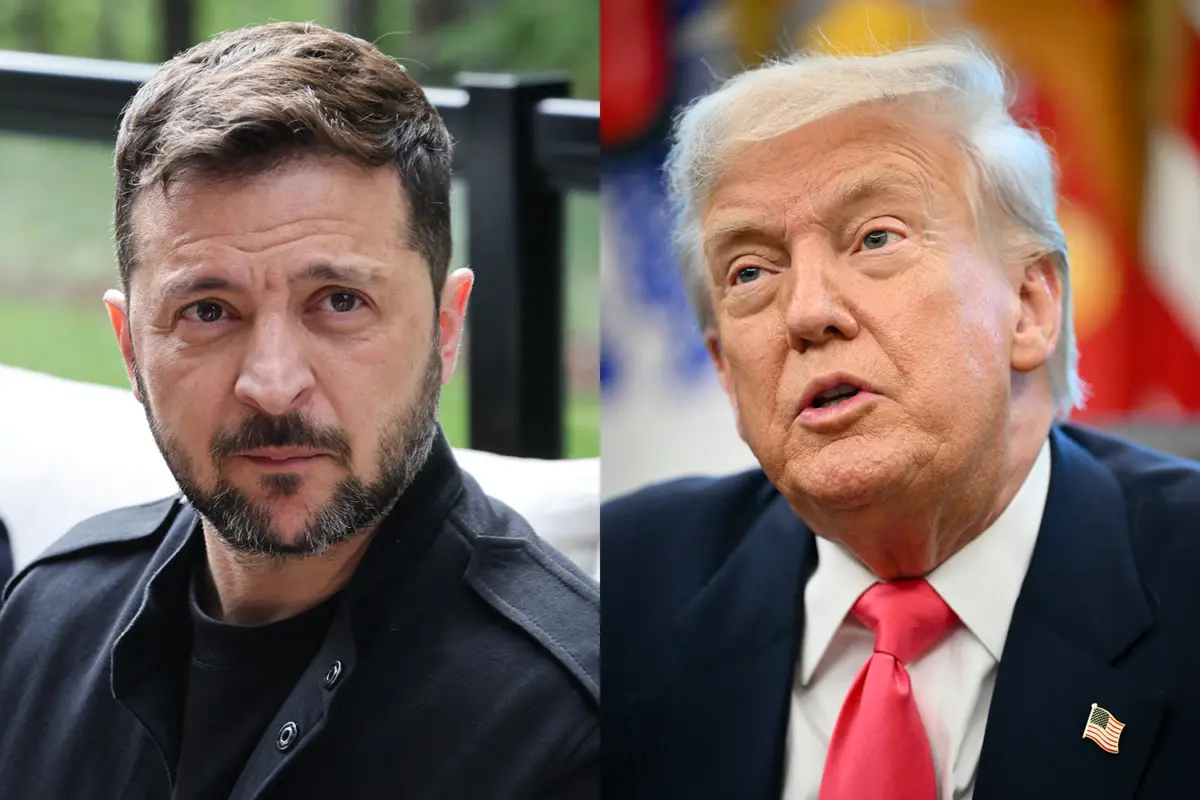
United States President Donald Trump has formally called for the removal of Ukrainian President Volodymyr Zelenskyy, accusing the Kyiv leadership of orchestrating a deliberate disruption of global energy markets. Speaking to reporters at the White House on Saturday, President Trump attributed the recent surge in domestic diesel prices—a critical economic factor ahead of the upcoming November midterm elections—to Ukrainian military strikes on Russian oil refineries. The president’s remarks signal a definitive and historic rupture in the U.S.-Ukraine relationship, marking a transition from strategic partnership to open diplomatic hostility.
The demand for a leadership change in Kyiv follows a series of escalations between Washington and Ukraine. President Trump argued that Zelenskyy’s military strategy has directly harmed American economic interests, specifically targeting the agricultural and logistics sectors. "I think it’s time for Ukraine to get a new president," Trump stated, emphasizing that Zelenskyy’s refusal to halt attacks on Russian energy infrastructure has placed an undue burden on American farmers and ranchers. The president highlighted that Russia remains a primary global supplier of diesel, and any disruption to its refining capacity inevitably translates to higher costs at American pumps.
The Diesel Supply Crisis and the U.S.-Russia Energy Pact
The immediate catalyst for this diplomatic crisis is the volatile state of the global diesel market. Throughout 2026, diesel prices in the United States have seen a steady climb, impacting the transportation of goods and the operational costs of the nation’s agricultural heartland. In response to these pressures, the Trump administration announced a landmark diesel supply deal with Moscow on Friday. This agreement, which involves the direct purchase of Russian fuel to stabilize U.S. reserves, represents a total reversal of the sanctions-heavy policy that defined Washington’s stance since the full-scale invasion of Ukraine in 2022.
The deal has been met with fierce condemnation from Kyiv. President Zelenskyy responded on Sunday, asserting that Ukraine’s strikes on Russian refineries are a necessary defensive measure against Moscow’s ongoing bombardment of Ukrainian civilian energy grids. In a statement published on X (formerly Twitter), Zelenskyy offered a conditional ceasefire on energy infrastructure: "Ukraine will be ready to stop striking Russian oil refineries if Russia stops striking our energy infrastructure." He further noted that while a mutual cessation is possible immediately, Russian President Vladimir Putin has shown no inclination to halt his campaign against the Ukrainian power grid.
Financial analysts note that every billion dollars Russia earns from these newly resumed energy exports contributes to its military budget. Zelenskyy warned that these funds are being channeled into drone upgrades, missile production, and the recruitment of mercenaries, thereby prolonging the conflict.
A History of Friction: The Trump-Zelenskyy Timeline
The current animosity is the culmination of a long and storied history of tension between the two leaders, dating back to Trump’s first term. The relationship was famously strained in 2019 when Trump pressured Zelenskyy to investigate political rival Joe Biden and his son, Hunter Biden, leading to the first impeachment of the U.S. president. Since Trump’s return to office in early 2025, the relationship has deteriorated through a series of high-stakes confrontations.
February 19, 2025: The "Gravy Train" Allegation
Just one month after his second inauguration, President Trump launched a scathing critique of Zelenskyy on Truth Social. He characterized the Ukrainian leader as a "dictator without elections," referring to the suspension of national elections under wartime martial law. Trump accused Kyiv of attempting to prolong the conflict to maintain the "gravy train" of U.S. military and financial support. At an investment summit in Miami, Trump doubled down, stating that Zelenskyy had done a "terrible job" and that Ukraine was "shattered" under his leadership. He claimed that only his administration possessed the leverage to negotiate a peace deal with Putin—a sentiment he alleged Putin himself had acknowledged.
February 28, 2025: The Oval Office Confrontation
A pivotal moment in the bilateral collapse occurred during an Oval Office meeting involving President Trump, Vice President JD Vance, and President Zelenskyy. The discussion, intended to cover security assurances and rare earth mineral agreements, reportedly devolved into a shouting match. Trump and Vance berated Zelenskyy for a perceived lack of gratitude for U.S. aid and for refusing to compromise on territorial claims. Trump issued a stark ultimatum: "You’re either going to make a deal or we’re out." The meeting ended abruptly when Zelenskyy departed the White House following accusations that he had "disrespected" the United States and "overplayed his hand."
April 2025: The Vatican Meeting and the Crimea Dispute
In mid-April, Trump intensified his rhetoric, suggesting that Kyiv was responsible for the initial outbreak of the war by seeking U.S. weaponry. "You don’t start a war against someone 20 times your size and hope people give you some missiles," Trump remarked on April 15. The tension escalated on April 23 when Zelenskyy publicly rejected the idea of ceding Crimea to Russia as part of a peace treaty, declaring the peninsula sovereign Ukrainian land. Trump labeled these comments "very harmful" to negotiations, noting that Russia had annexed Crimea in 2014 "without a shot being fired."
Despite this public vitriol, the two leaders held a brief private meeting at the Vatican on April 26, 2025, during the funeral of Pope Francis. However, the meeting failed to produce any meaningful rapprochement, and the rhetorical attacks resumed shortly thereafter.
October 2026: The Refineries and the Midterm Push
The current focus on oil refineries began in earnest in early October 2026. Trump revealed that he had explicitly instructed Zelenskyy to avoid hitting Russian energy facilities, offering a list of alternative targets. "I said to him, ‘Do what you want. Don’t hit refineries…’ And he went out and he hit," Trump told reporters. This defiance, coupled with the economic pressure of the midterm elections, has led to Trump’s current demand for Zelenskyy’s ouster.
Economic Data and Geopolitical Implications
The shift in U.S. policy carries significant economic and geopolitical weight. Diesel is the lifeblood of the global supply chain; in the United States, it powers nearly all semi-trucks, delivery vehicles, and agricultural machinery. According to Department of Energy data, a $1 increase in diesel prices can add billions in costs to the U.S. food supply chain annually. By securing a deal with Russia, the Trump administration seeks to decouple the U.S. economy from the volatility of the Ukrainian frontline, even at the cost of traditional alliances.
Geopolitically, the call for Zelenskyy’s removal marks a total abandonment of the "as long as it takes" doctrine that characterized the previous administration’s support for Ukraine. The realignment toward Moscow on energy issues suggests a new "Realpolitik" approach where domestic economic stability is prioritized over the territorial integrity of Eastern European allies.
Industry experts suggest that if the U.S. successfully integrates Russian diesel back into its domestic market, the leverage held by Kyiv to influence Western policy through energy disruption will be effectively neutralized. However, this move risks fracturing the NATO alliance, as several European nations remain committed to the total decoupling of their economies from Russian energy.
Broader Impact on the 2026 Midterm Elections
The Republican Party is banking on the "Trump-Putin Diesel Pact" to lower inflation and win over voters in key battleground states where fuel costs are a primary concern. By framing Zelenskyy as an obstacle to American prosperity, the administration is attempting to shift the narrative of the war from a struggle for democracy to a cause of domestic economic hardship.
Critics of the administration argue that calling for the removal of a democratically elected leader of an allied nation undermines the foundational principles of American foreign policy. Conversely, supporters of the president’s "America First" agenda view the move as a necessary step to end a "forever war" that they believe has drained American resources and destabilized global markets.
As the November elections approach, the standoff between Washington and Kyiv is expected to intensify. With Zelenskyy vowing to continue his campaign against Russian infrastructure and Trump demanding a new leadership in Ukraine, the stage is set for a period of unprecedented diplomatic uncertainty. The resolution of this conflict will not only determine the future of Ukraine but will also redefine the role of the United States in the global order for decades to come.
