

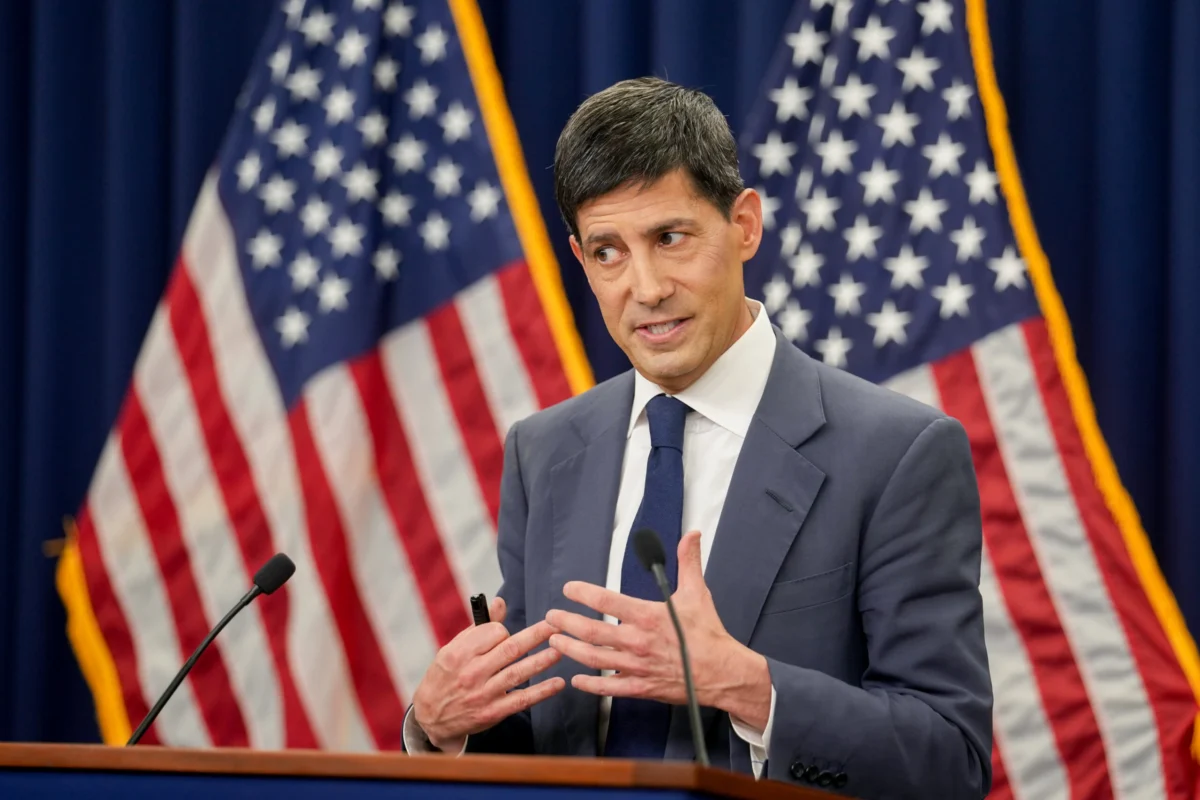
Federal Reserve Chairman Kevin Warsh finds himself at a critical juncture this week, navigating a complex decision-making process with his fellow policymakers regarding the immediate and future trajectory of interest rates. While markets have largely priced in a near-certain quarter-percentage-point hike at Wednesday’s Federal Open Market Committee (FOMC) meeting, the breadth of consensus among the twelve voting members remains a significant point of uncertainty. Chairman Warsh must also craft a clear message about the Fed’s intentions: will this be a singular, one-off increase, or are further hikes on the horizon? His communication strategy will be crucial in guiding market expectations and maintaining credibility.
The anticipation of a rate adjustment is palpable. As of Monday afternoon, futures traders indicated a greater than 92% probability of an increase this week, according to the CME Group’s FedWatch gauge. Furthermore, there’s a more than 75% chance that the FOMC will follow up with another move in December. This heightened expectation stems from a confluence of economic factors, most notably a recent surge in fuel prices and the latest inflation data, which revealed continued price increases in August. These trends emerged shortly after Chairman Warsh’s public remarks at Jackson Hole, Wyoming, where he signaled that the Federal Reserve would be compelled to act unless more definitive evidence emerged of inflation moderating towards the central bank’s 2% target. The current federal funds rate, the benchmark for overnight borrowing, stands in the range of 3.50% to 3.75%.
The Dilemma: Inflationary Pressures vs. Transitory Factors
The Federal Reserve’s decision-making process is complicated by divergent views on the nature and persistence of current inflationary pressures. Historically, the Fed has tended to look past temporary price fluctuations. Many economists contend that a significant portion of this year’s inflation surge can be attributed to external shocks, specifically tariffs and an energy supply disruption linked to geopolitical events in Iran. The long-term impact of these factors on the inflation outlook remains uncertain, leading to a debate about the necessity of immediate monetary tightening.
Goldman Sachs economist David Mericle articulated this perspective in a client note, stating, "We do not see a strong economic case for raising the funds rate. We think that all of the overshoot of 2% can be attributed to one-time factors whose impact is likely to fade." Despite this assessment, Goldman Sachs revised its forecast from a hold to a hike for the current meeting, primarily due to the firm’s belief that prevailing market expectations will exert pressure on the Fed to act.
Internal Divisions Within the FOMC
The internal dynamics of the FOMC are particularly relevant, especially considering the July meeting’s 9-3 vote in favor of maintaining the current interest rate. The three dissenting members—regional presidents Lorie Logan of Dallas, Beth Hammack of Cleveland, and Neel Kashkari of Minneapolis—all supported a quarter-point hike at the Fed’s previous meeting. If their stances remain unchanged, and there’s been no public indication to suggest otherwise, this would imply that four additional members would need to shift their votes from a hold to a hike to achieve a majority for an increase.
A key figure to watch in this deliberation is Governor Christopher Waller. In recent public remarks delivered on September 3rd, Waller expressed support for holding rates steady at the upcoming meeting, though he emphasized the importance of continuous data monitoring to confirm ongoing disinflationary trends. His primary message has been one of patience, cautioning against a premature rush to raise rates. "What’s the cost of waiting one meeting? Hiking 25 basis points, one meeting right now, is not going to bring the [consumer price index] down to 2%," Waller stated.
The August CPI data illustrated this complexity, with headline inflation registering at 3.4%. However, the core inflation rate, which excludes volatile food and energy costs, showed a more moderate increase of 2.4%, a slight decrease from July’s figure. Waller’s sentiment for patience was echoed by New York Fed President John Williams. Less than two weeks prior, Williams conveyed to CNBC that a "wait-and-see" approach appeared prudent. Earlier in the summer, Williams, whose position at the New York Fed traditionally carries significant influence, had indicated his belief that inflation had likely peaked and that interest rates were appropriately positioned.
Governor Michael Barr has also voiced concerns about the potential for temporary inflation to become more entrenched, suggesting he would be open to a rate hike, though not definitively committed to one. This cautious openness reflects a broader sentiment within the committee, where differing interpretations of the economic landscape are at play.
Forecasting the FOMC Vote Breakdown
The question of who will join the three July dissenters in supporting a rate hike is a subject of intense speculation. Chairman Warsh himself is widely expected to favor a hike, given his assertive stance at the Jackson Hole symposium. Governor Lisa Cook, in early August, declared her readiness to "act" to counter inflation. Conversely, Philadelphia Fed President Anna Paulson and Chicago Fed President Austan Goolsbee have generally advocated for a more measured approach.
This leaves Governors Philip Jefferson (who also serves as Vice Chair), former Chair Jerome Powell (who has maintained a relatively low profile since stepping down), and Michelle Bowman as potentially undecided voters. Bowman, in particular, has spoken sparingly on monetary policy throughout the summer, and her most recent relevant remarks in May expressed reservations about unnecessary rate increases.
An additional layer of complexity arises from the potential for Chairman Warsh’s leadership to sway undecided members. If he strongly advocates for a hike, it’s plausible that some members on the fence might coalesce around his position to present a unified front to the public and the administration. This dynamic could significantly influence the final vote margin.
David Kelly, chief global strategist at JPMorgan Asset Management, noted that if the Fed does raise rates, the decision might not appear to have been a close call in retrospect. "If a majority within the committee coalesces around a decision to hike, the other members may well join them to portray a more united front to the public and the President," Kelly observed in his weekly market commentary. Under such circumstances, the final vote could reflect only one or two dissents, or potentially none at all.
The Significance of the "Dot Plot" and Forward Guidance
Beyond the immediate rate decision, market participants will keenly scrutinize the FOMC’s updated "dot plot." This anonymous grid provides a snapshot of each participant’s individual projections for the future path of interest rates. Chairman Warsh notably withheld his own projection in the June update, a move that underscores his general reluctance to provide explicit forward guidance.
Investors will be looking for the degree of consensus regarding the likelihood of two rate hikes this year and the projected outlook for 2027. This update will also offer the first glimpse into expectations for 2029. The Federal Reserve historically favors acting in policy cycles rather than isolated, one-off adjustments, viewing incremental moves as less effective in achieving its objectives.
A scenario where the dot plot indicates a 10-8 split in favor of a single rate hike this year—assuming Warsh’s continued aversion to strong forward guidance—could suggest that some participants remain ambivalent about the necessity of further tightening, or perhaps wish to avoid amplifying market expectations. Mericle of Goldman Sachs suggested this possibility.
However, Mericle also highlighted the risk of a stronger consensus for two hikes if a larger number of participants perceive the current hike as a standard response to rising oil prices, increased demand fueled by artificial intelligence technologies, and the potential beginning of a tightening cycle. The FOMC’s internal debate reflects a nuanced assessment of economic indicators and a strategic approach to monetary policy.
Warsh’s Communication Challenge
In the event of a closely divided committee vote, the focus will inevitably shift to Chairman Warsh’s press conference following the FOMC meeting. His ability to articulate the committee’s rationale and future intentions will be paramount.
Bill Dudley, former president of the New York Fed, emphasized the need for clear communication: "The Fed needs to explain how they’re thinking about the economy." He added, "Now [Warsh has] just got to follow that up with action. If he does that, I think he’s basically fixed the problem that he created in his first two press conferences." The chairman’s performance in this critical communication role will be closely watched for its impact on market stability and public confidence in the Federal Reserve’s stewardship of the economy. The delicate balancing act between addressing inflation concerns and fostering sustainable economic growth will continue to define the Fed’s policy challenges in the months ahead.
