

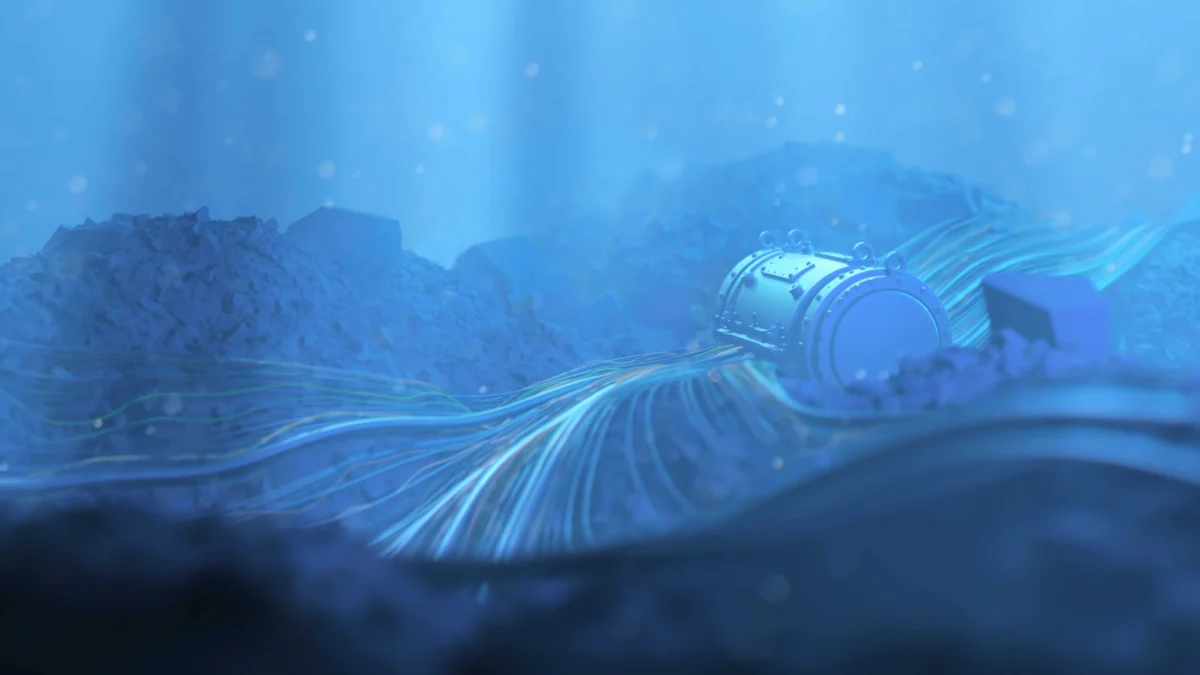
The landscape of modern conflict is undergoing a profound transformation, shifting from the visible theaters of land, air, and space into the dark, pressurized depths of the world’s oceans. As the strategic importance of the seabed becomes undeniable, a massive influx of capital and innovation is flowing into technologies designed to monitor and defend the vast networks of cables and pipelines that serve as the nervous system of the global economy. Governments and private defense corporations are increasingly realizing that the next decade of geopolitical competition will be defined not just by who controls the skies, but by who can secure the ocean floor.
This pivot comes at a time when the concept of "hybrid warfare" has moved from theoretical military doctrine to a daily reality. This form of conflict, which blends conventional military force with cyberattacks, economic sabotage, and disinformation, finds a uniquely vulnerable target in subsea infrastructure. With the rapid evolution of artificial intelligence, autonomous underwater vehicles (AUVs), and advanced sensor arrays, the maritime environment is being reimagined as the "next logical domain" for both defense and potential aggression.
The Catalyst: From Neglect to Urgent Rearmament
For decades following the end of the Cold War, subsea infrastructure was largely treated as a "set it and forget it" asset. While the world became increasingly reliant on fiber-optic cables for internet connectivity and pipelines for energy security, the physical protection of these assets remained a low priority for many Western navies. That complacency ended abruptly in September 2022.
The sabotage of the Nord Stream 1 and 2 gas pipelines in the Baltic Sea served as a seismic wake-up call for the international community. The explosions, which occurred months after Russia’s full-scale invasion of Ukraine, demonstrated that even the most robust industrial infrastructure could be targeted with precision in the "gray zone" of conflict—actions that fall below the threshold of open war but cause massive economic and political disruption.
Since then, a string of other incidents has kept tensions high. Damage to the Balticconnector gas pipeline between Finland and Estonia in late 2023, along with mysterious cable cuts near Taiwan and in the Arctic, has reinforced the narrative that the seabed is no longer a safe haven. Katja Bego, a senior research fellow at Chatham House, notes that the environment has shifted so rapidly that nations are now in a frantic race to catch up on decades of neglected maritime security.
The Economic Arteries: 1.5 Million Kilometers of Vulnerability
To understand the scale of the challenge, one must look at the sheer volume of infrastructure currently resting on the seabed. According to 2026 data from TeleGeography, a telecommunications research firm, there are more than 1.5 million kilometers of submarine communications cables in service globally. These cables carry an estimated 99% of all intercontinental digital traffic, facilitating everything from high-frequency stock trading and banking transactions to military communications and civilian internet usage.
Beyond data, the seabed is a critical corridor for energy. In addition to traditional oil and gas pipelines, the global push toward renewable energy has resulted in a burgeoning network of subsea power cables. These link offshore wind farms to mainland power grids and connect different national electricity markets, allowing countries to share surplus energy. A single well-placed strike on a primary data hub or power interconnector could potentially paralyze a nation’s economy or trigger a regional energy crisis.
The challenge of scale is the primary hurdle. "Our whole economy is built on top of this," Bego emphasized during a recent briefing. "But protecting a network of over a million kilometers is a task that no single navy, or even a coalition like NATO, can realistically achieve through conventional means alone."
The Corporate Shift: Defense Giants Enter the Deep
The realization that traditional naval assets—such as frigates and crewed submarines—are too expensive and scarce to provide 24/7 surveillance of the seabed has opened a lucrative door for the defense industry. Major players are now repositioning themselves to lead what is being called the "unconventional underwater" market.
Italian shipbuilding giant Fincantieri has been among the most aggressive in this space. In July 2024, the company announced plans to acquire majority stakes in four specialized firms for approximately 600 million euros ($689 million). This move was designed to consolidate expertise in underwater drones, marine surveying, and subsea communications. Pierroberto Folgiero, the CEO of Fincantieri, has described a future where surface ships act as "motherships," coordinating vast, automated networks of vehicles that operate across the entire water column.
Similarly, France’s Thales Group has expanded its focus on anti-submarine warfare (ASW) and mine detection, integrating AI into sonar systems to better distinguish between biological sounds and the mechanical signatures of enemy drones. The goal for these companies is to create a seamless "underwater internet of things" (UIoT), where sensors and autonomous craft provide a constant digital picture of the seabed.

The Rise of the AUV: GreyShark and the Future of Patrolling
Small, agile, and increasingly autonomous, AUVs are the underwater equivalent of the aerial drones that have revolutionized the war in Ukraine. German defense-tech firm Euroatlas is at the forefront of this technological surge with its GreyShark vehicle.
The GreyShark is designed to operate without continuous human intervention. It can follow pre-programmed mission parameters, navigate around obstacles, and use AI to identify "anomalies"—such as a foreign mine attached to a cable or an unidentified vessel loitering near a pipeline. Verineia Codrean, Chief Strategy and Partnerships Officer at Euroatlas, argues that the problem of subsea security is fundamentally a mathematical one. Because crewed ships cannot be everywhere at once, the only solution is a fleet of lower-cost, autonomous vehicles that can maintain a persistent presence in strategic corridors.
One of the most significant breakthroughs in this field is the development of long-endurance power sources. Euroatlas is currently working on a hydrogen fuel-cell version of the GreyShark, which aims to provide up to 16 weeks of continuous underwater operation or a range of 8,000 nautical miles. If realized, this would allow AUVs to cross entire oceans on a single charge, providing a level of persistence that was previously impossible.
Machine-on-Machine Conflict: The Next Frontier
As Western allies deploy these systems, their adversaries are doing the same. This has led to the emergence of "anti-AUV" missions—a specialized form of warfare where autonomous machines are tasked with hunting and neutralizing other autonomous machines.
"What we are building, so are our non-allies or our enemies building as well," Codrean noted. This creates a complex identification challenge. In the murky depths of the ocean, sensors must be able to classify whether a detected drone belongs to a NATO ally or a hostile power. This raises the prospect of "machine-on-machine" skirmishes occurring thousands of feet below the surface, often without the immediate knowledge of the public or even the governments involved.
While these drones are currently focused on surveillance and deterrence, the transition to armed AUVs is a subject of intense debate within military circles. For now, the focus remains on "interoperability"—the ability for drones to work in tandem with crewed submarines, providing the "eyes and ears" while humans retain the decision-making power for kinetic actions.
Technical Barriers and the "Panacea" Warning
Despite the "massive boom" in investment, operating underwater remains significantly more difficult than operating in the air or on land. The physics of the ocean are unforgiving. Saltwater is largely opaque to radio waves, meaning that GPS and standard Wi-Fi do not work. Communication must rely on acoustics (sound waves), which are slow and easily distorted by temperature changes and currents.
"This is not technology that’s anywhere near the level of the drones we see in Ukraine," Bego cautioned. "Progress is being made, but the tech hurdles are really quite significant."
Furthermore, there is the issue of legal and operational responsibility. Much of the world’s subsea infrastructure is owned by private telecommunications and energy companies. Historically, these companies handled their own repairs and security. However, in an era of state-sponsored sabotage, the line between private corporate responsibility and national security has blurred. Governments are now pushing for closer cooperation, but questions remain over who will foot the bill for the massive costs associated with deep-sea monitoring.
Implications for Global Security
The shift toward seabed warfare represents a permanent change in the global security architecture. The "Blue Economy" is no longer just a source of wealth; it is a strategic vulnerability. As Russia and China continue to invest heavily in their own "deep-sea research" programs—which many Western analysts view as cover for military mapping and sabotage preparation—the pressure on NATO and its allies to secure the ocean floor will only grow.
The future of maritime defense will likely be characterized by a multi-layered approach: deeper burial of cables to protect against dragging anchors or small explosives, the installation of permanent sensor arrays on the seabed, and the deployment of "wolf packs" of AUVs to patrol high-risk areas like the North Sea, the Mediterranean, and the South China Sea.
Ultimately, while autonomous technology provides a vital tool for deterrence and signaling, it is not a perfect solution. The vastness of the ocean ensures that total security remains an impossibility. Instead, the goal for nations and corporations alike is to make the cost of sabotage so high, and the likelihood of detection so certain, that the seabed ceases to be an attractive target for hybrid warfare. As the "silent frontier" becomes increasingly crowded with sophisticated machines, the race to master the depths has only just begun.
