

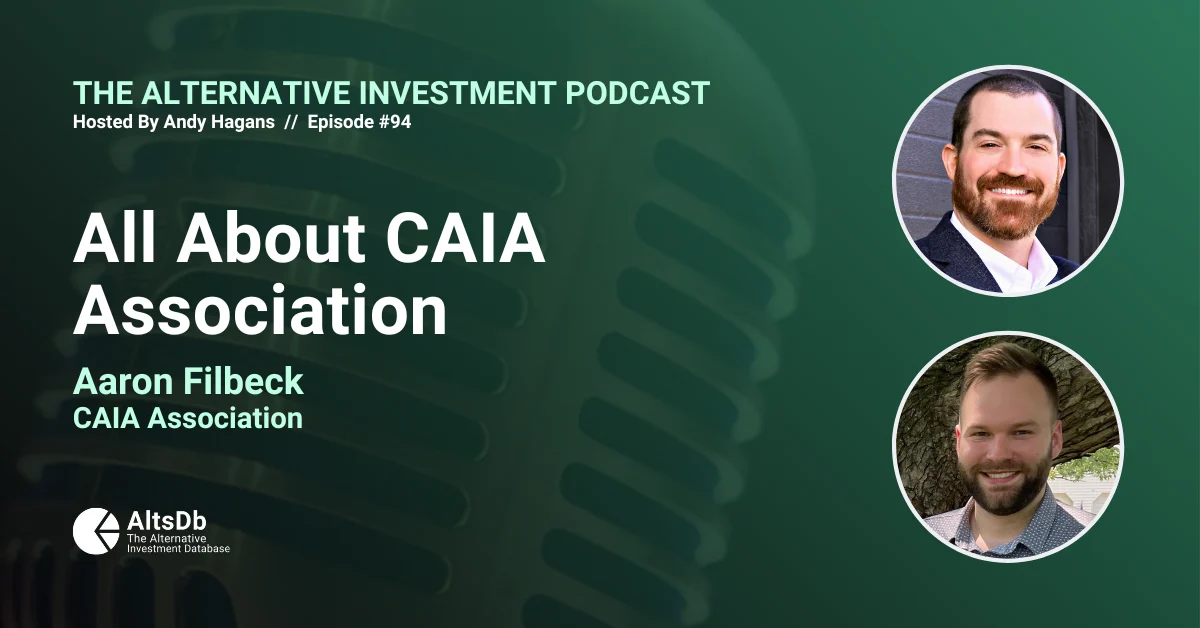
The landscape of financial advisory is undergoing a significant transformation, driven by the increasing integration of alternative investments into client portfolios. While these assets offer the potential for enhanced returns and diversification, a substantial education gap persists within the advisor community, hindering their ability to effectively leverage these complex instruments. Aaron Filbeck, Managing Director and Head of UniFi at CAIA Association, recently addressed this critical challenge in an interview, highlighting the organization’s mission to bridge this knowledge deficit and ultimately improve financial outcomes for clients and society.
The CAIA Association, a global professional body, is dedicated to fostering greater alignment, transparency, and knowledge within the investment industry, with a particular emphasis on alternative investments. With a membership base of approximately 13,000 professionals across 100 countries, CAIA offers a diverse range of educational resources and programs. This global reach underscores the universal nature of the challenges and opportunities presented by alternative investments, transcending geographical and regulatory boundaries.
"We are a global professional body dedicated to creating greater alignment, transparency, and knowledge for all investors," Filbeck explained. "We have a particular focus on the world of alternative investments. We’re a member-based organization, and our members are represented all over the place – LPs, GPs, advisors, regulators, distribution folks. It’s a very diverse population of membership that we’ve had grow over the past 20 years."
The CAIA Association’s commitment to education is multifaceted, encompassing formal certification programs, thought leadership, and advocacy. This comprehensive approach aims to equip professionals with the necessary understanding to navigate the intricacies of alternative assets, ranging from private equity and venture capital to real estate and hedge funds.
The CAIA Charter: A Deep Dive into Institutional Alternatives
At the core of CAIA’s educational offerings is the CAIA Charter program. This rigorous, two-level examination process is designed to provide a deep understanding of institutional-quality alternative investments. Candidates typically dedicate 400 to 500 hours of self-study to master the curriculum, which covers a broad spectrum of alternative strategies and portfolio management principles.
"The CAIA charter program has been around since the inception of CAIA," Filbeck noted. "It’s a two-level high-stakes examination process. Typically, a candidate will spend 200 to 250 hours per level, so 400 to 500 hours of study to successfully pass Levels I and II. The focus of the program is on what we deem ‘institutional quality’ alternative investments that are in the marketplace today."
Level I of the CAIA program introduces candidates to various alternative strategies, including private equity, real assets, hedge fund strategies, and structured credit. It delves into the fundamental risk-return profiles of these investments. Level II, on the other hand, shifts the focus to a top-down, allocator’s perspective, emphasizing portfolio construction, risk management, investment and operational due diligence, and ESG considerations. This dual approach ensures that charterholders possess both a granular understanding of individual strategies and a holistic view of how they integrate into broader investment portfolios.
The CAIA Charter is not solely for institutional investors. Its curriculum is designed to benefit a wide array of financial professionals, including advisors, asset managers, and distribution specialists. The program’s emphasis on thinking like an allocator equips participants with a valuable framework for understanding investment decisions from a strategic, portfolio-wide perspective, regardless of their specific role within the industry.
UniFi by CAIA: Democratizing Alternative Investment Education for Wealth Management
Recognizing the distinct needs of the private wealth management sector, CAIA Association launched UniFi by CAIA. This specialized learning platform is specifically designed to educate asset managers, intermediaries, and individual advisors on alternative investments. Unlike the comprehensive CAIA Charter, UniFi offers a more accessible and online-centric learning experience.
"UniFi by CAIA is a learning platform that was announced by CAIA Association last year, really designed to educate the private wealth management industry on alternatives," Filbeck elaborated. "If you are an asset manager with a distribution team that’s new to this stuff, or at an intermediary or a wirehouse, or an individual RIA or advisor sitting across from the client, UniFi is designed for you."
The platform currently features a flagship certificate program, "Fundamentals of Alternative Investments," a 20-hour course providing a foundational overview of alternative asset classes. CAIA plans to expand UniFi’s offerings with a series of micro-credentials, focusing on specific topics such as private debt and digital assets, each designed for a more targeted learning experience. This modular approach allows professionals to acquire knowledge in areas most relevant to their practice and client needs.
The delivery mechanism of UniFi, primarily through online courses and video content, makes it more accessible to a broader audience, particularly those who may not have extensive finance degrees but are seeking to enhance their understanding of alternative investments. This aligns with CAIA’s overarching mission to meet learners where they are and provide education that is most relevant to their roles.
The Financial Data Professional (FDP) Charter: Bridging Data Science and Finance
In addition to its alternative investment-focused programs, CAIA Association also offers the Financial Data Professional (FDP) Charter. This program addresses the growing intersection of data science and financial services, equipping professionals with the skills to navigate the increasingly data-driven investment landscape.
"The Financial Data Professional program is really the intersection of data science and financial services," Filbeck explained. "As you’ve probably seen, the rise of data science, data analytics, computer programming, and that intersection with finance has become a very popular tool. This program was the genesis of saying, ‘Okay, well, you’ve got this new brand of computer scientists being brought into an asset manager. They need to be able to speak to the investment professionals.’"
The FDP Charter aims to bridge the communication gap between data scientists and financial professionals, enabling them to collaborate effectively. It helps financial professionals better understand data science principles and translate them into actionable insights, while also guiding data scientists to avoid common pitfalls such as overfitting data. This program is particularly relevant as artificial intelligence and machine learning are increasingly being applied across various investment strategies, including long-only, hedge funds, and even private equity real estate.
Addressing the Education Gap: Progress and Future Outlook
The journey to close the alternative investment education gap has been a gradual one. Filbeck reflected on the evolution of the industry, noting that the initial wave of liquid alternatives around 2010 was characterized by a "product-first" approach, often without adequate educational underpinning.
"Compared to what we saw 10 years ago with this move in private capital, which has really accelerated over the past couple of years, I would say that we’ve done a much better job than we did," Filbeck stated. "But I think there’s still a lot of ground to cover in terms of providing education."
He emphasized that the focus is increasingly shifting from simply understanding products to understanding how alternative investments can genuinely improve client outcomes. This client-centric approach, where financial goals and objectives guide investment decisions, is seen as the crucial next step in democratizing access to alternatives responsibly.
"You should start with the client. You should understand how it all fits, then let’s get to the product," Filbeck advised. "I think where we probably got it wrong the first time around was we started with the product and then we tried to retrofit it into the client. What we’re really trying to do is reverse that trend and start with the client objectives, and then move yourself into the actual strategies themselves."
The trend towards greater educational awareness is heartening. Filbeck observes a growing willingness among financial professionals to acknowledge their knowledge gaps and actively seek out learning opportunities. This proactive engagement, coupled with advancements in educational technology, suggests a positive trajectory for improving advisor competency in alternative investments.
"I do see more and more conversations moving towards the client perspective and maybe away from leading with the product," Filbeck commented optimistically. "One of the trends that is just really interesting and heartening to see is that everyone is looking for education. People are much more willing to say, ‘I really need to learn about this. I need to find something.’"
The increasing demand from clients for exposure to alternative investments is also acting as a powerful catalyst for advisor education. As clients become more informed and inquisitive, advisors are compelled to deepen their understanding to meet these evolving needs. This dynamic is fostering a more knowledgeable and responsive financial advisory sector.
For those seeking to enhance their expertise in alternative investments, the CAIA Association offers a robust suite of resources. Their website, caia.org, provides comprehensive information on the CAIA Charter, UniFi by CAIA, and the FDP Charter. The organization is also active on social media platforms, offering further avenues for engagement and learning. As the alternative investment landscape continues to expand and evolve, the commitment to education championed by organizations like CAIA will be paramount in ensuring that financial professionals are well-equipped to serve their clients effectively and contribute to a more robust and informed investment ecosystem.
