

September 18, 2026
By Dalia Marin
For decades, Germany’s stability rested on an implicit bargain: high-value manufacturing would provide good jobs, strong export revenues, and broad-based prosperity, which political institutions would translate into social cohesion. Competition from China shakes that bargain to its foundations.
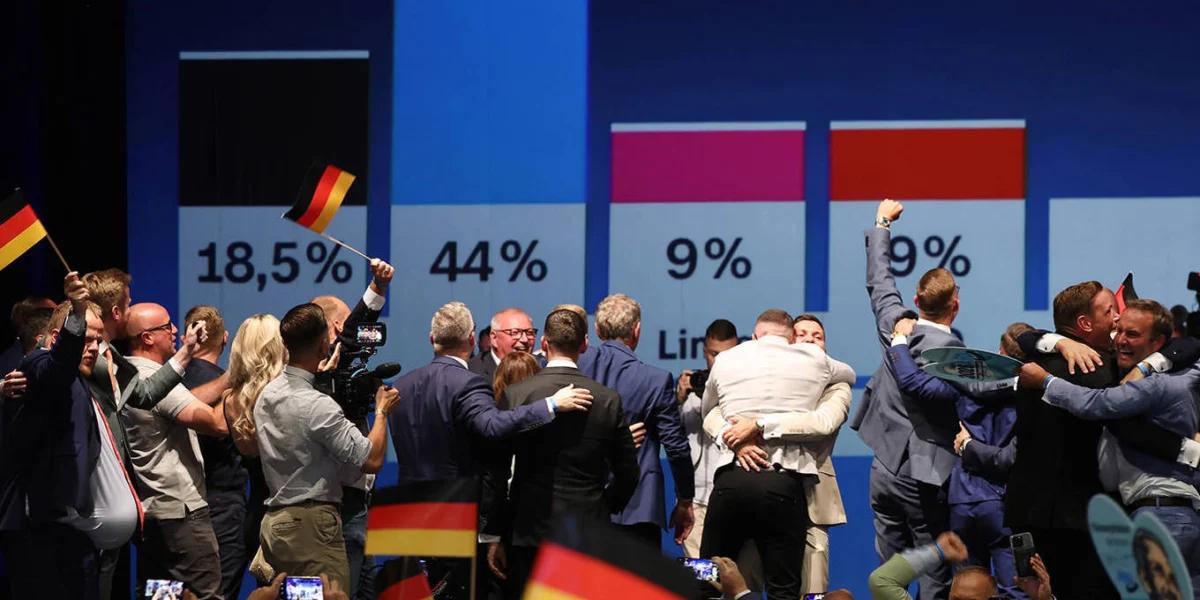
MUNICH – September 6, 2026, could mark a turning point in Germany’s postwar political history. In the Saxony-Anhalt state election, the far-right Alternative für Deutschland (AfD) came within three seats of an absolute majority, securing 43.8% of the vote. This represents a dramatic escalation from their 2021 performance, more than doubling their share and significantly eclipsing the 20.2% garnered in that election. The AfD’s meteoric rise came at the direct expense of the center-right Christian Democratic Union (CDU), the state’s incumbent governing party and the political home of Chancellor Friedrich Merz. The CDU’s vote share plummeted to just 17.2%, a precipitous drop from the 37.1% they commanded in 2021, effectively ceding their long-held dominance in the region.
The results in Saxony-Anhalt have sent shockwaves through the German political landscape, raising profound questions about the future of the federal government and the enduring principles of the German economic and social model. The AfD’s performance is not merely a statistical anomaly; it signals a deep-seated discontent that has been brewing for years, fueled by a complex interplay of economic anxieties, cultural shifts, and political disillusionment. This election outcome is likely to have far-reaching implications, not only for domestic German politics but also for the European Union and Germany’s role on the global stage.
The Saxony-Anhalt Election: A Deep Dive into the Results
The preliminary results from the Saxony-Anhalt state election, announced late on September 6, 2026, painted a stark picture of a deeply divided electorate. The AfD’s surge to 43.8% was the headline story, but the broader context reveals a significant realignment of political forces. The Social Democratic Party (SPD), the junior coalition partner in the federal government, also saw a decline, securing 11.5% of the vote, down from 13.5% in 2021. The Greens, another key component of the federal coalition, fared marginally better than their federal polling might have suggested, achieving 8.2%, a slight increase from their 2021 result of 7.9%. The Free Democratic Party (FDP), the coalition’s liberal wing, suffered a significant blow, falling to 4.9%, just below the 5% threshold required to enter the state parliament. This marginalization of the FDP further complicates the federal government’s ability to forge consensus.
The Saxony-Anhalt election is not an isolated event. It follows a pattern of increasing AfD support in eastern German states, where historical grievances, economic disparities, and perceptions of neglect have contributed to a fertile ground for populist narratives. However, the magnitude of the AfD’s victory in this particular state, a region with a significant industrial base and a history of CDU dominance, suggests a broader erosion of trust in traditional parties across a wider spectrum of the electorate.
Historical Context: The Postwar Bargain and its Erosion
Germany’s post-World War II economic miracle, often referred to as the "Wirtschaftswunder," was built on a foundation of strong manufacturing, export-oriented growth, and a robust social market economy. This model provided a high degree of social mobility and a widely shared sense of prosperity. The political institutions, primarily led by the CDU and later inclusive of other major parties, were instrumental in translating this economic success into social cohesion through comprehensive welfare programs, strong labor protections, and a commitment to multilateralism.
For decades, this implicit bargain held firm. A well-educated workforce, coupled with high-quality German engineering and a stable political environment, allowed the country to thrive in global markets. However, the rise of China as a manufacturing powerhouse, with its lower labor costs and rapidly advancing technological capabilities, began to exert pressure on this model in the early 21st century. This competitive pressure has intensified in recent years, impacting key German industries such as automotive, machinery, and chemicals.
The perceived inability of traditional political parties to adequately address these evolving economic realities, coupled with concerns over immigration, energy policy, and the pace of social change, has created a vacuum that parties like the AfD have adeptly exploited. Their platform often centers on nationalist rhetoric, protectionist economic policies, and a rejection of what they portray as out-of-touch liberal elites.
Chronology of Rising AfD Influence
The AfD was founded in 2013 as a Eurosceptic party, initially gaining traction by opposing the Eurozone bailouts. Its trajectory shifted significantly in 2015 with the refugee crisis, when the party began to incorporate anti-immigration sentiment into its core platform.
- 2013: Founded as an anti-Euro party.
- 2015: Significant shift towards anti-immigration rhetoric following the European migrant crisis.
- 2017: First entry into the German Bundestag, becoming the largest opposition party.
- 2019: Strong performance in European Parliament elections and several state elections.
- 2021: Achieved representation in all 16 German state parliaments and the federal Bundestag, though with a reduced national vote share compared to earlier highs.
- 2022-2024: Continued gains in regional and local elections, often fueled by dissatisfaction with the federal government’s handling of the COVID-19 pandemic, the war in Ukraine, and subsequent energy price shocks.
- September 6, 2026: Near-majority in Saxony-Anhalt state election, a significant leap in support.
This timeline illustrates a steady, albeit at times volatile, ascent of the AfD, culminating in the dramatic outcome in Saxony-Anhalt.
Supporting Data: Economic Headwinds and Social Discontent
Recent economic indicators provide context for the electorate’s mood. Germany’s export-driven economy has faced significant headwinds. According to the German Federal Statistical Office (Destatis), industrial production has seen a contraction in key sectors over the past year, with a notable slowdown in demand from traditional export markets. The automotive sector, a cornerstone of the German economy, has been particularly affected by increased global competition and the costly transition to electric vehicles.
Furthermore, inflation, while showing signs of easing, has eroded purchasing power for many households. Energy costs, exacerbated by geopolitical tensions and the accelerated phasing out of fossil fuels, remain a persistent concern, disproportionately impacting lower and middle-income families, many of whom reside in eastern Germany.
Surveys have also indicated a growing sense of insecurity among segments of the population. Concerns about the pace of social change, the integration of migrants, and the perceived erosion of traditional values have been amplified by populist messaging. A recent poll conducted by the German Institute for Economic Research (DIW Berlin) highlighted that approximately 35% of respondents in eastern Germany feel that their concerns are not adequately addressed by mainstream political parties.
Reactions and Official Responses
The immediate aftermath of the Saxony-Anhalt election was characterized by a mix of shock, concern, and calls for a strategic re-evaluation from across the political spectrum.
Chancellor Friedrich Merz (CDU), speaking from Berlin on September 7, acknowledged the "disappointing and serious" results for his party. He stated, "We must understand the reasons for this significant loss of trust. The CDU needs to reconnect with voters who feel left behind and unheard. This is a wake-up call for all of us." Merz stressed the importance of addressing the concerns of citizens regarding economic security and national identity.
Olaf Scholz (SPD), the Federal Chancellor, expressed his regret over the outcome, calling it a "clear signal that many people are dissatisfied." He emphasized the federal government’s commitment to working on behalf of all Germans and to addressing the challenges facing the country. "We will not shy away from difficult conversations, but we will not compromise on our democratic values," Scholz stated in a press conference on September 7.
Alice Weidel and Tino Chrupalla, co-leaders of the AfD, celebrated their party’s historic achievement. Weidel declared, "This is a clear mandate for change. The people of Saxony-Anhalt have spoken decisively against the failed policies of the current government. We are ready to lead and to put Germany first." Chrupalla highlighted the party’s focus on "security, economic prosperity, and controlled borders."
European Commission President Ursula von der Leyen issued a statement on September 8, expressing concern over the rise of far-right parties across Europe. While not singling out Germany, she remarked, "The strength of democratic institutions and the commitment to European values are paramount. We must continue to work together to address the legitimate concerns of our citizens through dialogue and constructive solutions, not through divisive rhetoric."
Broader Impact and Implications
The surge of the AfD in Saxony-Anhalt has immediate and profound implications for German domestic politics and its broader standing.
Federal Government Stability: The federal coalition, already facing internal challenges, will likely find it more difficult to maintain unity and implement its agenda. The diminished standing of the CDU at the state level could embolden internal dissent within the party and put further pressure on Chancellor Merz to demonstrate a more robust response to the AfD’s appeal. The potential for the AfD to become a dominant force in future federal elections looms large.
The Future of German Federalism: State elections in Germany often serve as bellwethers for national sentiment. The AfD’s near-majority in a significant industrial state could embolden them to target other eastern states and potentially challenge the CDU’s dominance in the West as well. This could lead to a more fragmented political landscape and greater difficulty in forming stable governing majorities at both the state and federal levels.
Economic Policy Debates: The AfD’s success will undoubtedly intensify debates around economic policy. Their calls for greater protectionism, skepticism towards renewable energy transitions, and a focus on perceived national economic interests are likely to gain more traction. This could lead to a divergence from established European economic policies and potentially impact Germany’s role as a champion of free trade and multilateral economic cooperation.
International Relations and the EU: A stronger AfD presence in German politics could strain Germany’s relationships with key European partners. The party’s Eurosceptic leanings and nationalist rhetoric have often been at odds with the integrationist goals of the European Union. This could lead to a more inward-looking Germany, potentially weakening the EU’s collective response to global challenges. Furthermore, the implications for Germany’s commitment to international climate agreements and its role in global supply chains will be closely watched.
Social Cohesion: The implicit bargain that underpinned German postwar stability – economic prosperity translated into social cohesion – is under severe strain. The AfD’s narrative often appeals to a sense of grievance and disenfranchisement, potentially exacerbating social divisions rather than bridging them. The challenge for mainstream parties will be to address the root causes of this discontent without adopting the divisive rhetoric that has propelled the AfD’s rise.
The election in Saxony-Anhalt serves as a stark reminder that the foundations of Germany’s enduring stability are not immutable. The country now faces a critical juncture, where a re-evaluation of its economic strategies, its social contract, and its political discourse will be essential to navigate the challenges ahead and preserve the democratic values that have guided its postwar reconstruction. The coming months will reveal whether Germany can successfully adapt to these seismic shifts or whether the fracturing of its postwar bargain will lead to a prolonged period of political and social uncertainty.
