

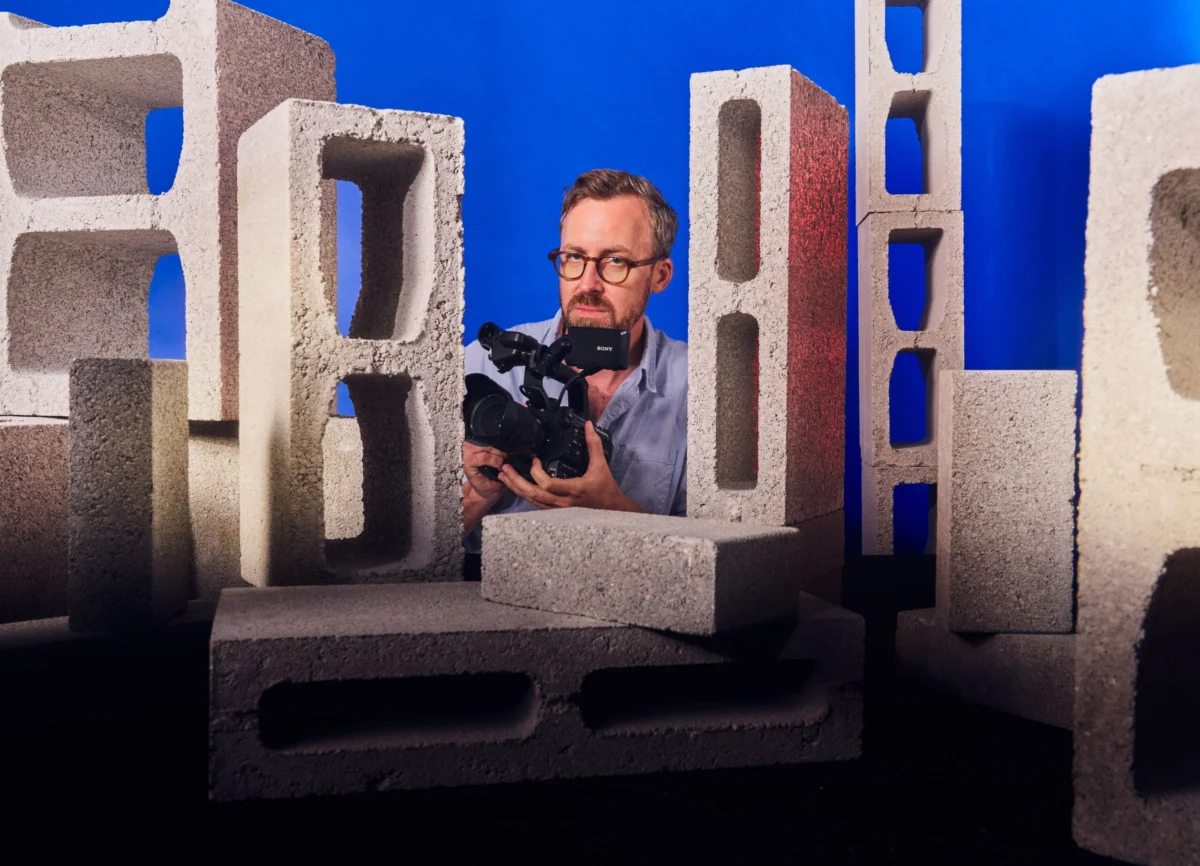
Seated on the 35th floor of One World Trade Center, the tallest skyscraper in the Western Hemisphere, filmmaker John Wilson contemplates the material that defines the verticality of New York City. The tower itself is a monument to the industrial utility of concrete, utilizing a massive central core, specialized floor slabs, and a foundation designed to withstand extreme tectonic and atmospheric pressures. Within this single structure, there is enough concrete to pave more than 4,000 city blocks, a statistic that underscores the sheer scale of human reliance on a substance that is the second-most-consumed material on Earth, trailing only water.
Wilson, widely recognized for his Emmy-nominated HBO series How to With John Wilson, has transitioned his focus from the episodic eccentricities of urban life to a feature-length investigation titled The History of Concrete. Scheduled for theatrical release on September 18, the film marks a significant milestone in Wilson’s career. It will debut at various venues, including Low Cinema, a 40-seat independent theater in Ridgewood, Queens, which Wilson recently restored in partnership with local collaborators. While the film’s title suggests a traditional documentary, the work functions as a multifaceted exploration of the built environment, the fragility of modern infrastructure, and the philosophical implications of living in a "50-year city."

The Material Foundation of Modernity
Concrete is the silent protagonist of the modern era. Globally, the industry produces over 4 billion tons of cement annually, which in turn creates approximately 30 billion tons of concrete. This material provides the literal foundation for global urbanization, yet its ubiquity often renders it invisible to the public eye. Wilson’s film seeks to strip away this invisibility by examining the substance on a molecular and historical level.
The narrative of The History of Concrete begins at Wilson’s own residence in Ridgewood. Faced with a cracked foundation and the resulting groundwater intrusion, Wilson eschewed professional contractors to study the material himself. This personal crisis serves as a microcosm for a broader systemic issue: the rapid deterioration of modern infrastructure. Wilson’s investigation takes him to Italy, where Roman concrete structures, such as the Pantheon, have remained standing for nearly two millennia. The contrast is stark. Roman concrete, which utilized volcanic ash and lime, possessed self-healing properties that allowed it to endure. In contrast, modern reinforced concrete—dependent on steel rebar that eventually rusts and expands, causing "concrete cancer"—is often designed with a lifespan of only several decades.
A Chronology of Urban Observation
John Wilson’s career has been defined by a unique "auteur" style of filmmaking that blends street photography, investigative journalism, and personal essay. This methodology has evolved over fifteen years, culminating in his current feature work.

- 2008–2010: Wilson begins documenting the minutiae of New York City, influenced by urban theorists and the "cinema verité" movement.
- 2020–2023: How to With John Wilson premieres on HBO, garnering critical acclaim for its ability to find profound meaning in mundane topics like scaffolding, split checks, and trash disposal.
- 2024: Wilson focuses on the rehabilitation of Low Cinema and the completion of The History of Concrete, moving from short-form episodic content to a 100-minute cinematic meditation.
- September 18, 2026: The official theatrical release of The History of Concrete, coinciding with a period of heightened public discourse regarding New York City’s infrastructure failures.
Wilson’s approach is rooted in the concept of the dérive—a term coined by Marxist theorist Guy Debord to describe an unplanned journey through a landscape where participants let themselves be drawn by the attractions of the terrain and the encounters they find there. By lingering on scenes that others ignore, Wilson acts as a "Virgil" for the audience, guiding them through the physical and emotional layers of the city.
Infrastructure in Crisis: The Case of the BQE and Beyond
A central focus of Wilson’s film is the catastrophic state of New York’s public works. He highlights the Brooklyn-Queens Expressway (BQE), specifically the triple-cantilever section that skirts Brooklyn Heights. This vital artery carries approximately 130,000 vehicles daily, yet it is visibly crumbling.
In the film, Wilson interviews Sam Schwartz, the former New York City Traffic Commissioner known as "Gridlock Sam." Schwartz points to exposed, rusted rebar as evidence of an impending structural failure. While the city recently announced a $4-billion, 10-year rehabilitation plan for the BQE, the project only promises to extend the road’s lifespan by another 40 years—a timeframe Wilson views as symptomatic of a short-term "disposable" approach to city planning.

The film further documents a series of recent architectural fiascos that suggest a systemic rot:
- 432 Park Avenue: A "supertall" luxury residential tower on Billionaire’s Row. Despite units selling for upwards of $80 million, the building has faced lawsuits over structural "creaking," flooding, and a facade that has shed chunks of material.
- Pfizer World Headquarters: The partial collapse of this site during an office-to-residential conversion project in the summer of 2026 served as a grim reminder of the risks inherent in repurposing aging industrial structures.
- Public Infrastructure: Wilson captures the decay of public pools and the "gum-spackled" state of New York’s 12,000 miles of sidewalks, arguing that the quality of the built environment is a direct reflection of civic health.
The Sociology of the "Not In My Backyard" Movement
Beyond the chemical composition of concrete, Wilson explores the social forces that dictate where and how it is poured. He describes The History of Concrete as "one of the most NIMBY movies" ever made, referring to the "Not In My Backyard" phenomenon. The film provides a front-row seat to the fractious world of civic hearings, where residents clash over proposed developments.
Wilson documents protests against affordable housing projects and the construction of a community skate park. The irony presented is that while most citizens agree on the necessity of these projects in the abstract, few are willing to accept the noise, dust, and demographic shifts that come with new construction. This gridlock, Wilson suggests, is as much a barrier to a "thousand-year city" as the limitations of modern cement. The film portrays a society caught between the desire for progress and an almost pathological attachment to the status quo, even when that status quo is literally falling apart.

Intellectual Foundations and Theoretical Influences
Wilson’s work is not merely a collection of "depressing trivia," as he self-effacingly puts it. It is an argument built on a decade of reading urban theory. He cites several formative texts that have shaped his worldview:
- Jane Jacobs’ The Death and Life of Great American Cities (1961): Wilson credits Jacobs with "lighting a fire" under him in 2008. Jacobs’ advocacy for mixed-use neighborhoods and her opposition to "slum clearance" projects inform Wilson’s skepticism of top-down urban renewal.
- William H. Whyte’s The Social Life of Small Urban Spaces (1980): Whyte’s observational study of how people use plazas and parks is mirrored in Wilson’s camera work, which often watches human-environment interactions with the patience of a naturalist.
- James Howard Kunstler’s The Geography of Nowhere: This text’s critique of suburban sprawl and the "tragic" nature of the American man-made landscape provides the cynical backbone to Wilson’s exploration of why modern spaces often feel soul-crushing.
By synthesizing these theories with his own "Mr. Bean-esque" persona, Wilson delivers a "pill in the peanut butter"—a serious critique of capitalist architecture wrapped in the guise of a wandering, humorous documentary.
Broader Impact and Implications for the Future
The release of The History of Concrete comes at a time when the global construction industry is under intense scrutiny. Concrete production is responsible for approximately 8% of global CO2 emissions. As cities face the dual threats of climate change and aging infrastructure, the "50-year" model of building is becoming increasingly untenable.

Wilson’s film poses a difficult question: Can we afford to continue building in a way that necessitates constant repair and replacement? Through interviews with engineers, activists, and even celebrities like Michael Imperioli—who advises making art as inexpensively as possible—Wilson draws a parallel between the "cheap" production of art and the "cheap" production of the places we inhabit.
The implications of Wilson’s analysis are clear. If the foundations of the city are built on a material designed to fail, the social and economic structures built atop them are equally precarious. The History of Concrete is ultimately a plea for a more deliberate approach to the urban environment. It encourages viewers to look past the grey surfaces of the city and recognize the molecular, political, and economic forces that hold the world together—or allow it to crumble. As Wilson concludes his journey from the heights of One World Trade Center back to the cracked patio of his home in Queens, the film leaves the audience with a stark realization: the permanence we assume in our cities is an illusion, maintained only by a constant, desperate cycle of pouring more concrete.
