

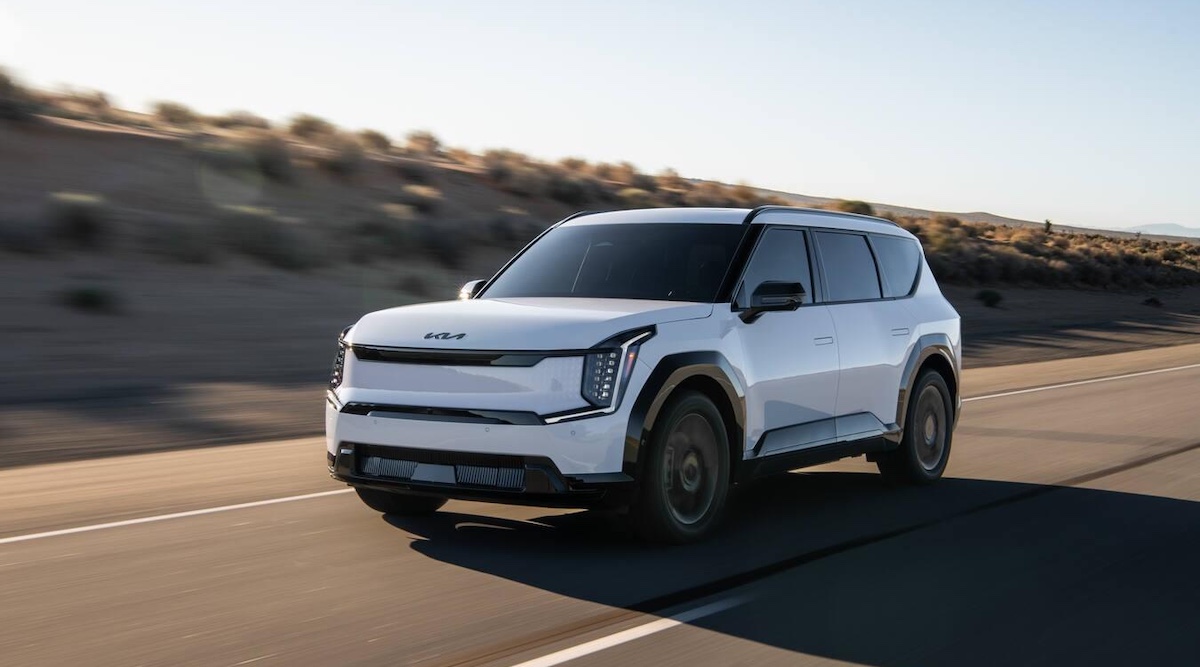
The automotive market is witnessing a significant shift in the pricing landscape for large-scale electric vehicles as dealerships across the United States implement aggressive discounting strategies for the Kia EV9. Traditionally positioned as a premium three-row electric SUV with a starting manufacturer’s suggested retail price (MSRP) of approximately $54,900, the EV9 has recently seen price reductions exceeding $16,000 at several high-volume locations. These price adjustments have effectively brought the cost of a full-sized, seven-passenger electric vehicle into direct competition with smaller, mass-market EVs such as the Tesla Model 3 and the Kia Niro EV, signaling a potential turning point in the accessibility of family-oriented sustainable transportation.
Unprecedented Dealership Incentives and Pricing Analysis
The trend toward aggressive discounting was highlighted by recent reports from retail centers in the southern and midwestern United States. In Texas, a prominent dealership made headlines by offering a $16,041 discount on the Kia EV9 Light RWD. This specific trim, which carries a standard MSRP of $54,900, was listed at a final price of $41,414. This reduction represents nearly 30% of the vehicle’s total value, a rare occurrence for a flagship model that has only been on the market for a limited duration.
A similar pattern has emerged in Illinois, where Liberty Auto Plaza reported substantial price cuts on multiple EV9 configurations. The EV9 Light Short Range model at this location received a $15,000 discount, lowering its price from $57,480 to $42,480. Furthermore, the more capable Light Long Range model, which offers a larger battery capacity and extended range, saw its price slashed from $59,785 to $44,785. These figures are particularly notable because they bridge the "price parity" gap between electric vehicles and their internal combustion engine (ICE) counterparts, such as the Kia Telluride or the Honda Pilot, even before considering potential state-level incentives or long-term fuel savings.
Technical Specifications and Value Proposition
The Kia EV9 is built upon the Hyundai Motor Group’s dedicated Electric-Global Modular Platform (E-GMP). This architecture allows for a flat floor and an expansive wheelbase, which is the primary reason the vehicle can comfortably accommodate up to seven adults—a feat few other electric vehicles in this price bracket can achieve.
The base "Light" trim, which is the focus of these major discounts, features a 76.1 kWh battery pack providing an EPA-estimated range of 230 miles. While this range is lower than some long-range competitors, industry analysts note that it is sufficient for the daily commuting and suburban driving patterns of the vast majority of American households. For consumers requiring more utility, the Light Long Range variant utilizes a 99.8 kWh battery, extending the range to 304 miles between charges.
One of the EV9’s most significant technical advantages is its 800-volt ultra-fast charging capability. Unlike many competitors that utilize 400-volt systems, the EV9 can theoretically charge from 10% to 80% in approximately 24 minutes when connected to a 350 kW DC fast charger. This high-speed charging infrastructure compatibility makes the vehicle a more viable option for long-distance family travel, mitigating some of the concerns associated with its large size and energy consumption.
The Competitive Landscape and Market Context
The decision by dealerships to move inventory through heavy discounting comes at a time of intensifying competition in the EV sector. For years, the three-row SUV segment of the electric market was dominated by high-luxury offerings like the Tesla Model X and the Rivian R1S, both of which often carry price tags exceeding $75,000 to $100,000. By pricing the EV9 in the low-$40,000 range, Kia is effectively creating a new sub-segment of "affordable" large EVs.
Market data suggests that while the EV9 has received critical acclaim—winning numerous "Car of the Year" awards globally—high interest rates and a general cooling of the early-adopter EV market have forced retailers to reconsider their margins. By lowering the entry price to the $41,000–$45,000 range, the EV9 becomes a direct competitor to the Tesla Model Y. While the Model Y is the best-selling EV in the world, it is a compact crossover with a significantly tighter third row compared to the true SUV proportions of the EV9.
Chronology of the EV9’s Market Entry and Performance
The Kia EV9 officially launched in the United States in late 2023, with the 2024 and 2025 model years establishing the vehicle as a premium alternative to traditional gasoline SUVs.
- Q4 2023: Initial launch with high demand and some "market adjustment" markups at dealerships.
- Q1-Q2 2024: Production ramps up at Kia’s Gwangmyeong plant in South Korea; Kia announces plans for North American assembly in West Point, Georgia, to qualify for federal tax credits.
- August 2025: Sales data indicates a steady climb as consumer awareness grows regarding the benefits of the E-GMP platform.
- September 2026: Year-to-date sales figures show a 12% increase in EV9 volume compared to the same period in 2025. This growth is largely attributed to the aggressive dealer incentives that began appearing in late summer.
The 12% sales growth is a significant metric for Kia. It suggests that the demand for the vehicle remains high, provided the price point aligns with consumer budgets. The shift from "prestige pricing" to "volume pricing" indicates that Kia and its dealer network are prioritizing market share and inventory turnover over per-unit profit margins in the short term.
Economic Implications and Total Cost of Ownership
For the average consumer, a $16,000 discount changes the total cost of ownership (TCO) equation dramatically. When comparing a discounted EV9 at $41,414 to a similarly equipped gasoline SUV, the electric model often emerges as the more economical choice over a five-year period.

- Fuel Savings: At an average electricity cost of $0.16 per kWh, the EV9 costs significantly less to "refuel" than a gasoline SUV averaging 20-22 miles per gallon, especially in states with high fuel prices.
- Maintenance: With fewer moving parts, no oil changes, and reduced brake wear due to regenerative braking, the EV9’s scheduled maintenance costs are projected to be 30-40% lower than ICE competitors.
- Resale Value: While EV depreciation has been a concern in recent years, the initial $16,000 discount provides a significant "buffer," protecting the second-hand owner from the steep initial depreciation typically seen in new vehicles.
Industry Reactions and Future Outlook
Industry observers suggest that Kia’s aggressive pricing strategy may force other manufacturers to follow suit. General Motors, with its Chevrolet Blazer EV and upcoming Equinox and Silverado EVs, as well as Ford with its F-150 Lightning and Mustang Mach-E, are all vying for the same "value-conscious" EV buyer.
"What we are seeing with the EV9 is a classic supply-and-demand correction," says an industry analyst specializing in automotive retail. "Kia built a world-class product, but the initial MSRP was a barrier for the average American family. By adjusting the price through dealer incentives, they are tapping into a massive well of demand from buyers who wanted an EV9 but were previously priced out."
Furthermore, the transition of EV9 production to Kia’s Georgia facility is expected to stabilize pricing further. Localized production allows the vehicle to qualify for the $7,500 federal EV tax credit under the Inflation Reduction Act (IRA), which can be applied at the point of sale. When combined with dealer discounts, it is theoretically possible for future buyers to secure an EV9 for a net price in the mid-$30,000 range—a figure that would have been unthinkable for a flagship electric SUV just two years ago.
Conclusion
The current "fire sale" on the Kia EV9 represents a pivotal moment for the electric vehicle industry in North America. By slashing prices by as much as $16,000, dealerships are demonstrating that there is a robust market for large electric SUVs when they are priced competitively with traditional gasoline vehicles. As sales continue to rise and production moves to domestic soil, the EV9 may well become the benchmark for how manufacturers can successfully transition the "family hauler" segment from internal combustion to electric power. For consumers, the message is clear: the era of the $40,000 three-row electric SUV has arrived, potentially accelerating the adoption of clean energy vehicles across the United States.
