

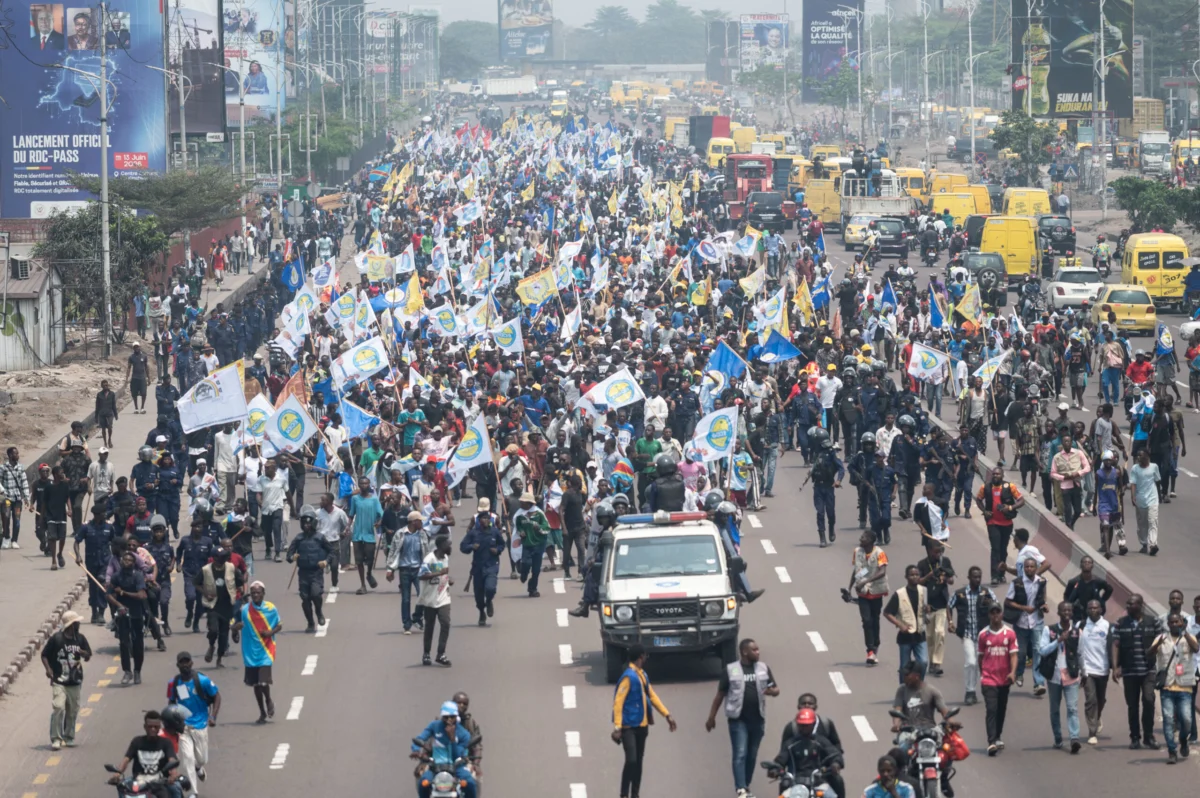
Kinshasa, DRC – The Democratic Republic of the Congo (DRC) was gripped by widespread unrest on Tuesday, September 15, 2026, as hundreds of citizens took to the streets in defiance of a proposed constitutional amendment that critics fear could pave the way for President Felix Tshisekedi to secure a controversial third term in office. The protests, which erupted in the capital Kinshasa and spread to key urban centers like Lubumbashi and Uvira, were met with a robust and often violent police response, characterized by the firing of tear gas and multiple arrests, underscoring the escalating political tensions in a nation already grappling with a devastating Ebola epidemic and persistent armed conflict in its eastern provinces.
In Kinshasa, security forces were heavily deployed, forming cordons and clashing with demonstrators who had gathered to voice their opposition to what they perceive as an assault on the country’s fragile democratic institutions. Witnesses reported scenes of chaos as tear gas canisters were lobbed into crowds, scattering protesters and leading to a tense standoff. At least 10 individuals were reportedly arrested during these confrontations, a figure that opposition leaders claim is an understatement. Similar scenes unfolded in Lubumbashi, the country’s vital mining hub in the southeast, and Uvira, located near the Burundi border, despite government-imposed restrictions on public gatherings.
The nationwide day of action was orchestrated by the "C64" coalition, a broad alliance of opposition parties and civil society groups united by their determination to prevent any constitutional changes that would allow President Tshisekedi to extend his tenure beyond the current two-term limit. Mohamed Eyenga, a prominent figure from the Envol opposition party and a senior member of the C64 coalition, condemned the government’s heavy-handed response. Speaking to AFP news agency, Eyenga stated, "Many of our activists were unfortunately and arbitrarily arrested. We were taken aback by the large deployment of the army and police to prevent this peaceful demonstration." Conversely, provincial police commander General Blaise Kilimbalimba insisted that only those engaging in violent acts were apprehended, maintaining that "peaceful" demonstrators had not been targeted for arrest. This conflicting narrative highlights the deep chasm of mistrust between the state and its political opponents.
The Constitutional Crossroads: A Battle for Democratic Principles
At the heart of the current crisis lies the DRC’s 2006 Constitution, a landmark document intended to usher in an era of democratic stability after decades of autocratic rule and civil war. Article 70 of this constitution explicitly limits the presidential term to two five-year mandates, a provision widely seen as a crucial safeguard against the concentration of power and a bulwark against the authoritarian tendencies that have historically plagued the nation. The adoption of this term limit was a direct response to the country’s turbulent past, aiming to prevent a repeat of the long-standing presidencies witnessed under figures like Mobutu Sese Seko and, more recently, Joseph Kabila, whose attempts to cling to power after his two terms ignited widespread protests and instability.
The current controversy began to escalate in June 2026 when the DRC’s parliament, dominated by President Tshisekedi’s Union for Democracy and Social Progress (UDPS) and its allies, adopted a bill that would allow constitutional changes to be put to a national referendum. While the specific nature of the proposed amendments has not been fully detailed, statements from members of the presidential coalition have openly advocated for changes that would enable President Tshisekedi to seek re-election beyond his constitutionally mandated second term, which would conclude in 2028. This move has been met with fierce condemnation from across the political spectrum, including opposition parties and the powerful Catholic Church, a highly influential moral authority in the predominantly Christian nation. The Church has historically played a crucial role in advocating for democracy, human rights, and good governance, often acting as a mediator in political disputes and a vocal critic of governmental overreach. Its unwavering opposition lends significant weight to the anti-third term movement, drawing parallels to its strong stance against former President Kabila’s attempts to extend his stay in power.
The fear among critics is that any attempt to amend term limits would undermine the democratic progress achieved since 2006 and set a dangerous precedent, potentially plunging the country back into political uncertainty and civil unrest. They argue that respecting constitutional limits is fundamental to fostering a stable, predictable political environment essential for economic development and social cohesion.
A History of Contested Transitions and Regional Trends
The current political standoff in the DRC is not an isolated incident but rather part of a broader, troubling trend across the African continent where several leaders have sought to amend or bypass constitutional term limits to remain in power. Notable examples include Denis Sassou Nguesso in neighboring Congo-Brazzaville, Paul Kagame in Rwanda, Yoweri Museveni in Uganda, and the late Pierre Nkurunziza in Burundi, all of whom successfully altered their respective constitutions to extend their rule, often amidst significant public opposition and accusations of democratic backsliding. This regional context highlights the fragility of democratic institutions and the persistent challenge of ensuring peaceful and constitutional transfers of power.
President Tshisekedi’s own path to power in 2018 was fraught with controversy. He was declared the winner of an election that many observers, including the influential Catholic Church, alleged was marred by irregularities and widespread fraud. There were persistent claims that Tshisekedi’s victory was the result of a backroom deal with his predecessor, Joseph Kabila, allowing Kabila to retain significant influence behind the scenes while avoiding a violent confrontation. These allegations, though denied by both parties, have cast a long shadow over Tshisekedi’s legitimacy and fueled skepticism about his commitment to genuine democratic reform. His current pursuit of constitutional changes, therefore, deepens concerns that he may be following in the footsteps of his predecessors, further eroding public trust in the country’s democratic process.
Official Responses and Allegations of Repression
The government’s response to the protests has been characterized by a blend of denial and forceful suppression. While General Blaise Kilimbalimba, the provincial police commander, maintained that only "peaceful" demonstrators were not arrested, opposition figures like Mohamed Eyenga painted a different picture, alleging arbitrary arrests and excessive force. The C64 coalition further detailed instances of activists being detained pre-emptively or subjected to harassment, suggesting a coordinated effort to stifle dissent. Human rights organizations, both local and international, have routinely criticized the DRC’s security forces for their heavy-handed tactics in dealing with peaceful protests, often using live ammunition, tear gas, and arbitrary detention to disperse gatherings. This pattern of repression raises serious questions about the government’s commitment to fundamental freedoms of assembly and expression, rights enshrined in the very constitution it now seeks to amend.
The government’s stance is that any demonstrations must adhere to legal procedures, including obtaining prior authorization, and that security forces are merely upholding public order. However, opposition groups often argue that such authorization is routinely denied for political reasons, effectively making legal protest impossible and pushing dissent onto the streets. This cycle of denial of permits, unauthorized protests, and violent crackdowns perpetuates instability and erodes the space for legitimate political discourse.
A Nation Under Strain: Intersecting Crises
The current political unrest adds yet another layer of complexity to the already precarious situation in the DRC, a country simultaneously battling multiple severe crises.

The M23 Conflict and Regional Tensions
For decades, the eastern provinces of the DRC have been plagued by chronic insecurity, fueled by the presence of numerous armed groups vying for control over the region’s vast natural resources. The M23 rebel group, which briefly captured significant territory in 2024 and caused widespread displacement, represents one of the most persistent and destructive threats. The conflict has its roots in ethnic tensions, historical grievances, and the illegal exploitation of minerals such as cobalt, coltan, and gold, which are crucial for global industries.
Kinshasa has consistently accused neighboring Rwanda of supporting the M23 rebels – an allegation that Kigali vehemently denies despite compelling evidence from UN reports and independent investigations. The involvement of regional actors, particularly Rwanda and Uganda, has transformed what might otherwise be a localized insurgency into a complex regional proxy conflict, destabilizing the entire Great Lakes region. The M23’s resurgence in 2024 led to renewed large-scale displacement, exacerbating a humanitarian crisis where millions are already internally displaced and dependent on aid. Key commitments under a precarious peace process, including the cantonment and disarmament of M23 fighters and the repatriation of Rwandan refugees, remain largely unresolved, highlighting the immense challenges to achieving lasting peace. The political instability arising from the constitutional debate could further derail these fragile peace efforts, diverting government attention and resources away from urgent security concerns.
The Ebola Crisis: A Public Health Emergency
Compounding the political and security challenges is the DRC’s ongoing struggle against the Ebola virus. The current outbreak, now considered the world’s worst on record, has surpassed 7,000 cases, devastating communities in the conflict-plagued eastern and northern regions. The disease’s spread has been severely complicated by the persistent insecurity, with armed groups attacking health workers, disrupting vaccination campaigns, and hindering contact tracing efforts. Mistrust of authorities and misinformation, often fueled by the volatile political environment, further impede public health interventions.
The affected areas, such as North Kivu and Ituri provinces, are characterized by weak state presence, dilapidated health infrastructure, and remote populations, making disease surveillance and rapid response incredibly challenging. The need for constant security escorts for medical teams not only slows down operations but also increases costs and risks. The political unrest, with its associated clashes and diversions of security forces, directly undermines efforts to contain the epidemic, creating an environment where the virus can continue to spread unchecked, posing a grave threat to both national and regional health security. Each new wave of political instability or conflict in these regions risks setting back months of painstaking public health work.
Economic Realities and Governance Challenges
Despite its immense mineral wealth – possessing some of the world’s largest reserves of cobalt, copper, coltan, and diamonds – the DRC remains one of the poorest countries globally. Decades of conflict, corruption, and mismanagement have prevented its vast resources from translating into widespread development and improved living standards for its population. The political instability fostered by the term limit debate threatens to further deter foreign investment, which is crucial for the development of the mining sector and broader economic growth. Investor confidence is inherently linked to political predictability and stability, and any perceived erosion of democratic norms can lead to capital flight and stagnation.
Good governance, transparency, and accountability are essential for harnessing the DRC’s economic potential and addressing pervasive poverty. However, the current political climate, characterized by distrust and accusations of power grabs, makes it exceedingly difficult to implement the necessary reforms. The focus on political maneuvering risks overshadowing critical governance issues, perpetuating a cycle where the nation’s wealth benefits a select few while the majority struggles.
The Path Forward: Dialogue and Diplomacy
Amidst the growing unrest, President Tshisekedi announced plans for a national dialogue, intended to bring together opposition parties, civil society groups, and religious leaders. This initiative, unveiled three weeks prior to the protests, aims to address national challenges and foster greater consensus. However, the efficacy and inclusivity of such a dialogue are now under scrutiny, especially given the government’s forceful response to the recent demonstrations. Critics argue that genuine dialogue cannot take place in an atmosphere of repression and that the exclusion of major armed groups like the M23 from these discussions limits their potential to resolve the root causes of conflict in the east.
In parallel to internal political maneuvering, international diplomatic efforts continue. Officials from the DRC and Rwanda were scheduled to reconvene in Geneva, Switzerland, on September 16 and 17, 2026, for critical talks on the implementation of the 2025 Washington Accords. These accords represent a framework for de-escalating tensions between the two countries and addressing the M23 conflict. The success of these talks is vital for regional stability, but their outcomes are inevitably influenced by the domestic political climate in both nations. The current political turbulence in the DRC could potentially complicate these diplomatic efforts, as a government preoccupied with internal dissent may be less capable or willing to make difficult concessions on the international stage.
Implications for DRC’s Future
The political crisis surrounding President Tshisekedi’s alleged third-term ambitions carries profound implications for the DRC’s future. Firstly, it poses a direct threat to the country’s nascent democratic institutions. Upholding constitutional term limits is a fundamental principle of democratic governance, and any attempt to circumvent them risks undermining the rule of law and setting a precedent for future leaders to cling to power indefinitely. Such actions can lead to increased political polarization, disillusionment among the populace, and a potential return to the cycles of violence and instability that have historically plagued the nation.
Secondly, the political unrest exacerbates the existing humanitarian crises. Diverted security resources, disrupted public services, and a climate of fear directly impede efforts to contain the Ebola epidemic and provide aid to millions displaced by conflict. Political instability makes it harder to implement effective governance, combat corruption, and deliver essential services to citizens, particularly in remote and conflict-affected areas.
Finally, the crisis has significant regional implications. The DRC is a critical player in the Great Lakes region, and its stability directly impacts neighboring countries. Renewed internal conflict or a breakdown of democratic order could reignite regional proxy wars, trigger refugee flows, and undermine broader peace and security initiatives. The international community, which has invested heavily in the DRC’s peace and development, will be watching closely, with many advocating for adherence to constitutional principles and respect for human rights as the only viable path to long-term stability and prosperity for the Congolese people. The ongoing protests serve as a stark reminder of the deep desire among many Congolese for genuine democracy and accountability from their leaders.
