

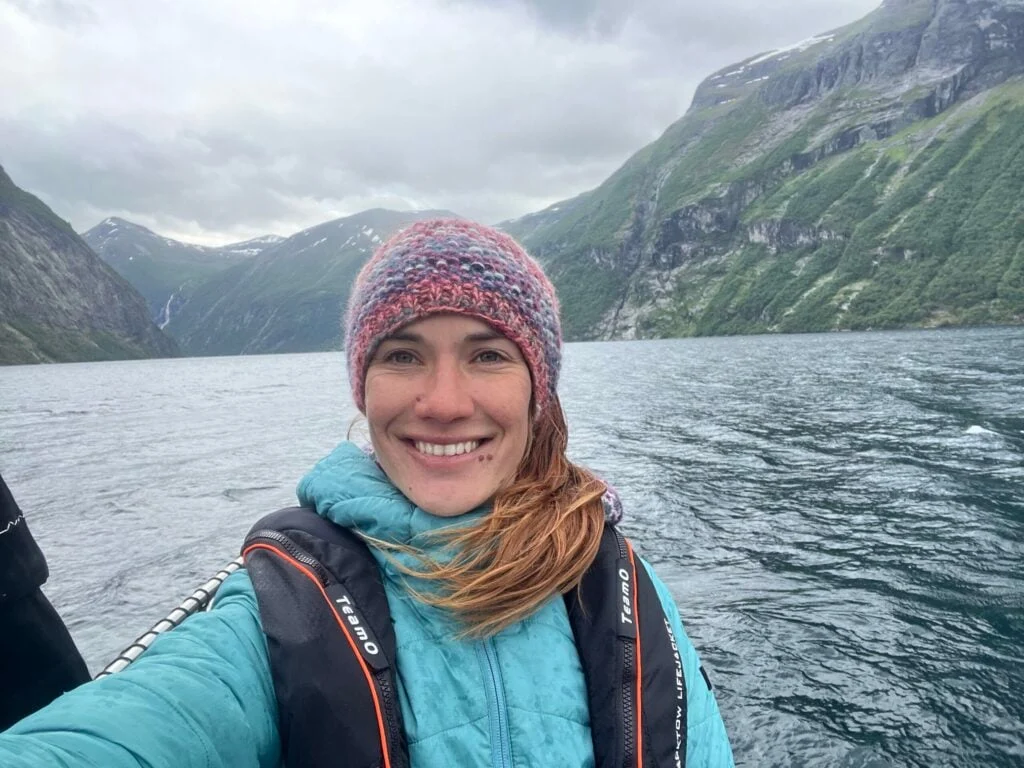
When conditions deteriorate, performance depends less on heroics than on the foundation leaders have built beforehand. Rehearsing failure, simplifying critical systems, and knowing when to pause can offer CEOs a practical framework for making better decisions when the pressure is highest. Laura Dekker’s 518 days at sea offer CEOs a practical playbook for performing under pressure: prepare relentlessly, rehearse failure, simplify what matters, and lead with calm when conditions turn rough. At 14, most teenagers are finding their place in the world. Laura Dekker decided to sail around it.
A Young Navigator’s Extraordinary Journey
Born in 1995 while her parents were traversing the globe by boat, Laura Dekker’s life has been intrinsically linked to the sea. She began sailing at the age of six and spent her formative years honing her skills in diverse maritime environments, navigating challenging currents, busy shipping lanes, and sometimes treacherous weather. Her audacious goal to circumnavigate the globe solo, a feat unprecedented for her age, began in August 2010 aboard her vessel, Guppy. Departing from Gibraltar, she completed the monumental journey 518 days later, at the remarkable age of 16, etching her name in history as the youngest person to achieve this incredible accomplishment.
Dekker’s ambition was not without its hurdles. A contentious court battle, initiated by Dutch child protection services concerned about her age and safety, delayed her departure and ignited a global debate about the boundaries of childhood, risk assessment, and the capabilities of young individuals. Despite the public scrutiny and the legal challenges, Laura possessed a crucial element that many critics overlooked: a profound depth of experience meticulously earned through years of deliberate practice and unwavering dedication.
When interviewed about her voyage, what resonated most was not solely the sheer magnitude of her extraordinary adventure, but the surprisingly practical, systematic approach that underpinned her success. This approach can be distilled into four key tenets: prepare relentlessly, imagine failure before it arrives, simplify what matters, and remain compassionate when others are looking to you for confidence. These principles offer a potent framework for leaders in any high-stakes environment, particularly in the business world where decision-making under duress is a recurring challenge.
The Bedrock of Performance: Relentless Preparation
Laura Dekker’s account of enduring days without sleep during her voyage underscores a critical truth: when conditions are at their most demanding, sound judgment cannot rely on feeling fresh, inspired, or inherently heroic. Instead, it hinges on the robustness of prior preparation. "The most important thing is still the preparation that you’ve done," she explained. "You know exactly what to do in different scenarios." Through relentless repetition and practice, routine actions become "second nature," even when facing extreme exhaustion. This deep-seated familiarity with procedures allows for effective action even when unexpected problems arise, as she had already mentally simulated various potential scenarios.
The meticulous outfitting of Guppy was a testament to this philosophy. For approximately a year, Laura and her father, Dick, worked tirelessly to prepare the vessel. More significantly, Laura developed an intimate knowledge of every aspect of her boat. "Having touched and tightened every bolt yourself, makes a huge difference when the s**t hits the fan," she stated candidly. This hands-on experience fostered a confidence that was not rooted in mere positive thinking, but in tangible evidence of her ability to diagnose problems, execute repairs, and maintain forward momentum.
This principle translates directly into the business arena. Research consistently highlights the detrimental impact of fatigue on cognitive functions. A review by The National Library of Medicine, encompassing studies with 2,276 participants, found that sleep deprivation regularly impairs decision-making capabilities. While preparation cannot eliminate fatigue, it can significantly reduce the number of novel decisions individuals must invent under pressure.
In business, it is vital for leaders to proactively identify the critical decisions their teams may need to make during a crisis. These scenarios should be rehearsed long before a crisis materializes. The implementation of checklists for essential tasks, the clear delineation of decision-making authority, and the extensive familiarity with critical responses ensure that individuals are not starting from scratch on their worst day. This proactive approach mitigates the cognitive load during high-stress periods, allowing for more effective problem-solving. For instance, financial institutions often conduct rigorous "day in the life" simulations for key personnel to test their responses to various market shocks, ensuring operational readiness.
Forecasting Challenges: Rehearsing for the Inevitable
Laura Dekker’s childhood was marked by her father’s strategic “what-if” exercises. He would suddenly announce hypothetical emergencies, such as a broken rudder or a failed engine, forcing her to devise immediate solutions. These simulations extended to scenarios where essential navigation tools like the GPS might malfunction, or critical maneuvers would need to be executed without the expected equipment.
"From a very young age, I’ve been trained to think in what ifs," she revealed. Before embarking on any significant crossing, she would mentally traverse the entire journey, including the complexities of arrival and docking. She acknowledges that "the future never unfolds exactly as expected, but the discipline of thinking through what could happen builds the adaptability needed when it does." This mental rehearsal, a form of practical scenario planning, proved invaluable during her voyage.

A critical incident occurred in the Torres Strait, situated at the northern tip of Australia’s Cape York Peninsula. At night, with the boat dangerously close to reefs and heavy shipping traffic, her front sail ripped apart. The natural human inclination in such a high-pressure situation might be to react impulsively. However, drawing on her ingrained training, Laura paused. "Even though I didn’t have a lot of time, I did sit down and go through the options I had." She systematically lowered the damaged sail, selected a replacement, and calmly continued her journey.
This experience encapsulates the true purpose of scenario planning in the corporate world. It is not about accurately predicting the future, which is an inherently impossible task. As highlighted by MIT Sloan Management Review, exploring multiple plausible scenarios allows leaders to test the resilience of their strategies across divergent future landscapes. This process prepares organizations for unforeseen threats and emerging opportunities that conventional forecasting methods might overlook. For example, energy companies regularly engage in scenario planning that considers various geopolitical shifts, technological advancements, and climate change impacts to stress-test their long-term investment strategies.
The Wisdom of the Pause: Navigating Turbulence with Deliberation
Dekker’s crisis response rhythm is remarkably disciplined: "First step is pause, breathe, make sure I’m calm." She then prioritizes the most immediate need, acts on that priority, and pauses again before determining the subsequent action. "It just comes down to letting everything else go" and concentrating solely on the present problem.
This deliberate approach is crucial because the illusion of urgency can often equate speed with success. Research published by Ahead Solutions, examining the cognitive effects of sleep deprivation, indicates that fatigued individuals tend to shift away from complex information processing and rely more heavily on readily accessible cues. In high-stakes moments, the first solution that surfaces can appear compelling but may not be the wisest course of action.
Therefore, in a business context, establishing a "pause ritual" is essential. This could be as simple as taking one deep breath, posing three critical questions: What is happening? What matters most right now? And what could my first action unintentionally make worse? A mere ten seconds of disciplined thought can avert weeks of avoidable damage and recovery efforts. Companies like Amazon, known for its rigorous operational focus, encourage engineers and managers to pause and reflect before implementing significant changes, particularly in critical systems, to avoid unintended consequences.
Simplifying Systems, Humanizing Leadership
Laura Dekker’s philosophy extends to the very design of her vessel. "I’m a huge fan of simplicity. My thinking is the more we have, the more can break," she stated. Her priorities lie with the fundamental integrity of the hull, the rudder, the sails, the rigging, and the anchoring systems. She places less emphasis on complex navigation technology, demonstrating an impressive capability to navigate using a sextant and the stars. Her rationale is clear: "I can’t navigate if I don’t have a boat."
Business systems, unfortunately, often tend towards the opposite extreme. Tools, interfaces, and interdependencies can accumulate over time to the point where few individuals fully comprehend how the entire system will perform under stress. The consequences can be substantial, as demonstrated by the 2016 power outage and subsequent computer problems at Delta Air Lines. This incident led to the cancellation of 2,300 flights over three days and an estimated $150 million reduction in pretax profits, illustrating the cascading impact of system complexity and failure.
However, simplicity is not solely an issue of equipment. It also profoundly shapes how a leader guides their team. When conditions become challenging, individuals require clarity and assurance, not unnecessary complexity or a display of bravado. Dekker believes a captain must project sufficient confidence to stabilize the crew, while simultaneously ensuring there is a trusted individual with whom uncertainty can be candidly discussed. Compassion is also a vital component. "I don’t generally like captains that are pretending that they are much better than everybody else," she remarked. People are more likely to contribute their best efforts when they feel their leader genuinely "cares."
The business imperative is to simplify critical operations, rigorously test backup systems, and maintain close proximity to frontline work to identify potential failure points. Concurrently, it is essential to foster the human conditions that enable resilience. Individuals perform more effectively when leaders combine calm confidence, honest vulnerability, and visible empathy. This was evident in the response of Southwest Airlines during the COVID-19 pandemic, where leadership prioritized transparent communication and demonstrated care for employees, which contributed to maintaining morale and operational continuity.
Beyond the Achievement: The Transformative Power of Experience
Perhaps Laura Dekker’s most profound insight emerged when asked about the ultimate takeaway from her remarkable achievement. The voyage, she explained, "wasn’t really what was defining me." Instead, it provided "the building blocks that I needed to become me." Sailing solo for 518 days compelled her to confront her mistakes, her limitations, and her capabilities without external excuses. "When you’re alone, you run into yourself a lot. It’s incredibly humbling," she admitted.
Great challenges do not merely reveal character; they forge it, often in quiet, internal processes. The crucial question for leaders and organizations is whether difficult experiences are treated as mere trophies to be displayed, setbacks to be escaped, or as invaluable raw material from which a wiser, more resilient version of oneself and the organization can be constructed. This perspective shift transforms adversity into a catalyst for growth, emphasizing the long-term development of character and capability over immediate outcomes. The journey, much like a challenging project or a market downturn, becomes less about the destination and more about the profound personal and organizational transformation it engenders.
