

Manufacturing confidence held remarkably steady in September, a stark contrast to the downward revisions in forecasts by CEOs across other sectors. This resilience has positioned the manufacturing industry ahead of the broader business landscape in terms of both current and anticipated economic conditions. However, beneath this overarching stability, a significant divergence is emerging between industrial and consumer-focused manufacturing segments, signaling differing economic realities within the sector.
September’s CEO Confidence Index: A Tale of Two Sectors
Chief Executive’s latest CEO Confidence Index, meticulously compiled from surveys conducted between September 1st and 3rd among over 150 U.S. CEOs, paints a compelling picture of the economic climate. For the majority of 2026, manufacturing CEOs have generally expressed a slightly more cautious outlook on current business conditions compared to their counterparts in non-manufacturing sectors. Historically, manufacturing confidence has trailed the broader CEO population, averaging 5.6 on a scale of 1 to 10 for current conditions, versus 5.7 for CEOs overall.
However, September marked a significant shift. Manufacturing’s current conditions score remained anchored at 5.8 out of 10, mirroring August’s 2026 peak. This figure represents a notable 9 percent increase from January’s 5.3 and surpasses the year-to-date average of 5.6. This stability is particularly noteworthy when juxtaposed with the performance of non-manufacturing sectors. In September, non-manufacturing CEOs’ rating for current conditions experienced a significant decline, dropping 6 percent from 6.1 to 5.7. This divergence effectively propelled manufacturing to the forefront in terms of perceived current economic health.
Future Outlooks Diverge: Manufacturers Trim Optimism Slightly, Non-Manufacturers More Sharply
While manufacturing demonstrated resilience in its assessment of current conditions, its outlook for the year ahead saw a modest recalibration. Manufacturers slightly trimmed their 12-month forecast, easing to 6.0 from August’s 6.1. This minor adjustment, however, pales in comparison to the more pronounced decline in confidence among non-manufacturers. Their year-ahead outlook fell to 5.8 from 6.1, marking their weakest reading since March.
The data reveals a persistent trend of manufacturers holding a more optimistic view for the future. Across 2026, manufacturers have, on average, rated their 12-month outlook at 6.1, marginally higher than the 6.0 average for non-manufacturers. September’s data widened this gap, creating the most favorable differential for manufacturers since June.
Looking ahead, a more substantial proportion of manufacturers expressed confidence in improved conditions. Forty-seven percent of manufacturing CEOs anticipate better economic conditions in the next 12 months, an increase from 41 percent in August. In stark contrast, only 31 percent of non-manufacturing CEOs shared this optimistic sentiment.
Demand as a Driving Force for Manufacturers, Policy for Non-Manufacturers

The underlying drivers of these differing outlooks are also illuminating. "Demand" emerged as the preeminent factor influencing manufacturers’ positive projections, cited by 51 percent of respondents. This contrasts with only 46 percent of non-manufacturing CEOs who identified demand as a primary driver.
Conversely, for CEOs outside the manufacturing sector, the influence of Washington looms larger. Forty-four percent of non-manufacturing CEOs pointed to policy or political developments as a significant factor shaping their forecasts. Manufacturers, while not entirely dismissive of these external forces, were less swayed, with only 31 percent citing policy or politics. When non-manufacturing CEOs projected deteriorating conditions, a significant majority (59 percent) attributed it to government actions or geopolitical instability. Manufacturers, on the other hand, distributed their concerns across a broader spectrum, including rising costs, geopolitical tensions, and demand fluctuations.
The Widening Chasm: Industrial vs. Consumer Manufacturing
Beneath the surface of the overall manufacturing sector’s stability, a critical and widening split is evident between industrial and consumer goods producers. Industrial goods manufacturers reported a robust assessment of current conditions, rating them at 6.0, and projected a strong outlook for the next year with a forecast of 6.2.
In contrast, consumer goods producers painted a significantly more subdued picture. Their current conditions rating stood at a modest 5.1, with a future forecast of 5.5. The gap in current conditions assessment between these two sub-sectors widened to 0.9 points in September, up from 0.7 points in August, underscoring the growing disparity.
Voices from the Factory Floor: Demand Dynamics and Cost Pressures
The qualitative insights from CEOs further illuminate these trends. A CEO of a mid-sized industrial manufacturer in New Jersey, for instance, attributed his positive outlook to a surge in demand from "data centers and general construction pick up." This highlights a concentrated demand driven by specific, robust sectors within the industrial landscape.
The consumer goods sector, however, is experiencing a different economic reality. The CEO of a mid-sized consumer manufacturing firm in Michigan, who operates as a contract manufacturer for major brands, stated, "All of them are much softer in demand than originally forecasted." This suggests a widespread slowdown in consumer spending or a more cautious approach by major brands in their ordering patterns.
Cost pressures are also impacting different segments of manufacturing disproportionately. For some consumer producers, energy costs have become a significant concern. A CEO of a small consumer manufacturer in Massachusetts lamented, "Geopolitics have increased the cost of energy dramatically and is affecting many parts of the business." This points to the ripple effects of global events on operational expenses.
Firms with extensive global footprints are also facing cumulative headwinds. The CEO of a mid-sized industrial manufacturer in North Carolina articulated, "Uncertainty in the marketplace due to [the] Iran war, tariffs, inflation and interest rates continue to cause a drag on our business." This underscores the complex interplay of international relations, trade policies, and macroeconomic factors impacting businesses with international exposure.

Economic Outlook Diverges: Manufacturers Lean Towards Growth, Non-Manufacturers Show Caution
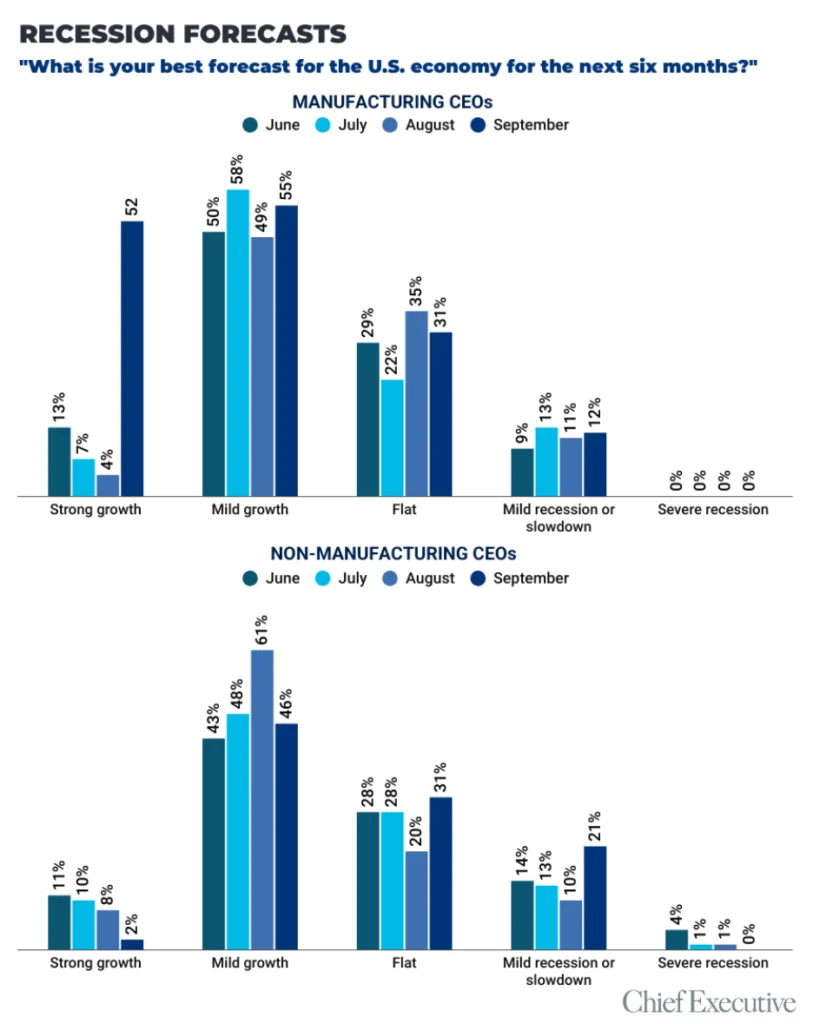
The six-month economic outlook further emphasizes the diverging paths of manufacturers and other business leaders. In September, 57 percent of manufacturers forecasted some form of economic growth, a slight increase from 54 percent in August. Concurrently, the proportion anticipating flat economic conditions decreased to 31 percent from 35 percent. Notably, recession forecasts remained relatively stable at around 12 percent, with no manufacturer predicting a severe recession for the second consecutive month.
The non-manufacturing sector, however, witnessed a significant reversal of its August surge in optimism. The percentage of non-manufacturing CEOs forecasting growth plummeted from 69 percent to 48 percent. Simultaneously, the share expecting a mild recession or slowdown doubled to 21 percent from 10 percent, signaling a palpable increase in caution within this segment.
Optimism Thins, Costs Rise: The Nuances of Manufacturing Confidence
Despite the overall positive trend, a closer examination of manufacturers’ optimism reveals a subtle thinning. Only 2 percent of manufacturers predicted strong growth in September, down from 4 percent in August. This leaves the majority, 86 percent, clustered in expectations of mild growth or flat conditions.
Concurrently, cost expectations are on the rise. Manufacturers now anticipate headline CPI to reach 3.7 percent over the next 12 months, an increase from 3.5 percent in August. Furthermore, a substantial 35 percent of manufacturers expect an inflation rate of 4 percent or higher, indicating a growing concern about rising price levels.
International Exposure: A Narrowing Gap
The gap in confidence between manufacturers with significant international operations and those focused solely on the domestic market narrowed in September. Firms with global operations maintained their assessment of current conditions at 5.7, unchanged from August. Domestic-exclusive firms, however, saw their rating dip from 6.1 to 5.9, effectively reducing the confidence gap from 0.4 points to 0.2 points. This convergence is attributed more to domestic firms experiencing a decline in their outlook rather than a significant gain in confidence by globally exposed companies. U.S.-only CEOs continue to exhibit higher optimism for the year ahead, forecasting 6.2 compared to 5.9 for their international counterparts.
The Year Ahead: Revenue Expectations Stable, Profit Margins Under Pressure
Manufacturers’ expectations for revenue growth in the coming year remained largely consistent with August figures. However, profit expectations tell a different story. The gap between projected revenue growth and anticipated profit growth widened to 12 percentage points in September, up from 7 points in August. While revenue projections have remained relatively stable, this widening disparity suggests less optimism about growing profit margins.

A concerning trend is the increase in manufacturers anticipating a decline in profits. One in five manufacturers now expects profits to fall this year, a rise from one in six in August. Furthermore, the proportion braced for a significant profit drop of 20 percent or more has more than doubled, escalating from 4 percent to 10 percent within the past month. This suggests that manufacturers are facing increasing challenges in translating revenue into profitability, with pricing power becoming a more critical factor. As one CEO of a large industrial manufacturer in Indiana noted, "Ability to price will get more scrutiny."
Despite these profit margin pressures, the immediate impact on hiring and investment plans appears limited. Capital spending intentions remained largely stable. The share of manufacturers planning to expand their workforce rose to 49 percent from 45 percent in August. However, a significant portion, 39 percent, still anticipate their payrolls remaining unchanged, representing the largest single response category.
Working Capital Under Pressure: Inventory Management and Supplier Terms
New questions introduced this month regarding working capital reveal distinct strategies employed by manufacturers compared to other sectors. When asked about their primary working capital and liquidity priorities for the next 12 months, inventory management emerged as a dominant focus for manufacturers. A substantial 56 percent of manufacturers are actively working to reduce inventory levels, a stark contrast to the 21 percent of non-manufacturers pursuing similar goals.
Manufacturers are also more inclined to extend supplier payment terms, with 31 percent indicating this strategy compared to 20 percent of non-manufacturers. Conversely, non-manufacturers are prioritizing the building of cash reserves, with 57 percent focusing on this objective, versus 44 percent of manufacturers.
The impact of trade policy has exacerbated cost challenges into liquidity issues for some. A CEO of a large industrial manufacturer in Illinois succinctly stated, "Tariffs threatening cash." For smaller firms, access to traditional funding remains a persistent hurdle. The CEO of a small industrial manufacturer in Utah highlighted this challenge: "Traditional or bank funding for small business is an ongoing issue, as it is simply not available." This points to potential systemic issues in the availability of credit for smaller industrial enterprises.
About the CEO Confidence Index
Since its inception in 2002, Chief Executive Group has consistently polled hundreds of U.S. CEOs across a diverse range of organizations and sizes to compile its authoritative CEO Confidence Index. This index meticulously tracks CEO sentiment regarding current and future business environments, drawing upon their firsthand observations of various economic and business indicators. For comprehensive details on the Index and access to historical data, readers are encouraged to visit ChiefExecutive.net/category/CEO-Confidence-Index/.
