

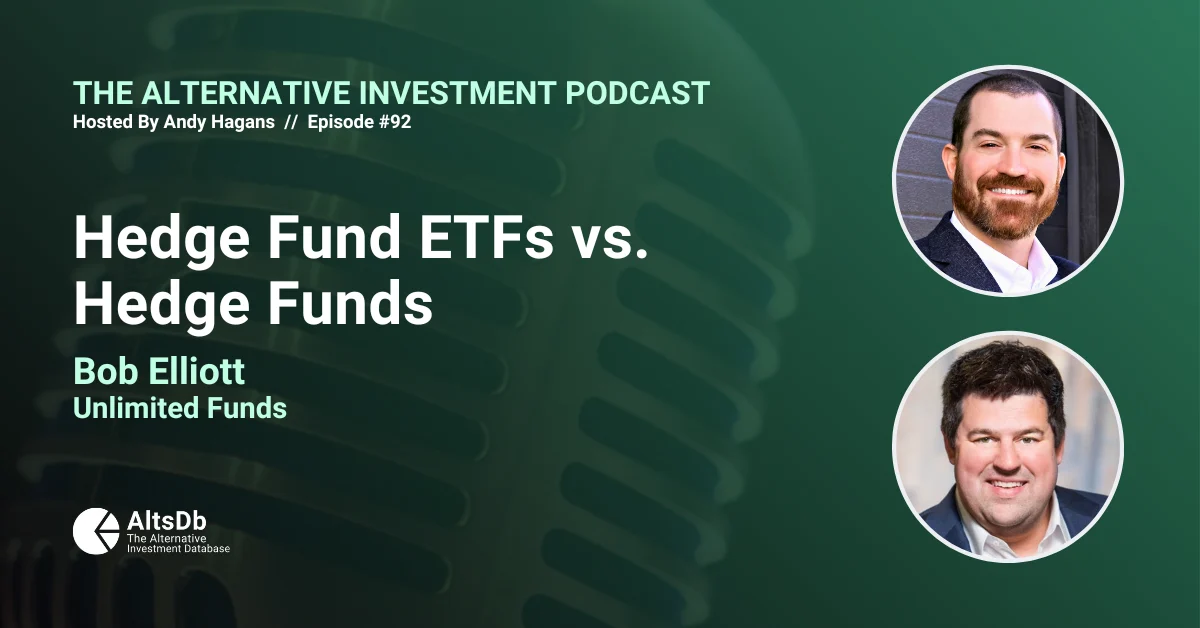
Leading hedge funds have the capability to deliver enormous returns for investors, but their active management comes at a price. Bob Elliott, CEO at Unlimited, joins the show to discuss HFND’s unique alternative strategy, and why he believes alternative ETFs have the potential to outperform hedge funds, net of fees.
The intricate world of alternative investments, long the domain of sophisticated institutional investors and high-net-worth individuals, is undergoing a significant transformation. While hedge funds have historically offered the allure of outsized returns through active management, their associated costs, complexities, and accessibility issues have presented persistent challenges for many investors. In this evolving landscape, exchange-traded funds (ETFs) are emerging as a powerful vehicle to democratize access to these strategies, offering a compelling alternative that aims to deliver comparable performance at a significantly lower cost.
Bob Elliott, CEO of Unlimited Funds, a firm at the forefront of this innovation, recently articulated this vision during an interview on The Alternative Investment Podcast. Elliott, whose career has been shaped by extensive experience at Bridgewater Associates, a titan in systematic macro investing, believes that alternative ETFs, particularly those employing advanced technological approaches, are poised to redefine the investor experience.
The Allure and Accessibility of Hedge Funds
The term "hedge fund" often conjures images of exclusive clubs and complex financial maneuvers. Traditionally, these funds have been lauded for their ability to generate alpha, or market-beating returns, by employing a wide array of strategies, including long/short equity, global macro, event-driven, and credit strategies. Their active management allows for flexibility in asset allocation, the ability to take short positions, and the use of leverage, all aimed at achieving absolute returns regardless of market direction.
However, this active management comes with a significant price tag. The standard "2 and 20" fee structure – a 2% management fee and a 20% performance fee on profits – has long been a point of contention. For investors, these fees can erode substantial portions of gross returns, leading to a net return that may not always justify the initial performance. Furthermore, hedge funds often have high minimum investment requirements, typically in the millions of dollars, making them inaccessible to a broad swathe of investors, including many accredited individuals and smaller family offices. The operational complexities, including extensive paperwork, tax implications (especially the dreaded K-1 forms for U.S. investors), and lock-up periods, further add to the barriers of entry.
Elliott’s Journey: From Bridgewater to Unlimited
Bob Elliott’s understanding of these dynamics is deeply rooted in his formative years at Bridgewater Associates. Joining the firm shortly after college, Elliott spent nearly 15 years immersed in the world of systematic macro investing. He witnessed firsthand the evolution of Bridgewater from a "challenger asset manager" to a global leader, learning to apply rigorous, systematic approaches to understanding and navigating the complexities of the global macroeconomy. This experience provided him with a profound insight into how various asset classes are interlinked and how to quantify these relationships to develop investment strategies.
"The thought was at the time that systematic or that macro investing really was for the savants of the world," Elliott recalled, referring to his early days at Bridgewater. "The real innovation in that space was bringing the sort of rigorous and systematic approaches that had existed for a long time in things like equity long-short, and areas like that, and bringing that understanding into the macro space."
His academic background in the pure sciences, specifically botany, might seem an unconventional path to finance, but Elliott views it as instrumental in developing a holistic, systems-thinking approach to investing. This scientific mindset, he explained, fostered an ability to observe, analyze, and understand complex interdependencies, a skill directly transferable to deciphering the intricate mechanisms of global markets and economies.
The Art and Science of Macro Investing
At its core, macro investing, as practiced by Elliott and his contemporaries, is about understanding the cause-and-effect drivers of the global economy and financial markets. It’s not about predicting the future with absolute certainty, but rather about identifying probable outcomes based on a deep understanding of economic linkages and market participants’ behaviors.
"The macroeconomy works very differently than what you’d learn in a college macroeconomics class or what a traditional academic finance education would give you," Elliott stated. He elaborated on the process of systemization, which involves quantifying these intuitive linkages. For example, an increase in inflation above expectations would logically lead to rising bond yields. The edge comes from quantifying the pressures on inflation relative to what is already priced into the bond market.
Systemization, according to Elliott, brings discipline and the ability to synthesize vast amounts of information. This is crucial because discretionary investors can often be swayed by incremental news, leading to overreactions or underreactions. Systematic strategies, conversely, adhere to a disciplined execution of a pre-defined plan.
"The biggest benefit of systemization is quantification and discipline," he emphasized. "Often investors can challenge. If you’re a discretionary investor, it can be very challenging to basically pursue, keep true to your investment strategy because you’re always being influenced by the incremental information that’s out there."
Even the most skilled macro investors operate with probabilities, not certainties. Elliott cited that the best macro investors might be correct about 55% of their bets in any given month. However, when applied across numerous markets and over time, this slight probabilistic edge can lead to exceptional long-term performance. This probabilistic nature, he likened to being the "best blackjack player that’s ever walked into the casino," where a consistent edge, however small, compounds into significant success.
The Evolution of the ETF Landscape
The interview highlighted a critical juncture for alternative investments, particularly concerning the role of ETFs. Historically, ETFs were primarily associated with passive, low-cost indexing strategies. However, recent regulatory changes and technological advancements have paved the way for more sophisticated, actively managed ETFs, including those designed to replicate hedge fund strategies.
Elliott pointed to the limitations of the traditional hedge fund structure for many investors. These include:
- High Fees: The standard 2% management fee and 20% performance fee can significantly impact net returns, often diminishing the perceived value of active management.
- Tax Inefficiency: Traditional Limited Partnership (LP) structures can lead to unfavorable tax treatment, with annual distributions often taxed at marginal income tax rates or higher.
- Diversification Challenges: Smaller investors struggle to achieve adequate diversification across a meaningful number of hedge funds due to high minimums and the complexity of selecting and managing multiple funds.
- Operational Burden: The extensive paperwork, potential for K-1 forms, and lack of liquidity in LP structures create significant administrative hurdles for both investors and financial advisors.
Unlimited’s HFND ETF: A New Paradigm
In response to these challenges, Unlimited Funds launched the HFND Multi-Strategy Return Tracker ETF. The fund’s stated objective is to create a portfolio with return characteristics similar to the hedge fund industry’s gross-of-fees returns, while aiming to outperform hedge fund industry net-of-fees returns by charging comparatively lower expenses.
"The first pain point is that hedge fund fees are very high," Elliott explained. "So, if you take the hedge fund industry as a whole, they’re typically adding between 300 and 400 basis points of fees on an annual basis." He contrasted this with the HFND ETF, which he stated charges approximately a quarter of the management fee of a typical hedge fund.
The ETF structure offers several inherent advantages that directly address the pain points of traditional hedge fund investing:
- Liquidity: ETFs trade on major stock exchanges, providing investors with real-time liquidity and the ability to enter or exit positions easily without redemption processes.
- Accessibility: There are no high minimum investment requirements; investors can purchase as little as one share, making sophisticated strategies accessible to a broad audience.
- Transparency: The holdings and strategy of an ETF are generally more transparent than those of a private hedge fund.
- Tax Efficiency: The ETF wrapper typically offers superior tax efficiency compared to traditional LP structures, particularly for U.S. investors.
- Simplified Administration: The absence of extensive paperwork and K-1s significantly reduces the administrative burden for investors and their advisors.
The Role of Machine Learning and Systematic Replication
A key differentiator for the HFND ETF is its reliance on modern machine learning techniques to replicate hedge fund strategies. Elliott highlighted that their approach involves leveraging their deep experience in developing proprietary hedge fund strategies, combined with advanced technology, to "look over the shoulder of the hedge fund managers, see what they’re doing in close to real-time." This understanding is then translated into long and short positions in various index products, packaged within the ETF wrapper.
This systematic replication aims to capture the gross-of-fees returns of the hedge fund industry, thereby providing investors with the performance characteristics they seek without the associated high costs and complexities. The use of technology, rather than solely relying on individual "star" portfolio managers, is what enables Unlimited Funds to offer its strategies at a significantly lower cost.
"We can offer it at, you know, about a quarter of the management fee that a typical hedge fund would charge," Elliott noted. "And because it’s in the ETF wrapper, it ends up being about twice as tax efficient, or half the taxes roughly, than it would be in a traditional LP structure."
The Future of Alternative Investments: A Rationalization of Fees
Looking ahead, Elliott anticipates a significant rationalization of fees across the investment management industry. The era of cheap money and consistently rising markets, which often masked the impact of high fees, is likely drawing to a close. In a macroeconomic environment characterized by potentially lower returns, the skill of an investor relative to the fees charged will come under greater scrutiny.
This shift, Elliott believes, will lead to a bifurcation within the hedge fund industry. The most sophisticated and genuinely alpha-generating hedge funds, often inaccessible to the majority of investors, will likely continue to command their fees. However, a substantial portion of the hedge fund industry, which may not consistently deliver differentiated alpha, will face increased pressure.
"For the rest of the world, you know, who aren’t those big, sophisticated institutions, we’re gonna have a real reckoning of the rest of the hedge fund industry, where frankly, the vast majority of the hedge fund industry does not justify its fees," he stated.
In this context, innovative products like the HFND ETF, which replicate hedge fund strategies at a fraction of the cost and with greater tax efficiency, are poised to gain significant traction. Elliott envisions a future where capital flows increasingly towards these sophisticated replication strategies housed within investor-friendly structures like ETFs. This transition, he concluded, will ultimately benefit investors by providing access to advanced investment strategies in a diversified, consistent, and significantly more cost-effective manner than was previously available. The evolution of alternative ETFs represents not just a new investment product, but a fundamental reshaping of how sophisticated investment strategies are delivered to the broader investment community.
