

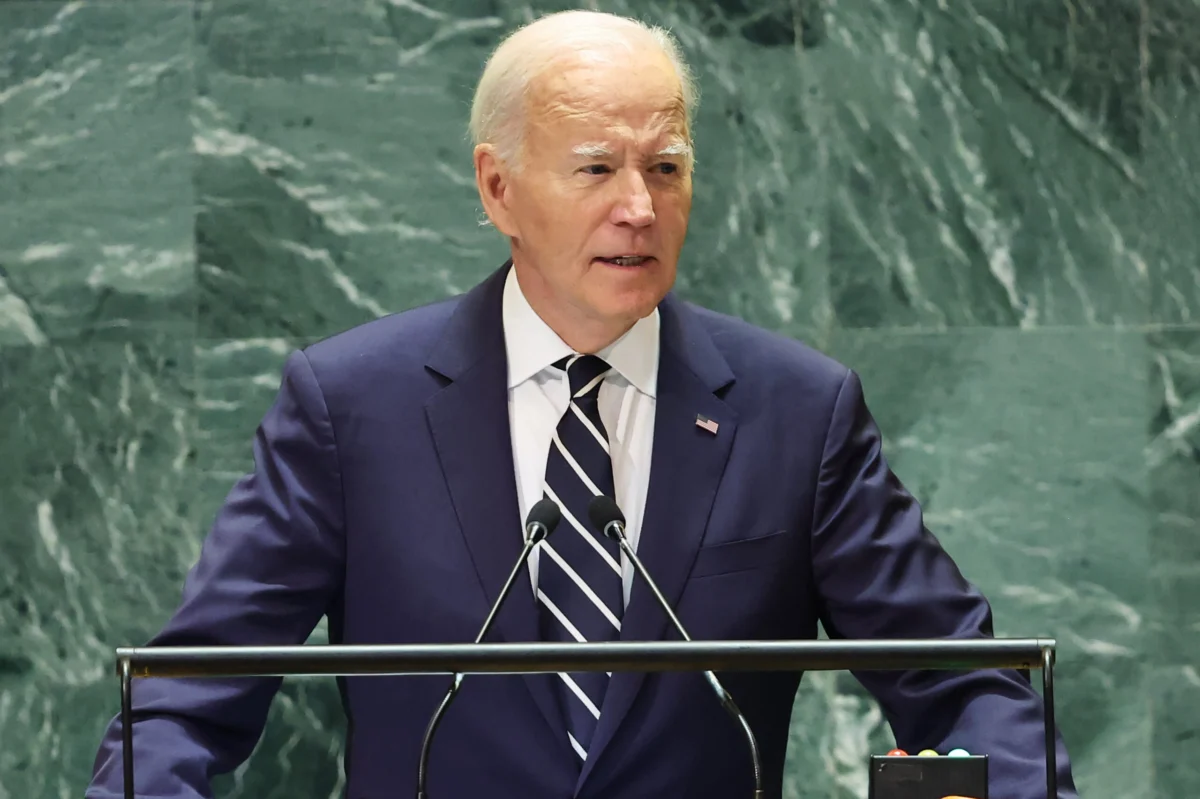
President Joe Biden delivered his final address to the United Nations General Assembly on Tuesday, attempting to reconcile the diplomatic ambitions of his administration with the stark, often violent realities currently reshaping the global order. Speaking before an audience of world leaders at the 79th session of the UNGA in New York City, Biden sought to frame his half-century of public service and four years in the Oval Office as a period of persistent optimism in the face of mounting despair. The speech served as both a valedictory lap and a somber warning, as the President addressed the ongoing wars in Ukraine, the Middle East, and Sudan, while also justifying his decision to step aside from the 2024 presidential race as a necessary act for the preservation of democracy.
Throughout the 25-minute address, Biden leaned heavily on his long-standing belief in the power of international cooperation, even as the very institutions he praised—most notably the United Nations itself—struggle to contain escalating regional conflicts. "I know many look at the world today and see difficulties and react with despair," Biden told the assembly. "But maybe because of all I’ve seen and all we have done together over the decades, I have hope." This hope, however, was balanced against a backdrop of "crisis and uncertainty," a phrase Biden used to describe the state of the world when he assumed the presidency in 2021.
A Geopolitical Landscape Defined by Conflict
The timing of Biden’s final UNGA appearance coincided with one of the most volatile periods in recent diplomatic history. Since his previous address in September 2023, the world has seen the outbreak of a devastating war between Israel and Hamas, a significant escalation in tensions between Israel and Hezbollah in Lebanon, and the continued grinding attrition of the Russian invasion of Ukraine.
In the Middle East, Biden’s rhetoric focused on the urgent need for a ceasefire and a hostage release deal. The administration has spent months mediating between Israel and Hamas, yet a definitive agreement remains elusive. Biden noted that the Middle East is teetering on the brink of an all-out regional war, particularly as violence flares on the Israel-Lebanon border. He emphasized that the Oct. 7, 2023, attack by Hamas, which resulted in the deaths of approximately 1,200 people and the taking of hundreds of hostages, was a catalyst for a cycle of violence that has left tens of thousands of Palestinians dead and Gaza in a state of humanitarian ruin.
"Now is the time for the parties to finalize its terms, bring the hostages home, to secure security for Israel and Gaza free from Hamas’ grip, ease the suffering in Gaza, and end this war," Biden declared. He also took the notable step of addressing the rising violence against innocent Palestinians in the West Bank, underscoring that a two-state solution remains the only viable path toward long-term regional stability.
Supporting Ukraine and the Defense of the UN Charter
Turning to Europe, Biden reaffirmed his unwavering support for Ukraine as it enters its third year of defending against Russia’s full-scale invasion. The President framed the conflict not just as a regional dispute, but as a direct assault on the principles of the UN Charter, which guarantees the sovereignty and territorial integrity of all member states.
Under Biden’s leadership, the United States has provided more than $175 billion in total aid to Ukraine, including critical air defense systems, tanks, and long-range missiles. However, the President acknowledged the growing political friction within his own country, where some congressional Republicans have become increasingly vocal in their opposition to continued funding. Biden countered this sentiment by highlighting the revitalization of NATO, which has expanded to include Finland and Sweden during his tenure, directly contradicting Vladimir Putin’s goal of weakening the alliance.
"We could have stood by and merely protested, but Vice President [Kamala] Harris and I understood that that was an assault on everything this institution was supposed to stand for," Biden said. He issued a stern directive to the international community: "You cannot grow weary. You cannot look away. We will not let up on our support for Ukraine, not until Ukraine wins a just and durable peace."
The Humanitarian Crisis in Sudan and Global AI Governance
While Ukraine and Gaza dominated the headlines, Biden also brought attention to the often-overlooked civil war in Sudan. The conflict between the Sudanese Armed Forces (SAF) and the Rapid Support Forces (RSF) has displaced over 10 million people and created what the UN has described as one of the worst hunger crises in the world. Biden’s inclusion of Sudan in his address was a deliberate attempt to signal that U.S. foreign policy remains committed to humanitarian stability across the African continent, even as other crises demand immediate resources.

Beyond traditional warfare, Biden touched on the frontier of technological diplomacy. He outlined the administration’s efforts to establish global principles for artificial intelligence (AI), arguing that the technology must be developed and deployed in ways that protect human rights and prevent the spread of misinformation. This focus on "digital sovereignty" and "responsible AI" has been a cornerstone of the Biden-Harris administration’s tech policy, aiming to create a democratic alternative to the authoritarian models of surveillance and control seen in other parts of the world.
A Personal Reflection on Power and Democracy
Perhaps the most poignant moment of the speech came when Biden addressed his decision to withdraw from the 2024 presidential election. In July, following a period of intense scrutiny regarding his age and fitness for a second term, Biden announced he would not seek reelection, endorsing Vice President Kamala Harris as his successor.
At the UN, Biden used his personal decision as a broader lesson for the world’s leaders, many of whom have held power for decades through less-than-democratic means. "As much as I love the job, I love my country more," Biden said. "I decided, after 50 years of public service, it’s time for a new generation of leadership to take my nation forward." He added a pointed reminder to the assembly: "My fellow leaders, let us never forget: Some things are more important than staying in power."
This statement was widely interpreted as a defense of democratic transitions and a subtle critique of autocratic leaders who prioritize personal rule over the institutional health of their nations. By framing his exit as a service to the country, Biden sought to contrast his leadership style with that of his predecessor and current political rival, Donald Trump.
The Diplomatic Marathon: Meetings and Successors
Biden’s schedule during the UNGA week reflects the breadth of his administration’s "omni-directional" diplomacy. Before arriving in New York, he hosted a "Quad" summit in Wilmington, Delaware, with the leaders of Australia, India, and Japan, focusing on maritime security in the Indo-Pacific—a clear signal of his strategy to counter China’s regional influence.
In New York and Washington, the President’s itinerary remains packed:
- UAE Relations: Biden met with United Arab Emirates President Mohamed bin Zayed Al Nahyan to discuss trade and regional security.
- Synthetic Drugs: He will host a summit focused on the global fentanyl crisis, emphasizing that the trafficking of synthetic drugs is a national security priority.
- Vietnam and Ukraine: Meetings with Vietnamese President Tô Lâm and Ukrainian President Volodymyr Zelenskyy are scheduled for later in the week. Zelenskyy is expected to present a "victory plan" to Biden at the White House on Thursday.
Notably, the presence of both Kamala Harris and Donald Trump loomed over the assembly. Foreign leaders, aware of the high stakes of the upcoming U.S. election, are split-tracking their engagements. Harris held her own meeting with the UAE president and will join Biden’s meeting with Zelenskyy. Meanwhile, Trump is reportedly planning to meet with Zelenskyy, Indian Prime Minister Narendra Modi, and Polish President Andrzej Duda, signaling that the GOP nominee is already conducting a shadow foreign policy campaign.
Analysis: The Biden Legacy and the Path Forward
As Joe Biden prepares to exit the world stage, his foreign policy legacy remains a subject of intense debate. Supporters point to the revitalization of traditional alliances, the successful rallying of the West against Russian aggression, and a return to multilateralism after the isolationist "America First" years. Critics, however, point to the chaotic withdrawal from Afghanistan in 2021 as a turning point that emboldened adversaries, and they argue that the current instability in the Middle East suggests a failure of U.S. deterrence.
Biden’s final UNGA speech was an attempt to define his tenure as one of "principled engagement." By emphasizing hope and the transition of power, he sought to reassure a nervous international community that the United States remains a reliable partner. However, the reality of the "grim backdrop" he described—the ruins of Gaza, the trenches of the Donbas, and the famine in Sudan—suggests that the next administration will inherit a world more fractured and dangerous than the one Biden entered four years ago.
The President’s call for a "new generation of leadership" is not just a domestic political move; it is a recognition that the post-WWII international order, represented by the very hall in which he spoke, is facing its greatest test in nearly a century. Whether that order survives may depend less on the speeches delivered in New York and more on the outcome of the American election in November. For now, Biden has laid out his final vision: a world where democracy is preferred over autocracy, and where the "U.N. Charter" remains the ultimate, if fragile, blueprint for global peace.
