

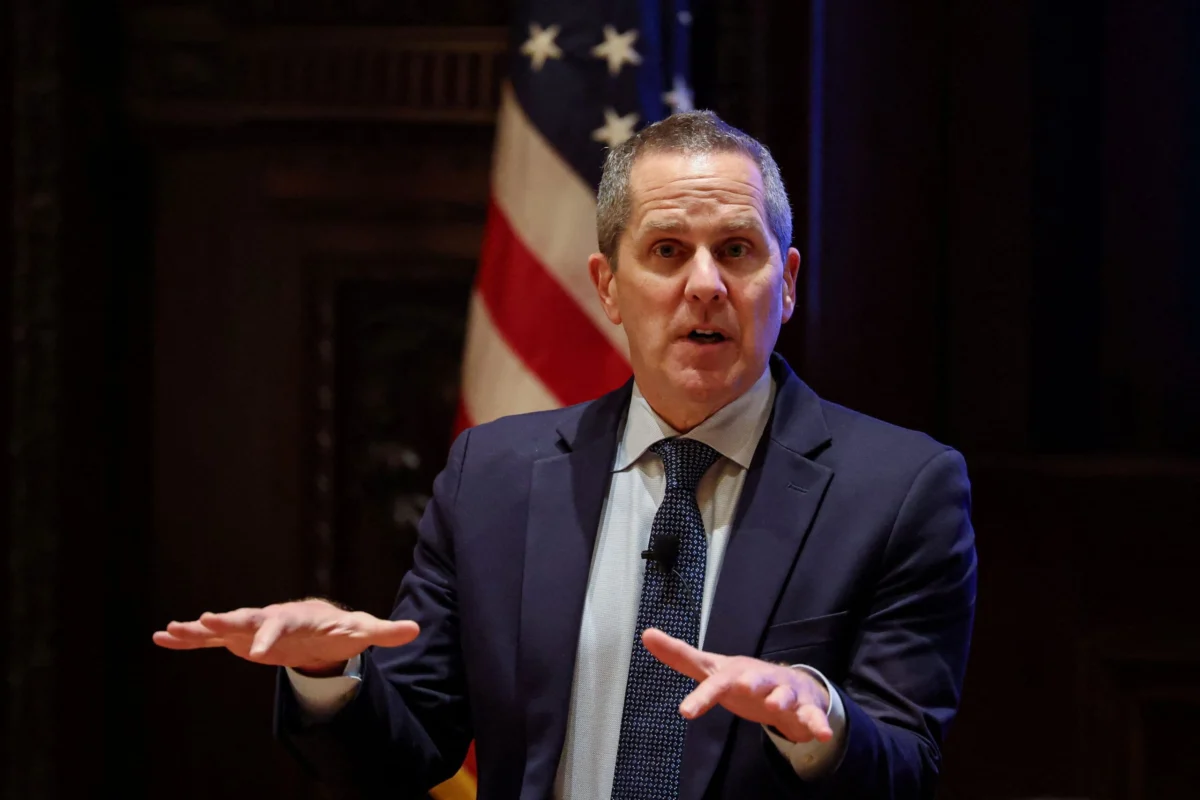
Federal Reserve Board Governor Michael Barr delivered a stark warning on Tuesday, signaling his preparedness to support an interest rate hike if inflationary pressures fail to sufficiently moderate. Speaking at a high-profile banking forum in Washington, D.C., Barr articulated a clear conditional stance, emphasizing the central bank’s commitment to its price stability mandate. This assertive posture comes at a pivotal moment for global financial markets, grappling with stubbornly elevated inflation, escalating geopolitical tensions in the Middle East, and a discernible shift in rhetoric from key Federal Reserve policymakers.
The Persistent Challenge of Inflation: A Five-Year Battle
Barr’s remarks underscored deep-seated concerns within the Federal Reserve regarding the enduring nature of inflation. He noted that the annual inflation rate has remained stubbornly above the Fed’s long-term 2% target for an extended period, now stretching to nearly five and a half years. This protracted inflationary episode, unprecedented in recent memory, has its roots in a complex interplay of factors that emerged following the global economic disruptions of the early 2020s. Initial surges were attributed to robust post-pandemic demand, exacerbated by severe supply chain bottlenecks and significant fiscal stimulus measures. However, what was initially deemed "transitory" has evolved into a more entrenched phenomenon, leading to what Barr described as "broader price pressures taking hold" across the economy.
The latest available data from July 2026 painted a challenging picture. The headline Personal Consumption Expenditures (PCE) price index, the Fed’s preferred inflation gauge, indicated an annual increase of 3.7%. Even more concerning to policymakers was the core PCE, which strips out volatile food and energy components, rising by 3.3% year-over-year. While a marginal deceleration from previous months, these figures remain significantly above the central bank’s comfort zone, fueling anxieties that inflation expectations could become unanchored. Economists point to persistent services inflation, a tight labor market driving wage growth, and robust consumer demand as key contributors to this inflationary stickiness. The Fed’s dual mandate, encompassing both maximum employment and price stability, faces its most significant test in decades as policymakers strive to cool prices without precipitating a sharp economic downturn.
Navigating the Policy Tightrope: Barr’s Conditional Approach
Governor Barr’s address was characterized by a nuanced yet firm conditional framework for future monetary policy. "If trends in the data give me some confidence that inflation is moderating on a path to 2%, then I think we can take a bit more time to assess our policy stance," Barr stated in his prepared remarks, highlighting the data-dependent nature of the Fed’s strategy. However, he swiftly followed with a decisive caveat: "However, if inflation appears not to be moderating sufficiently, then I think we should act decisively to raise rates." This "if-then" declaration signals a clear willingness to resume monetary tightening, should incoming economic indicators not align with the desired disinflationary trend.
As a member of the Federal Reserve’s Board of Governors, Barr holds a permanent voting seat on the Federal Open Market Committee (FOMC), the principal policymaking body of the U.S. central bank. His statements, therefore, carry significant weight, offering a direct insight into the deliberations and prevailing sentiment within the Committee. His emphasis on acting "decisively" suggests a growing impatience with the pace of disinflation and a potential readiness to tolerate further economic cooling in pursuit of price stability. This stance reinforces the central bank’s resolve to prevent a re-acceleration of inflation or the embedding of higher inflation expectations into the economic fabric.
A Broader Hawkish Chorus? Chairman Warsh’s Precedent
Barr’s hawkish comments echo, and perhaps amplify, signals sent by other senior Fed officials, most notably Federal Reserve Chairman Kevin Warsh. Just last week, on August 28, 2026, Chairman Warsh delivered a highly anticipated address at the annual Jackson Hole Economic Symposium. His remarks, widely interpreted by markets and analysts as leaning strongly towards a rate hike, underscored the Committee’s collective concern over persistent inflation. The Jackson Hole Symposium has historically served as a crucial platform for Fed chairs to signal shifts in monetary policy, and Warsh’s speech was no exception. He reportedly stressed the need for "unwavering commitment" to the 2% inflation target, even if it meant risking a temporary slowdown in economic activity.
The confluence of hawkish rhetoric from both the Chairman and a permanent voting Governor within such a short timeframe suggests a potential consensus building within the FOMC for further policy tightening. This collective signaling could be interpreted as an effort to prepare markets for a potential rate increase at the upcoming policy meeting, scheduled to conclude in just two weeks. While Barr had supported the FOMC’s July 29, 2026 decision to keep the benchmark federal funds rate targeted between 3.5%-3.75%, the evolving data landscape and persistent inflationary pressures appear to have shifted the internal calculus.
The Geopolitical and Economic Headwinds: Rising Yields and Middle East Tensions
The backdrop to these monetary policy discussions is further complicated by an increasingly precarious global environment. Renewed worries over the situation in the Middle East have injected significant volatility into financial markets. Geopolitical tensions in the region have historically impacted global energy markets, supply chains, and investor confidence, often leading to a flight to safety or, conversely, a repricing of risk. On Tuesday, these concerns contributed to another sharp jump in Treasury yields, with the benchmark 10-year note reaching levels not seen since mid-January 2025. This move reflects a combination of factors: increased inflation expectations, a reassessment of global growth prospects, and potentially a shift in safe-haven demand away from long-duration government bonds.
Rising Treasury yields have broad implications across the economy. They directly influence borrowing costs for everything from corporate bonds and municipal debt to consumer mortgages and auto loans. A sustained upward trend in yields can tighten financial conditions, acting as a de facto monetary policy tightening even without direct Fed action. For businesses, higher borrowing costs can deter investment and expansion, while for consumers, they translate into more expensive debt, potentially dampening spending on big-ticket items like homes and cars. The interplay between geopolitical risk, inflation expectations, and bond market dynamics creates a complex environment for the Federal Reserve as it charts its course.
The State of the U.S. Economy: Resilience Amidst Headwinds
Despite the persistent inflation, Governor Barr offered a relatively sanguine assessment of the broader U.S. economy, particularly highlighting the resilience of consumer spending. "Consumer spending to date has been largely resilient," he noted, a critical observation given that consumption accounts for approximately two-thirds of U.S. economic activity. This resilience has been supported by a robust labor market, with the national unemployment rate hovering near historical lows at 3.8% as of August 2026, and continued, albeit moderating, wage growth. Recent GDP data indicated an annualized growth rate of 1.8% in the second quarter of 2026, suggesting the economy, while slowing from its post-pandemic surge, is not yet on the brink of recession.
However, Barr quickly tempered this optimism by reiterating the central problem: "But inflation remains too high — and has been for over five years." This statement encapsulates the core dilemma facing the Fed: how to tame inflation without unduly sacrificing the strength of the labor market and broader economic activity. The housing market, in particular, has shown sensitivity to higher interest rates, with declining sales and moderating price growth in many regions. Business investment, while steady, has also demonstrated signs of caution in the face of elevated uncertainty and borrowing costs. The Fed’s challenge lies in engineering a "soft landing," a delicate balance of cooling demand sufficiently to bring inflation down without triggering a sharp contraction in employment and output.
The Road Ahead: Upcoming Data and the Next FOMC Meeting
The immediate path forward for monetary policy will be heavily influenced by forthcoming economic data. The Federal Reserve will receive one more critical look at inflation when the consumer and producer price indexes (CPI and PPI) for August are released next week. These reports, particularly the core components, will be scrutinized for any signs that price pressures are indeed moderating towards the Fed’s 2% target. Analysts will also closely monitor wage growth data and other labor market indicators for signs of cooling in what has been a historically tight job market.
The market’s anticipation of a potential rate hike at the next FOMC meeting, scheduled for two weeks from now, is palpable. According to the CME Group’s FedWatch tool, which tracks market expectations for Fed policy, traders Tuesday morning were pricing in approximately a 66% chance of an increase this month. This probability reflects a significant shift from earlier in the summer, indicating that market participants are increasingly aligning with the hawkish signals emanating from the central bank. A rate hike, if enacted, would likely involve a 25-basis-point increase, pushing the federal funds rate target range to 3.75%-4.00%.
Implications for Markets and Main Street
A decision to raise rates would have immediate and far-reaching implications across financial markets and the broader economy. For equity markets, another rate hike could introduce further volatility, particularly impacting growth stocks and sectors sensitive to borrowing costs. Higher rates increase the discount rate used to value future earnings, potentially making equities less attractive relative to fixed-income assets. Conversely, certain sectors like financials, which often benefit from wider net interest margins in a rising rate environment, could see relative outperformance.
In the fixed-income market, a rate hike would likely push Treasury yields higher across the curve, further increasing borrowing costs. This would also impact corporate bond yields, making it more expensive for companies to raise capital. The U.S. dollar could strengthen as higher interest rates attract foreign capital seeking better returns, potentially impacting U.S. exports by making them more expensive.
For Main Street, the consequences would be direct. Consumers with variable-rate mortgages, credit card debt, or other forms of floating-rate loans would see their monthly payments increase. Prospective homebuyers would face higher mortgage rates, further dampening affordability in an already strained housing market. Businesses contemplating expansion or investment would confront higher financing costs, potentially leading to a slowdown in hiring and capital expenditures. While designed to curb inflation, a rate hike carries the risk of slowing economic growth and potentially leading to an increase in the unemployment rate, presenting a difficult trade-off for policymakers.
The Federal Reserve’s Evolving Strategy: Balancing Mandates
The current economic juncture represents one of the most challenging periods for the Federal Reserve in decades. Balancing its dual mandate of achieving maximum employment and price stability has become an intricate dance, particularly when the two objectives appear to be in tension. The prolonged period of elevated inflation has tested the Fed’s credibility and resolve. Governor Barr’s recent statements, along with Chairman Warsh’s earlier remarks, underscore the central bank’s unwavering commitment to bringing inflation back to target, even if it entails further tightening of monetary policy.
The Fed’s communication strategy will remain critical in the coming weeks, as it seeks to manage market expectations and convey a clear, consistent message regarding its policy intentions. Transparency about its data-dependent approach, its assessment of economic risks, and its ultimate goals will be essential to maintaining confidence and minimizing market disruption. The upcoming FOMC meeting will undoubtedly be one of the most closely watched in recent memory, as the Federal Reserve navigates the complex path towards achieving price stability in an uncertain global landscape.
