

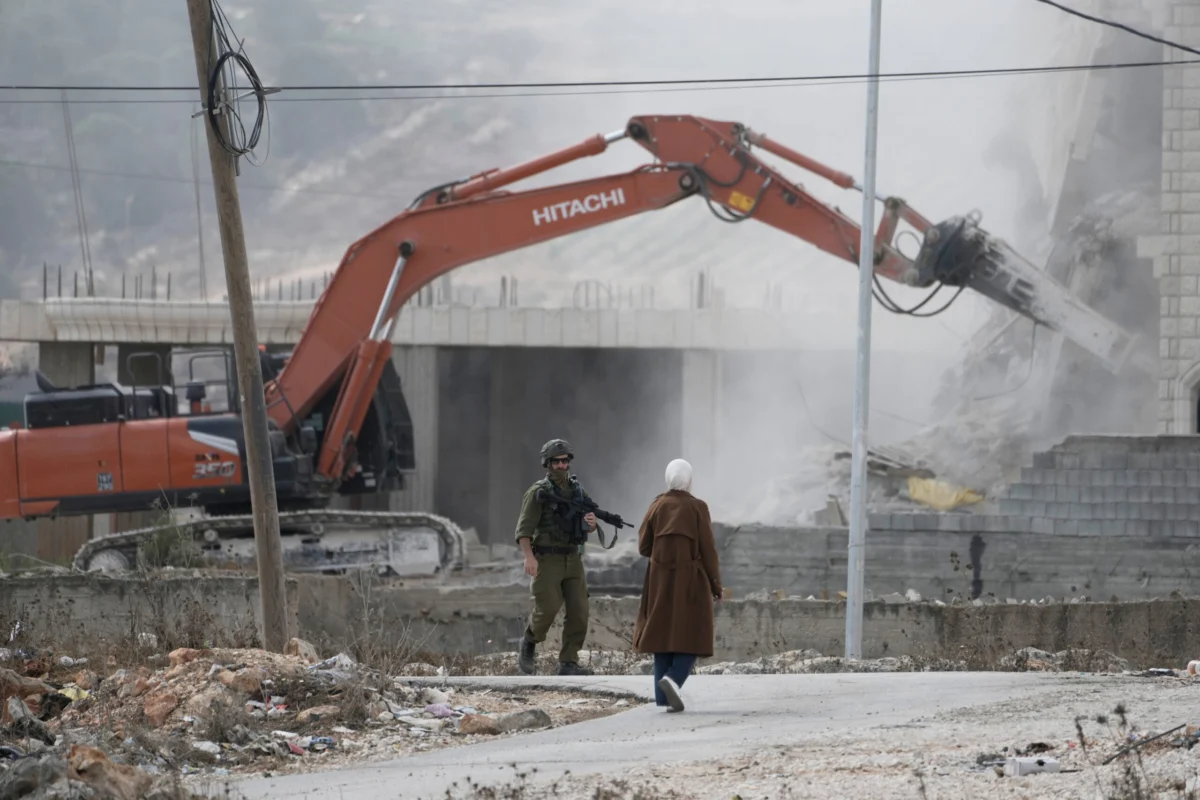
The occupied West Bank continues to witness a surge in violence, characterized by Israeli military demolitions of Palestinian homes in areas like Birzeit and Nablus, and sustained attacks by Israeli settlers against Palestinian communities. These actions, which Palestinians and human rights organizations often describe as "pogroms," have intensified, contributing to an already volatile situation ahead of upcoming Israeli elections. This escalation coincides with renewed international efforts, notably by Ireland, to push for stronger European Union sanctions on goods originating from illegal Israeli settlements, a critical topic at an informal meeting of EU ministers this week.
Immediate Events and On-the-Ground Impact
Monday, October [Insert Specific Date, e.g., 23rd], saw a concentrated series of incidents underscoring the deteriorating security and human rights situation for Palestinians. In the town of Birzeit, located north of Ramallah, Israeli forces carried out the demolition of two residential buildings. The justification provided by Israeli authorities, as reported by the Palestinian news agency Wafa, was the lack of required building permits. This explanation is frequently challenged by Palestinian residents and human rights groups, who argue that obtaining such permits in Israeli-controlled areas of the West Bank (primarily Area C) is an almost impossible bureaucratic hurdle designed to prevent Palestinian development and expansion.
Further south, in the city of Nablus, Israeli forces deployed heavy machinery, including a bulldozer, to raze a two-storey house and a three-storey building that was under construction. The demolitions in Nablus, like those in Birzeit, displaced families and destroyed significant investments, leaving residents homeless and often without recourse. These actions are part of a broader pattern of punitive and administrative demolitions that have long been a feature of the Israeli occupation, profoundly impacting Palestinian livelihoods and their ability to sustain communities.
Concurrent with these demolitions, a significant and violent settler attack unfolded in the village of Burqa, situated east of Ramallah. Verified video footage, including clips reviewed by Al Jazeera, depicted a large group of Israeli settlers raiding the village and engaging in direct confrontations with Palestinians. Eyewitness accounts indicated that settlers entered the village from multiple directions on Monday night, assaulting residents, attempting to set cars alight, and stealing livestock. The confrontations reportedly involved both settlers and Palestinians throwing stones at each other, highlighting the extreme tension and danger faced by Palestinian communities in areas proximate to Israeli settlements. Such attacks not only cause physical harm and property damage but also inflict deep psychological trauma on the affected communities, perpetuating a cycle of fear and insecurity.
Context of Escalating Violence and Settlement Expansion
The events of Monday are not isolated incidents but rather represent a continuation and intensification of trends that have been consistently documented by various international bodies and human rights organizations. The United Nations human rights office, for instance, reported last month that settler violence had reached an "all-time high." This alarming rise in attacks is often coupled with the continued approval and expansion of new Israeli settlements, a process considered illegal under international law. Critics frequently point out that Israeli settlers and the Israeli army often operate in close proximity, and in some cases, appear to act in concert against Palestinian communities, leading to accusations of complicity or inadequate protection for Palestinians.
The phenomenon of settler violence manifests in various forms, including physical assaults, vandalism of property (such as olive trees, a vital source of income for many Palestinian farmers), intimidation, and the harassment of shepherds and farmers attempting to access their lands. These acts are often aimed at dispossessing Palestinians from their land, expanding settlement territories, and making daily life untenable for Palestinians in certain areas, thereby encouraging their displacement. According to data from the UN Office for the Coordination of Humanitarian Affairs (OCHA), 2023 has seen an unprecedented number of settler attacks leading to Palestinian casualties or property damage, surpassing previous years’ figures. For example, OCHA reported over 1,100 settler-related incidents causing casualties or damage to property in the West Bank in the past two years, with a significant spike observed in recent months.
International Law and Legal Frameworks
The core of the international community’s concern lies in the legal status of the Israeli occupation and its associated policies. Under international humanitarian law, specifically the Fourth Geneva Convention, an occupying power is prohibited from transferring its own population into occupied territory. This principle renders Israeli settlements in the West Bank, including East Jerusalem, illegal. Furthermore, the destruction of property by an occupying power is forbidden unless absolutely necessitated by military operations, which is rarely the case for administrative demolitions based on permit issues.
The Israeli military and civil administration, however, enforce Israeli planning laws in Area C of the West Bank, which constitutes over 60% of the territory and remains under full Israeli security and administrative control. Palestinians residing in Area C face extreme difficulty in obtaining building permits from the Israeli Civil Administration. Data indicates that only a tiny fraction of Palestinian permit applications are approved, forcing many to build without permits out of necessity. This creates a Catch-22 situation where Palestinian development is stifled, and structures deemed "illegal" are subject to demolition, leading to displacement and further fragmentation of Palestinian communities.

Diplomatic Efforts and European Union Divisions
The escalating settler violence and continued settlement expansion are prominent items on the agenda of a two-day meeting of EU foreign ministers, which commenced in Ireland on Tuesday. Ireland, currently holding the rotating presidency of the Council of the EU, has emerged as a vocal proponent for stronger action. Having already taken steps to ban settlement goods within its own borders, Ireland is now advocating for a unified approach among EU member states.
The discussions in Ireland are expected to build upon previous deliberations held in Brussels in July. During those earlier talks, a confidential European Commission paper reportedly outlined three potential options for the EU to address the issue of settlement goods: an import licensing system, the imposition of prohibitive tariffs, or an outright ban. While EU rules currently mandate that goods from illegal West Bank settlements be labelled as originating in the occupied territory rather than Israel, the bloc has historically refrained from imposing a comprehensive ban on trade with these settlements, leaving such decisions to individual member states.
The issue of Israel-Palestine policy remains a deeply divisive one among the 27 member countries of the EU. Historically, some member states have maintained strong ties with Israel, often citing security concerns and historical alliances, while others are more sympathetic to the Palestinian cause and critical of Israeli policies in the occupied territories. This division has consistently hampered the EU’s ability to adopt a robust, unified stance, often resulting in watered-down resolutions or a lack of decisive action.
Neale Richmond, an Irish minister of state, articulated Ireland’s firm position, stating unequivocally that Israel’s occupation of Palestinian territory and its failure to curb settler violence constitute breaches of international law. He further criticized what he perceived as support from "certain EU politicians or European politicians" not only for the actions of settlers and settler violence but also for the Israeli government that, in his view, supports them. Richmond’s strong condemnation, particularly his characterization of the broader Israeli government actions as "genocidal," underscores the profound moral and ethical concerns driving Ireland’s diplomatic push. This strong language, while reflecting a particular perspective, highlights the gravity with which some European nations view the situation.
Broader Impact and Implications
The ongoing violence and demolitions have far-reaching implications. For Palestinian communities, the immediate impact is devastating: loss of homes, livelihoods, and the constant threat of displacement. The destruction of agricultural land and vital infrastructure further erodes the economic viability of these communities, pushing them into deeper poverty and dependence. Psychologically, the constant threat of attack and demolition fosters an environment of chronic stress and insecurity, particularly affecting children.
The escalation also has significant political implications. It further entrenches the occupation and makes the prospect of a viable two-state solution increasingly remote. The continued expansion of settlements fragments Palestinian territory, making a contiguous and sovereign Palestinian state a geographical impossibility. This ongoing reality fuels despair among Palestinians and contributes to a sense of injustice, potentially leading to further instability and conflict in the region.
Domestically in Israel, the upcoming elections in October add another layer of complexity. The issue of settlements and security often becomes a focal point in Israeli election campaigns, with various political factions vying for votes by adopting strong stances on these issues. The settler movement holds considerable political sway, and calls for increased settlement activity or a firmer hand against Palestinians often resonate with segments of the Israeli electorate. This political dynamic can sometimes contribute to a permissive environment for settler actions and a reluctance to rein them in.
Internationally, the EU’s struggle to forge a common policy on settlement goods reflects a broader challenge in upholding international law and human rights principles in the face of complex geopolitical realities. A failure to act decisively could be perceived as tacit approval of illegal activities, undermining the EU’s credibility as a proponent of international law and human rights. Conversely, a unified and robust EU response could exert significant economic and political pressure on Israel, potentially prompting a re-evaluation of its policies in the occupied territories.
The international community, including the United Nations and various human rights organizations, consistently calls for an end to settlement expansion, settler violence, and demolitions. They urge Israel to adhere to its obligations under international law and protect Palestinian civilians. However, without concrete enforcement mechanisms and unified political will from major global powers, these calls often remain unheeded, allowing the cycle of violence and displacement to persist, further diminishing prospects for a just and lasting peace. The unfolding events in the West Bank serve as a stark reminder of the urgent need for renewed diplomatic efforts and accountability to de-escalate tensions and protect human rights.
