

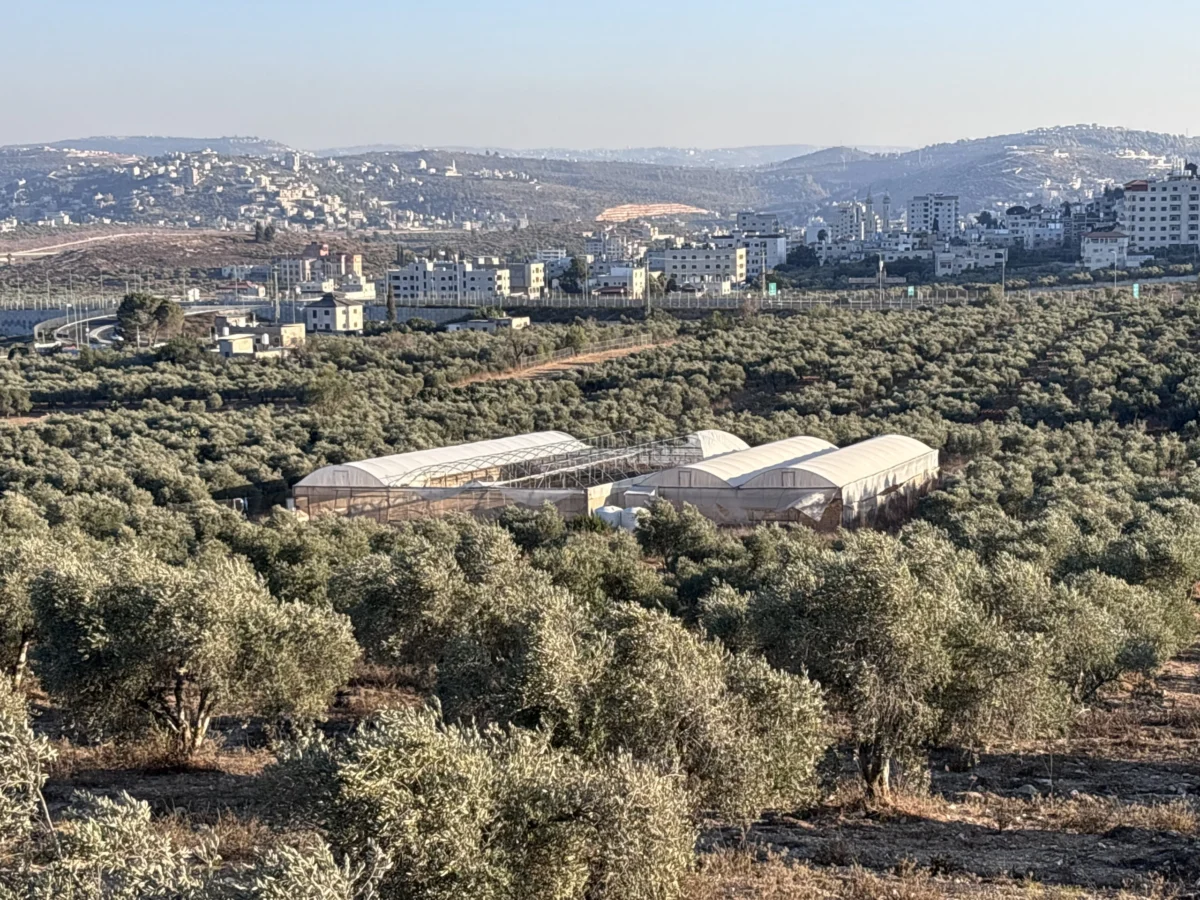
In the village of Burin, nestled within the occupied West Bank, the rhythms of daily life are inextricably linked to the pervasive presence of the Israeli military and the constant threat of settler violence. For Ghassan Najjar, a prominent figure in Burin’s Land and Farming Cooperative, the sound of Israeli army vehicles entering the village is a frequent and unwelcome signal, prompting calls and a collective readiness for disruption. These daily incursions, characterized by armored personnel carriers navigating narrow streets and soldiers often forcing the closure of local shops, represent just one facet of the relentless pressure exerted on Palestinian communities in the region.
Najjar, along with approximately two dozen other farmers, is a member of the cooperative, an organization born from a profound understanding that direct armed confrontation with Israel’s military might is not an option. Instead, their resistance is rooted in the soil itself—a steadfast commitment to cultivating their land and preserving their ancestral connection to it. This agricultural activism, however, unfolds against a backdrop of escalating hostilities, most notably settler attacks, which Palestinians across the West Bank describe as reaching a fever pitch, akin to a pogrom. These settlers reside in outposts and settlements built on occupied Palestinian land, structures widely considered illegal under international law.
A Chronology of Provocation and Destruction
The cooperative recently experienced a stark illustration of this volatile environment. On July 13, a settler attempted to graze his flock within one of the cooperative’s five greenhouses, a brazen act of trespass on cultivated land. Members of the cooperative intervened, struggling to deter the livestock until Israeli border police arrived on the scene. Najjar recounts challenging the officers, questioning how a settler was permitted access to land that the army itself had designated a closed military zone—a status that, on paper, also bars Israeli citizens. The settler, visibly angered by the confrontation, departed with a chilling threat to Najjar: "You’ll see."
The ominous promise materialized the following night. Approximately ten settlers returned, systematically vandalizing all five of the cooperative’s greenhouses. They meticulously cut away the protective plastic sheeting, rendering the structures useless, and deliberately destroyed the intricate irrigation networks essential for farming. The financial toll of this act of sabotage was substantial, estimated by the cooperative to be around 30,000 shekels (approximately $10,000) for the plastic sheeting alone. Compounding the loss, 9,000 tomato seedlings, valued at 8,000 shekels ($2,670), had been purchased just that morning for planting. Deprived of their protective environment, these nascent crops perished within hours.
For a cooperative that pools land, labor, and produce among roughly 25 families, this destruction had ripple effects far beyond the physical damage to the greenhouses. "We’re talking about 25 families working inside the cooperative," Najjar emphasized, highlighting the collective impact. He described the current year as "the most difficult" for the cooperative, citing the increasing frequency and severity of attacks from both settlers and the military.
The agricultural losses extended rapidly. Just weeks after the greenhouse incident, Burin lost more than 1,500 olive and other trees, according to Najjar’s count. Some were intentionally burned by settlers, while others were cut down or uprooted by military bulldozers operating along a local route accessible to Israelis but explicitly restricted for Palestinians. The wheat harvest also suffered significant damage; of the 10,000 square meters (2.5 acres) planted by the cooperative, a devastating 7,000 square meters (1.7 acres) were burned before farmers could even begin harvesting the crop that summer. Much of Burin’s farmland now falls within "closed military zones," designations Najjar states are renewed every month or two. While officially issued on security grounds, ostensibly to protect against attacking settlers, in practice, these orders disproportionately restrict the Palestinian landowners whom the settlers are targeting.
A Broader Pattern of Violence and Dispossession
The challenges faced by Burin are not isolated incidents but rather symptomatic of a wider, escalating trend across the West Bank. The United Nations Office for the Coordination of Humanitarian Affairs (OCHA) recorded a staggering 1,418 settler attacks resulting in casualties or property damage across the West Bank through July of the current year. This alarming rate is projected to surpass the record high of 1,836 such attacks recorded in 2025, signaling a worrying intensification of violence.
Prominent human rights organizations, including Human Rights Watch and Amnesty International, have consistently accused Israeli authorities of enabling these settler attacks. Their reports frequently describe the cumulative effect of such violence on Palestinian communities as contributing to forced displacement, a severe violation of international humanitarian law. These organizations argue that the systemic failure to protect Palestinians from settler violence, coupled with the military’s restrictive policies, creates an environment where Palestinians are increasingly dispossessed of their land and livelihoods. The establishment and expansion of settlements and outposts, deemed illegal under Article 49 of the Fourth Geneva Convention, further exacerbate tensions and contribute to the fragmentation of Palestinian territory.
The "Tom and Jerry Programme" and the Spirit of Resilience
In this context of continuous siege and violence, Najjar and the cooperative members have developed a unique, albeit bittersweet, strategy they affectionately term the "Tom and Jerry Programme," inspired by the classic cartoon. "We go to the land early every morning," Najjar explained. "When the army comes, we run away. And when the army goes, we come back again." This seemingly simple routine is a profound act of non-violent resistance, a daily assertion of presence and ownership. "Even if we don’t have planting or harvesting to do on the land, we [go to] drink coffee – to tell the settlers and the army that this is our land and we’re not going to leave it," he stated, encapsulating the unwavering resolve.

Building Towards Food Sovereignty: A Cooperative’s Vision
The Land and Farming Cooperative was founded by Najjar in March 2020, mere weeks before the COVID-19 lockdowns swept through the West Bank. Starting with just five members, it has since grown to include approximately 25 individuals, 17 of whom are women, collectively farming around 25,000 square meters (6 acres) of land around Burin.
Najjar’s vision for the cooperative was always more expansive than mere agriculture. "We’re not just a cooperative that plants vegetables and sells them," he asserted. "For us, the cooperative straddles the economic and the political because everything is connected." He perceives the cooperative as simultaneously fighting on three distinct but interconnected fronts: the Israeli occupation, which imposes military control and restrictions; what he terms the "bureaucracy" of the Palestinian Authority, which can sometimes hinder grassroots initiatives; and the broader "umbrella" of capitalism and NGO funding structures, which he believes often come with limiting conditions.
The cooperative embodies a strong commitment to community welfare and self-reliance. Fifteen percent of all its sales are reinvested back into the village, funding crucial children’s and women’s programming. Initially, the cooperative provided free vegetables to 20 families identified as most in need. However, they have since evolved this approach, shifting towards a more empowering model by helping these families cultivate small plots of their own. This initiative, dubbed their "don’t give me fish; teach me to fish" program, epitomizes their philosophy. "This is the real food sovereignty," Najjar declared. "People who don’t eat from what they’ve grown will never have real freedom."
Before becoming full members, new recruits undergo a rigorous six-month training program. This curriculum covers not only the political economy of the occupation but also the practicalities of agroecology, including sustainable methods for soil treatment and pest management without resorting to harmful chemicals. Regular meetings every two weeks facilitate work planning, and monthly evaluations ensure continuous improvement and adaptation.
Vision Forged in Isolation
Much of the cooperative’s foundational vision was conceptualized by Najjar during a period he refers to as "the Palestinian school of revolution": Israeli prison. Two months after the cooperative’s establishment, Najjar was placed under administrative detention, a controversial Israeli policy that allows for the indefinite holding of Palestinians without charge or trial. He spent approximately a year in prison, with four months in solitary confinement. "In isolation, I thought a lot about the cooperative because, to be honest, it gives you the time to think," he reflected. "I wrote all the procedures and the goals for the cooperative – exactly what we needed." Upon his release, he found that the cooperative members, in a testament to their collective spirit, had not only sustained but expanded their operations, building two additional greenhouses and bringing three more plots of land under cultivation.
"The cooperative is not for us," Najjar emphasized, underscoring its enduring, institutional nature. "If Ghassan gets arrested, if Ghassan dies, if Ghassan is travelling, the cooperative doesn’t close. It’s for the farmers, for Burin, for whoever believes in freedom and food sovereignty."
"We Prefer to Die on Our Land"
The July attack on the greenhouses marked the seventh time the cooperative had suffered such vandalism or destruction. When questioned about the motivation to continuously rebuild structures that may simply be torn down again, Najjar repeatedly returns to the concept of dignity. "This is the work between the evil and the right. You have to decide which side you’re going to be on," he articulated. "We decided to be at the front of the struggle because this is our land. We connect our dignity to the land, and I don’t think anyone in this world can live without dignity."
Burin itself is geographically vulnerable, sandwiched between the notoriously violent settlements of Yitzhar and Har Brakha, and the Givat Ronen outpost. In recent months, Najjar notes, 13 outposts have been established or expanded in the vicinity. Despite the escalating pressure, Najjar observes a shift in the village’s perception of his work, from initial bemusement to profound respect, viewing the cooperative’s persistence as a fundamental victory against psychological occupation. "The real occupation is not when they create the checkpoint and invade the village," he asserted. "The real occupation is if they occupy your mind. When you are waking up in the morning and working your land – this is the real freedom."
For now, that unwavering resolve manifests in the early morning "Tom and Jerry" trips to their lands and in the arduous task of replacing what was destroyed. They are also building a fence, a modest hope that it might at least slow the next attack. "We prefer to die on our land rather than accept another Nakba," Najjar declared, referencing the 1948 displacement of Palestinians. "We work as a family, we work as comrades and we work for freedom."
Najjar concluded with a defiant rejection of superficial notions of peace: "We’re not working just for economic reasons or for ‘peace.’ F*** ‘peace.’ I care about freedom. And when you work the land, you feel you have freedom, even if you are under attack by the settler." His words encapsulate the profound connection between land, identity, and the relentless pursuit of self-determination in the face of ongoing occupation and violence.
