

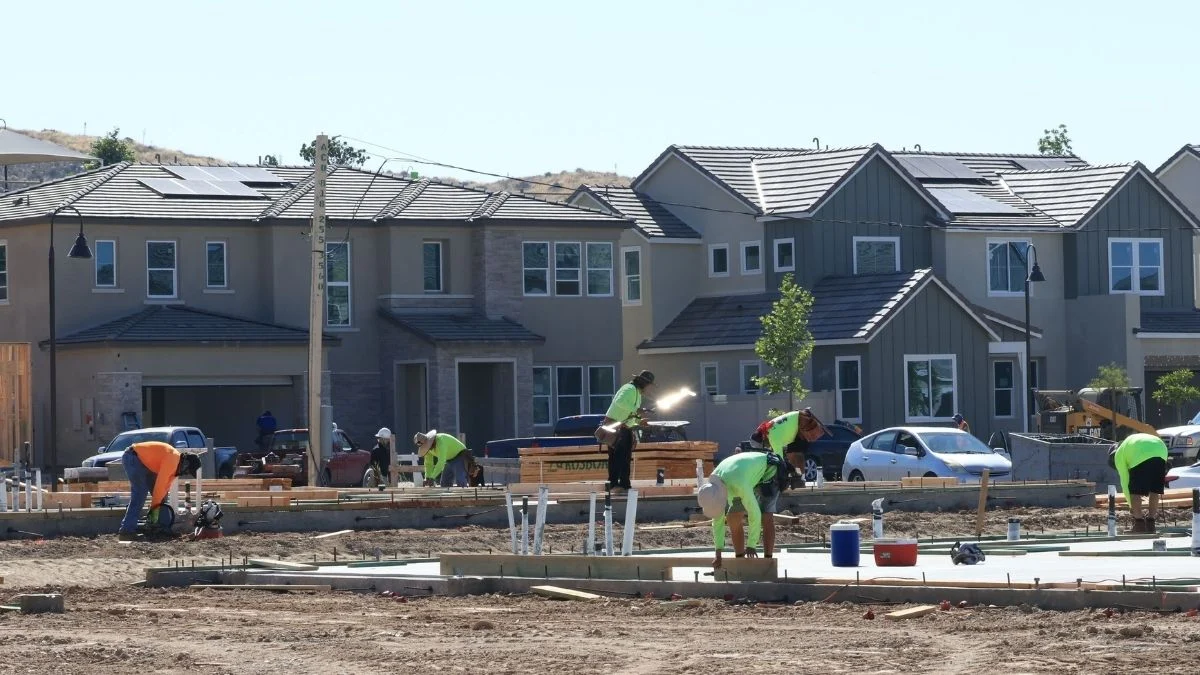
U.S. Immigration and Customs Enforcement (ICE) agents recently executed a high-intensity operation at a residential construction site in Martinsburg, West Virginia, utilizing drones and battering rams to detain approximately 30 workers. The incident, characterized by local homebuilding executives as unprecedented in its aggression, marks a significant escalation in a months-long enforcement campaign that is currently disrupting the residential construction industry across several U.S. markets. This intensification of immigration enforcement has left builders facing critical labor shortages, operational gridlock, and escalating financial pressures that threaten the viability of ongoing housing projects.
The operation in Martinsburg is not an isolated event but rather part of a broader national trend. According to data from the Deportation Data Project at UC Berkeley and UCLA, July 2026 recorded a historic peak in ICE arrests, totaling 49,571—the highest monthly figure on record. This surge follows the passage of a $70 billion immigration enforcement bill by the U.S. Senate in early June, which provided the federal government with the resources necessary to scale operations significantly. As the administration aims for a target of 2,000 arrests per day, the homebuilding sector, which relies on immigrants for approximately 25% of its workforce, finds itself at the center of the resulting economic and social turbulence.
A Growing Climate of Fear and Labor Attrition
The immediate impact of these enforcement actions has been the creation of a "culture of fear" that transcends the legal status of individual workers. In regions such as West Virginia’s Eastern Panhandle, Idaho, and South Texas, builders report that even workers with valid documentation are refusing to report to job sites or travel across state lines. The psychological toll on the workforce has led to mass resignations and "no-shows," effectively halting construction in markets that were previously experiencing high demand for new housing.
In West Virginia, a homebuilding executive speaking on the condition of anonymity noted that the intensity of raids has "ramped up significantly" over the past few weeks. This has led to a near-total collapse of the local trade base. Field reports indicate that delivery drivers are now refusing to cross the West Virginia state line, fearing checkpoints where law enforcement reportedly stops vehicles based on the ethnic appearance of the occupants. Consequently, builders are forced to source labor from as far away as Florida or Minnesota, paying exorbitant premiums for lodging, per diems, and rental vehicles to maintain some level of productivity.
Record-Setting Arrests and Policy Drivers
The statistical backdrop of this crisis reveals a strategic shift in federal enforcement. While ICE arrests fluctuated around 30,000 per month in the early part of 2026, the legislative developments in June acted as a catalyst for the current surge. The $70 billion infusion of capital into the Department of Homeland Security (DHS) has enabled ICE to expand its reach, particularly in jurisdictions that participate in the 287(g) program. This program allows state and local law enforcement agencies to perform certain functions of federal immigration officers, creating a force-multiplier effect in "cooperating" states.
The geographical distribution of these raids is notably uneven. While homebuilding associations in states like Indiana, Arizona, and Kansas report little change in enforcement activity, states like Texas, Florida, Idaho, and Pennsylvania have become hotspots. In July 2026 alone, Texas and Florida accounted for nearly 40% of all ICE arrests nationwide. This regional concentration has created a fragmented housing market where some areas remain stable while others face what industry leaders describe as a "crippling" blow to the construction supply chain.
Regional Snapshots: Idaho, Texas, and Pennsylvania
In Idaho, the enforcement landscape shifted dramatically in August 2026. Steve Martinez, a national state delegate with the Idaho Home Builders Association, observed that while enforcement was rare in previous years, recent raids in Boise-area communities like Nampa and Eagle have sent shockwaves through the local industry. Martinez and other contractors have resorted to group texts and encrypted messaging to warn one another of ICE presence in the field, a practice that has become a necessary survival tool for project management.
In Texas, the situation is even more dire. Mario Guerrero, Executive Director of the South Texas Builders Association, reports that the fear among workers has "skyrocketed" since the June funding bill. In one instance, a bricklayer with valid U.S. work authorization was arrested mid-job, causing the builder to lose both the labor and a $4,000 deposit. Similar stories of U.S. citizens and legal residents being detained for hours for "profiling" have become common. Nicholas Riley, a roofing contractor in Austin, noted that his legal immigrant workers are now reluctant to take jobs in San Antonio or San Marcos, leading to significant scheduling delays and a backlog of unfinished roofs.

In Pennsylvania, specifically in the South Central region encompassing Harrisburg and York, builders report that some projects are being raided as frequently as every two weeks. This persistence has caused a "bidding war" for the remaining legal labor pool, as subcontractors realize they can demand higher wages to compensate for the perceived risk of working in high-enforcement zones.
Economic Implications for the Housing Market
The disruption of the construction labor force has direct and measurable impacts on the cost and availability of housing. Builders report that framing labor costs—one of the most significant expenses in home construction—have jumped by 25% to 50% in affected markets. In the Eastern Panhandle of West Virginia, some framing costs have reportedly tripled over a 30-day period.
These labor shortages translate into severe project delays. Foundations that typically wait days for a framing crew are now sitting idle for over 45 days. For homebuyers, this means closing dates are being pushed back indefinitely. Many buyers, already struggling with high interest rates and pricing imbalances, are seeing their "rate locks" expire or their moving plans collapse because builders cannot guarantee when a home will be finished.
The "racket" of transporting out-of-market labor further inflates the price of a finished home. When a builder must pay for a worker’s hotel, food, and a "non-construction" rental car to avoid detection at checkpoints, those costs—ranging from $2,000 to $5,000 per unit—are either passed on to the consumer or absorbed by the builder, the latter of which puts smaller firms at risk of bankruptcy.
Official Responses and Political Stalemate
Despite the escalating crisis, efforts by homebuilders to seek relief from state and federal officials have largely proven futile. In West Virginia, industry leaders have held meetings with the governor’s office, the attorney general, and the Department of Labor. According to participants, while officials express "understanding," no substantive policy changes or moratoriums on site raids have been implemented.
At the federal level, the message remains one of continued aggression. Representatives from the homebuilding industry who attended recent congressional hearings in Washington, D.C., report that the administration has no intention of scaling back. Instead, the policy is to "double down" on enforcement, viewing it as a fulfillment of campaign promises and a necessary component of national security.
This political stalemate leaves builders in a precarious position. The industry is being asked to solve a national housing shortage while simultaneously losing the workforce required to build the homes. Industry analysts suggest that if the current pace of enforcement continues, the "trade base" in several key U.S. markets may be permanently damaged, leading to a long-term contraction in housing supply and a further spike in home prices.
Analysis of Long-Term Impacts
The ongoing ICE operations represent a fundamental shift in the risk profile for residential development. Beyond the immediate loss of labor, the "chilling effect" on the industry may lead to:
- Market Exit: Larger developers may choose to "bug out" of high-enforcement states, shifting their capital to regions where the labor pool is more stable.
- Increased Automation: The labor vacuum may accelerate the adoption of pre-fabricated and modular housing, though these technologies currently lack the scale to replace traditional site-built construction entirely.
- Financial Fragility: Subcontractors, who often operate on thin margins, may face insolvency if their crews are detained or if they cannot fulfill contracts due to labor flight.
- Housing Affordability Crisis: As builders absorb or pass on the "enforcement premium," the dream of homeownership moves further out of reach for the average American, particularly in growth markets like the West Virginia Panhandle or Central Texas.
As the second and third parts of this series will explore, the push for policy solutions and the domestic effort to build skilled labor capacity are now more urgent than ever. However, for the builders currently watching their job sites "swarm with drones," the immediate reality is one of survival in an environment where the rules of engagement have fundamentally changed.
