

The National Venture Capital Association (NVCA) recently featured Will Borthwick of BOLD Capital Partners in its "Meet a VC" series, an initiative designed to illuminate the individuals, philosophies, and driving forces within the venture capital industry. Borthwick’s journey, emblematic of a shifting paradigm in finance, underscores a profound commitment to investing in founders who are not merely building companies, but architecting the future through what BOLD Capital terms "exponential technologies"—innovations poised to fundamentally advance humanity.
The NVCA’s "Meet a VC" Series: Illuminating Industry Leadership
The NVCA’s "Meet a VC" series serves as a crucial platform for transparency and education within the often-misunderstood world of venture capital. By profiling leading figures like Will Borthwick, the series aims to demystify the investment process, showcase diverse career paths, and highlight the strategic thinking that underpins successful venture firms. These interviews offer invaluable insights into the perspectives and convictions that guide investment decisions, fostering a deeper understanding among entrepreneurs, policymakers, and the broader public about the vital role venture capital plays in economic growth and technological progress. For an industry that has grown exponentially itself, from a niche sector to a global powerhouse, such initiatives are critical in shaping narratives and demonstrating value beyond purely financial metrics. The series consistently emphasizes the human element of venture capital, portraying VCs not just as capital allocators but as partners, mentors, and strategic advisors to the innovative companies they support.
From Traditional Finance to the Vanguard of Innovation: Will Borthwick’s Trajectory
Will Borthwick’s professional trajectory is a compelling narrative of evolution from the structured corridors of traditional finance to the dynamic frontier of exponential technology investment. His career began within the esteemed institutions of the Federal Reserve, providing him with a foundational understanding of macroeconomic forces and financial systems. This early experience was followed by a significant tenure in investment banking, where he honed his analytical skills and gained exposure to complex corporate transactions. Subsequently, his expertise broadened into private equity, focusing on large-scale buyouts of established technology companies. This diverse background equipped him with a comprehensive financial toolkit, blending macroeconomic insight with deep corporate finance and M&A experience.
However, approximately eight and a half years ago, Borthwick made a deliberate pivot, joining BOLD Capital Partners. This decision was driven by a powerful confluence of factors: the allure of a team composed of seasoned entrepreneurs and investors, and a compelling investment thesis centered on "exponential technologies." Unlike linear advancements, exponential technologies are characterized by capabilities that improve at an accelerating rate, often doubling in power or efficiency within short periods. This rapid evolution means that what was considered infeasible or purely theoretical eighteen months prior can become a practical reality today. For Borthwick and BOLD Capital, the fundamental question then becomes: "How do you leverage this transformative shift to address truly significant and impactful global challenges?" This ethos, encapsulated by the query, "How do you fundamentally move the needle to make humanity better?", defines BOLD Capital’s investment philosophy and Borthwick’s personal commitment.
BOLD Capital’s Investment Thesis: Harnessing Exponential Technologies
BOLD Capital Partners distinguishes itself through its unwavering focus on exponential technologies—a category of innovation that includes, but is not limited to, artificial intelligence (AI), advanced robotics, biotechnology, quantum computing, space exploration, and synthetic biology. These fields are marked by rapid, non-linear advancements that promise to reshape industries, economies, and human existence itself. The firm’s thesis is built on the premise that these technologies are not just incremental improvements but foundational shifts that create entirely new possibilities and solutions for humanity’s grandest challenges.
The market for these technologies is experiencing unprecedented growth. For instance, the global AI market, valued at approximately $150 billion in 2023, is projected to exceed $1.8 trillion by 2030, demonstrating a compound annual growth rate (CAGR) of over 37%. Similarly, the commercial space industry, estimated at around $400 billion currently, is forecast to reach well over $1 trillion in the coming decades. Biotechnology and advanced robotics also show similar trajectories of rapid expansion and profound impact. BOLD Capital strategically positions itself within these burgeoning sectors, identifying companies at the cutting edge of these developments.
The BOLD portfolio vividly illustrates this ambition, featuring investments in diverse and groundbreaking areas such as stratospheric drones, which offer new paradigms for communication and surveillance; de-extinction initiatives, pushing the boundaries of genetic science; humanoid robotics, poised to redefine labor and human-machine interaction; and AI-enabled hardware, integrating intelligence directly into physical systems. These investments are not merely speculative bets on future trends but calculated commitments to foundational technologies that BOLD believes will form the infrastructure of tomorrow’s world. The firm’s approach is to identify visionary founders who possess not only the technical prowess but also the strategic foresight to apply these exponential capabilities to solve problems on a global scale.
The Transformative Decade: Scaling Capital and Complexity in Venture Capital
Will Borthwick has been a firsthand witness to the dramatic evolution of the venture capital industry over the past decade. He recalls a time when VC was largely perceived as a "small, cottage, bespoke, artisanal industry." This characterization highlighted a landscape where deals were often smaller, more intimate, and driven by a tight-knit community of investors. A Series A funding round of $15-20 million was considered substantial, reflecting a more conservative approach to early-stage capital deployment.
Fast forward to today, and the landscape is virtually unrecognizable. The scale of capital flowing into venture has exploded, transforming it into a mainstream asset class. Data from industry reports such as PitchBook and CB Insights confirm this seismic shift. Global venture capital funding surged from under $100 billion annually in the early 2010s to peak at over $680 billion in 2021, before a market correction in 2022 and 2023 still saw hundreds of billions deployed. Average Series A rounds, once in the single-digit millions, now routinely reach $30-50 million, with "mega-rounds" of $150 million or more becoming increasingly common, especially for companies perceived to have high growth potential in critical sectors like AI and biotech.
This influx of capital has brought increased competition, not only among startups vying for funding but also among VC firms themselves. The industry has seen the emergence of new players, including corporate venture capital arms, sovereign wealth funds, and large institutional investors, all seeking to tap into the high-growth potential of private markets. While this capital abundance offers unprecedented opportunities for founders, it also intensifies the pressure to demonstrate rapid scalability and market dominance.
The Inherent Difficulty of Building and Investing in Generational Companies

Despite the massive infusion of capital, Borthwick emphasizes that the core challenge of company building remains incredibly difficult. He candidly admits that early in his career, witnessing the meteoric rise of companies like Facebook and Snapchat from nascent concepts to multi-billion-dollar valuations, he might have underestimated the sheer grit and resilience required. "It turns out it’s incredibly hard," Borthwick states, acknowledging the immense hurdles founders face. "It’s even harder to build a generational company." A "generational company" implies an enterprise that not only achieves significant financial success but also leaves an enduring impact on society, often redefining an entire industry or creating a new market.
The difficulty extends equally to the investor side. Borthwick points out, "But it’s also very hard to invest, support, and find the entrepreneurs capable of doing it." This highlights the dual challenge: identifying truly transformative ideas and the exceptional individuals behind them, and then providing the robust support necessary for them to navigate the arduous path to success. The venture capital model, by its very nature, accepts a high rate of failure, with only a small percentage of investments delivering the outsized returns needed to justify the portfolio’s risk. This makes the selection process and the subsequent partnership with founders critically important.
Beyond the Check: The "Marriage" of Capital and Support
For Will Borthwick, venture capital transcends the mere transaction of capital allocation. He firmly posits that "Venture isn’t a fancier broker-dealer collecting a fee on the wire. It’s what happens after." This philosophy underscores a deep-seated belief in active partnership, viewing the investment not as a standalone event but as the commencement of a profound, long-term commitment. "When we invest into a company, it’s truly a marriage – not a date or a fling. We get in the bunker with you through thick or thin."
This "marriage" metaphor signifies a comprehensive and unwavering commitment to founders, recognizing that their journey is often fraught with isolation and immense pressure. The role of a CEO or founder is frequently cited as one of the loneliest jobs, where the ultimate responsibility for success or failure rests squarely on their shoulders. In this context, the venture capital partner steps into a multifaceted support role that extends far beyond financial oversight.
BOLD Capital’s approach, mirroring Borthwick’s conviction, involves active engagement across numerous fronts:
- Strategic Advice: Providing guidance on market positioning, product development, and scaling strategies.
- Network Access: Leveraging extensive industry connections for crucial introductions to potential customers, strategic partners, and executive talent. This includes facilitating hires for critical leadership roles.
- Operational Expertise: Offering insights drawn from experience in scaling companies, navigating regulatory landscapes, and managing rapid growth.
- Psychological Support: Acknowledging the emotional toll of entrepreneurship, VCs serve as a sounding board, a source of encouragement, and, as Borthwick puts it, "Whether it’s a shoulder to cry on or a person to scream at, that’s an important part of the role."
This hands-on, empathetic approach transforms the VC from a passive investor into an "operator-investor." This model recognizes that venture partners, often with entrepreneurial backgrounds themselves, can bring invaluable operational insights and practical guidance to the table. This philosophy of deep engagement and unwavering support is increasingly becoming a differentiator in the competitive VC landscape, as founders seek "smart money" that offers more than just capital.
Addressing Misconceptions: The Realities of Entrepreneurship and Venture Capital
Will Borthwick highlights two critical areas where public perception often diverges significantly from the realities of the venture capital and entrepreneurial ecosystems.
The first concerns founders. He laments the "unnecessary roadblocks" that often impede innovators. Building a company, especially one aiming for transformative impact, is an extraordinarily difficult endeavor. Founders are driven by a powerful impulse to "change the world in an impactful way," originating from "a place of good." They are problem-solvers, envisioning solutions that can improve human lives, create efficiencies, and push the boundaries of what’s possible. Yet, they frequently encounter bureaucratic hurdles, complex regulatory frameworks, talent acquisition challenges, and market resistance that can stifle innovation. Industry advocates, including the NVCA, frequently lobby for policies that foster a more conducive environment for startups, recognizing that technological progress, driven by entrepreneurialism, has historically been the primary engine of human advancement and economic prosperity. Streamlining regulatory processes, encouraging skilled immigration, and investing in STEM education are often cited as key policy levers to support this vital ecosystem.
The second misconception pertains to venture capitalists themselves. Borthwick confronts the "cartoon version" of VCs—a caricature often depicting them as aloof figures who engage in superficial "five-minute meetings," dispense "large checks," and then "walk away." This portrayal, he argues, bears little resemblance to the dedicated professionals he works with daily. The reality is far more nuanced and demanding. Venture capital involves extensive due diligence, often months of research and relationship-building before an investment is made. Post-investment, the commitment is deep and long-term, requiring significant time, strategic thinking, and active involvement with portfolio companies. "We are capital allocators and investors, but in a lot of ways we’re entrepreneurs ourselves," Borthwick reiterates. "I’d view it almost as an operator-investor, rather than a passive investor." This active, engaged role is crucial for navigating the inherent risks and maximizing the potential for success in early-stage ventures.
Optimism Amidst Uncertainty: The Democratization of Capability
In a world frequently characterized by uncertainty and an information environment that amplifies every challenge, Will Borthwick maintains a profound sense of optimism. This optimism is not born of naivety but from a deep understanding of the underlying trajectory of technological progress and its societal implications. He frames this progress as a "longer arc of democratization of capability."
Historically, groundbreaking technologies and powerful tools were accessible only to a select few: large corporations, governments, or elite research institutions. Borthwick offers a compelling chronology of this democratization:
- Twenty years ago: Building a scalable technology company often required substantial capital investment in physical infrastructure, such as owning and managing proprietary server racks. This was a significant barrier to entry for many.
- Then came cloud compute on demand: The advent of cloud computing services from providers like Amazon Web Services (AWS), Microsoft Azure, and Google Cloud Platform revolutionized this, offering scalable, pay-as-you-go infrastructure. This dramatically lowered the cost and complexity of launching and scaling tech ventures, empowering smaller teams and startups.
- Now we have intelligence on demand in the palm of our hands: The most recent phase is the widespread accessibility of advanced artificial intelligence capabilities. Large language models, sophisticated data analytics, and powerful AI tools are now available through APIs, open-source platforms, and user-friendly interfaces, often accessible via smartphones or standard computing devices. This means individuals and small teams can leverage computational power and intelligence that was once the exclusive domain of supercomputers or highly specialized research labs.
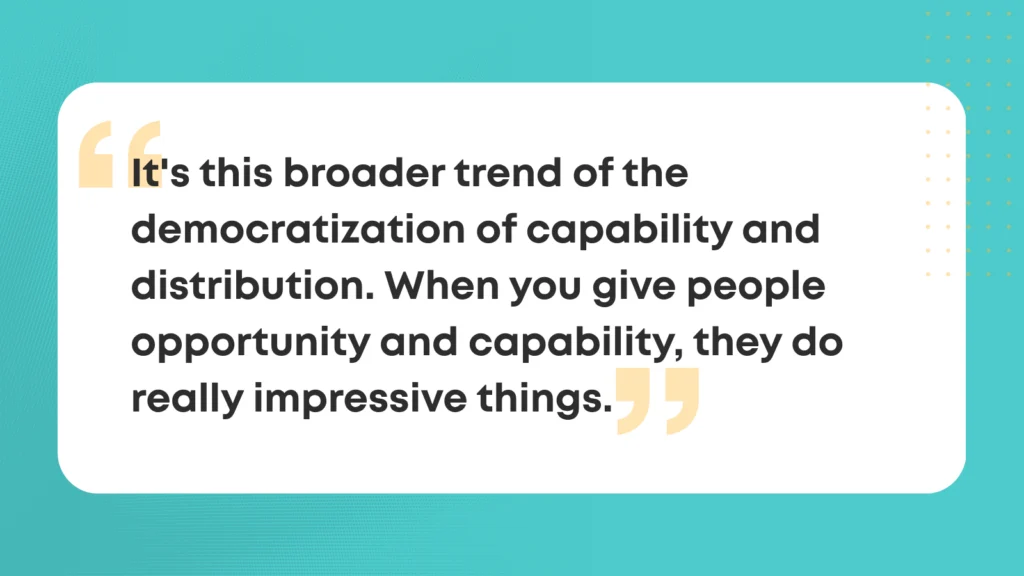
This continuous lowering of barriers to entry and the increasing accessibility of powerful tools mean that "when you give people opportunity and capability, they do really impressive things." This sentiment encapsulates the core of Borthwick’s optimism: human ingenuity, when amplified by democratized technology, has an unbounded potential to solve problems and create value. "And it’s only going to get better tomorrow, and a year from now, and five years from now. It’s like we have superpowers – and our superpowers just keep getting stronger."
This conviction is what sustains Borthwick’s dedication to BOLD Capital’s mission. The companies that BOLD backs are not merely developing new products or services for existing markets. They are, fundamentally, "building the infrastructure of what humanity will be capable of next." This perspective elevates their investment strategy beyond commercial returns to a broader vision of shaping the future of human potential and collective achievement. By investing in the pioneers of exponential technologies, BOLD Capital is actively contributing to the foundation upon which future generations will build, innovate, and thrive.
