

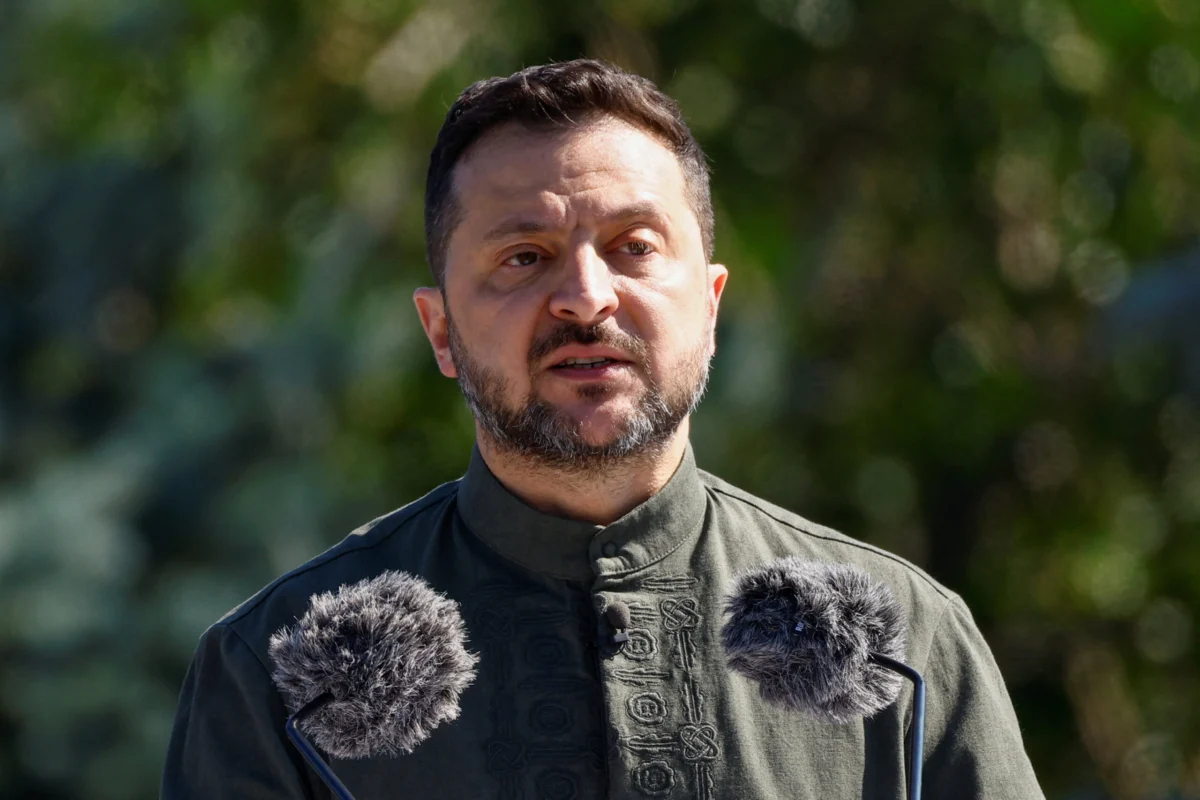
Ukrainian President Volodymyr Zelenskyy has formally dismissed growing calls to hold national elections while the country remains locked in a full-scale war with Russia, characterizing the proposal as a "huge risk" that could trigger a domestic "tsunami" of instability. The president’s remarks, delivered during an extensive press briefing on Saturday and published on Sunday, mark a definitive stance against a burgeoning internal political movement led by former high-ranking officials who argue that the suspension of democratic processes is beginning to undermine the nation’s governance.
The debate over Ukraine’s democratic schedule has intensified as the conflict enters its fifth year. Under Ukrainian law and the current state of martial law, all elections—including presidential and parliamentary votes—are strictly prohibited. While this legal framework has remained largely unchallenged since the 2022 invasion, the recent dismissal of former Defence Minister Mykhailo Fedorov has catalyzed a new wave of domestic dissent. Fedorov, a 35-year-old political figure whose popularity surged during his six-month tenure, has become the primary advocate for a wartime vote, arguing that Kyiv faces a "systemic crisis of governance" that can only be resolved through the ballot box.
The Internal Political Rift: Zelenskyy vs. Fedorov
The confrontation between the presidency and the former defense chief highlights a rare moment of public political friction in a country that has largely maintained a unified front since the war began. Fedorov was removed from his post by Zelenskyy in July 2026, a move that sparked sporadic protests across major Ukrainian cities. Following his ousting, Fedorov released a nine-minute video on YouTube that quickly went viral, challenging the narrative that security concerns should override democratic mandates.
"Can Russia actually be entitled to define when Ukrainians can elect their authorities next time?" Fedorov asked in the video, suggesting that by delaying elections, Ukraine is inadvertently granting the Kremlin a "veto" over its democratic health. He asserted that the current administration is struggling with efficiency and that a fresh mandate is required to navigate the increasingly complex military and economic landscape.
President Zelenskyy, however, countered this logic with a stark warning about national cohesion. "I believe that in a war like this, elections as such are a huge risk," Zelenskyy told reporters. "Elections right now are a tsunami for the country that will split Ukraine. If we want to destroy the country, then we can move in the direction of elections during these times of war."
The president’s rhetoric reflects a deep-seated concern that a political campaign would distract from the war effort, drain essential financial resources, and provide Russia with opportunities to exploit internal divisions through disinformation and targeted strikes on polling stations.
The Logistical and Legal Impasse
Beyond the political rhetoric, the practicalities of holding a national election in a country under constant bombardment remain nearly insurmountable. Legal experts and international observers, including analysts cited by Al Jazeera, have pointed out several "practically impossible" hurdles that would compromise the integrity of any wartime vote:
- Security Risks: Polling stations would serve as high-value targets for Russian missile and drone strikes. Gathering large numbers of civilians in specific locations on a publicized date would present a catastrophic security risk.
- Disenfranchisement of Soldiers: Hundreds of thousands of Ukrainian citizens are currently serving on the front lines. Facilitating their participation in a secret ballot while they are engaged in active combat operations is logistically unfeasible.
- Displaced Populations: Millions of Ukrainians remain internally displaced or are living abroad as refugees. Ensuring they have access to registration and voting mechanisms would require a massive international effort that is currently not in place.
- Territorial Integrity: Significant portions of Ukrainian territory remain under Russian occupation. Holding an election that excludes these regions could be seen as a de facto surrender of those territories in the eyes of the law.
Despite these challenges, Fedorov and his supporters argue that digital voting or phased elections could be explored. However, the Zelenskyy administration maintains that anything less than a standard, secure, and nationwide process would only serve to delegitimize the government.
Escalating Aerial Warfare and the Patriot Shortage
As the political debate simmers in Kyiv, the reality of the war continues to manifest in deadly strikes across the country. On Sunday, Ukrainian emergency services reported that Russian strikes in the eastern Donetsk region killed two people and wounded two others, damaging at least 141 private homes. In Kharkiv, a drone attack wounded eight people, including a child, and set residential buildings ablaze. Meanwhile, a Russian drone targeted a passenger train in the Odesa region; while no casualties were reported, the incident underscored the vulnerability of Ukraine’s critical infrastructure.
A central concern for the Zelenskyy administration is the diminishing supply of advanced air defense munitions. The president revealed a worrying trend regarding the procurement of US-designed Patriot missiles, which are the only systems capable of reliably intercepting Russian ballistic missiles.
According to data provided by the presidency, Ukraine’s acquisition of Patriot missiles has plummeted:

- 2023: 675 missiles received.
- 2025: 364 missiles received.
- 2026 (to date): 264 missiles received.
This 60% drop in supply compared to 2023 levels has forced the Ukrainian military to shift its strategy. "When our antiballistic missiles are minimized, here is another tactic—hunting their nearby locations from which ballistic missiles are launched," Zelenskyy explained. This "hunt at the source" strategy involves using long-range drones and precision strikes to destroy Russian launchers before they can fire, rather than relying solely on mid-air interceptions.
To address this long-term vulnerability, Ukraine is seeking to move toward domestic production of Patriot-compatible interceptors. This initiative has reportedly received a "political blessing" from United States President Donald Trump, suggesting a shift toward industrial partnerships rather than purely aid-based transfers.
The Satellite Arms Race: Beyond Starlink
The technological dimension of the conflict is also evolving, particularly in the realm of battlefield communications. For years, the Starlink satellite system, owned by Elon Musk’s SpaceX, has been the backbone of Ukrainian military coordination. However, Zelenskyy confirmed on Saturday that both Moscow and Kyiv are now racing to build their own independent alternatives.
Russia is reportedly developing a satellite communication network "together with the Chinese," which Zelenskyy expects to be operational by December 2026. This partnership signals a deepening of military-technical cooperation between Moscow and Beijing.
In response, Ukraine is not remaining idle. "We are not just sitting and waiting for Russia and China," the president stated, noting that Kyiv is implementing a similar satellite project in collaboration with a European partner. The move to diversify away from Starlink is seen as a strategic necessity to ensure that Ukrainian communications are not subject to the whims of a single private individual or foreign corporation.
Financial Strain: The $27 Billion Funding Gap
The ability of Ukraine to sustain its defense and maintain social stability is currently threatened by a massive budgetary shortfall. Zelenskyy revealed that the country faces a $27 billion defense funding gap for the current year, primarily due to higher-than-expected military expenditures in the first half of 2026.
The financial requirements for the near future are staggering:
- Immediate Gap: $27 billion for 2026 operations.
- 2027 Start-up Costs: $8 billion required for a "normal start" to the next fiscal year.
- Personnel Costs: Approximately $20 billion is needed for military salaries and mandatory payments to the families of fallen soldiers.
Despite these daunting figures, some relief is coming from international partners. Norway announced on Sunday that it would provide 85 billion crowns ($9.2 billion) to Kyiv for the 2027 fiscal year, maintaining the same level of support it provided in 2026. Additionally, Ukraine has secured an agreement with France for at least one SAMP/T air defense system this year and a deal with Germany for the supply of approximately 600 PAC-2 and PAC-3 interceptors through 2028.
Analysis of Implications: A Nation at a Crossroads
The rejection of elections and the revelation of a massive funding gap suggest that Ukraine is entering one of its most precarious phases since the start of the invasion. Zelenskyy’s "tsunami" metaphor underscores the fear that the internal unity which has been Ukraine’s greatest strength could be fracturing under the weight of a prolonged war of attrition.
The emergence of Mykhailo Fedorov as a political challenger indicates that the "rally around the flag" effect may be waning, giving way to more traditional political debates about efficiency, corruption, and the future of the state. While the logistical impossibility of elections remains a powerful argument for the administration, the pressure to maintain democratic legitimacy will only grow as the war stretches toward 2027.
Furthermore, the declining supply of Western interceptors and the $27 billion deficit highlight a growing "fatigue" or "recalibration" among Western allies. While the Trump administration has signaled support for domestic Ukrainian production, the immediate shortfall in munitions and cash puts the Ukrainian front lines at increased risk.
As Russia prepares to launch its own satellite network and continues its missile campaign, Ukraine’s survival depends not just on its military "hunting" launchers, but on its ability to bridge the widening gap between its democratic aspirations and its wartime realities. The coming months will likely determine whether Zelenskyy can maintain the delicate balance of national unity or if the "tsunami" he fears will begin to reach the shores of Ukrainian politics.
