

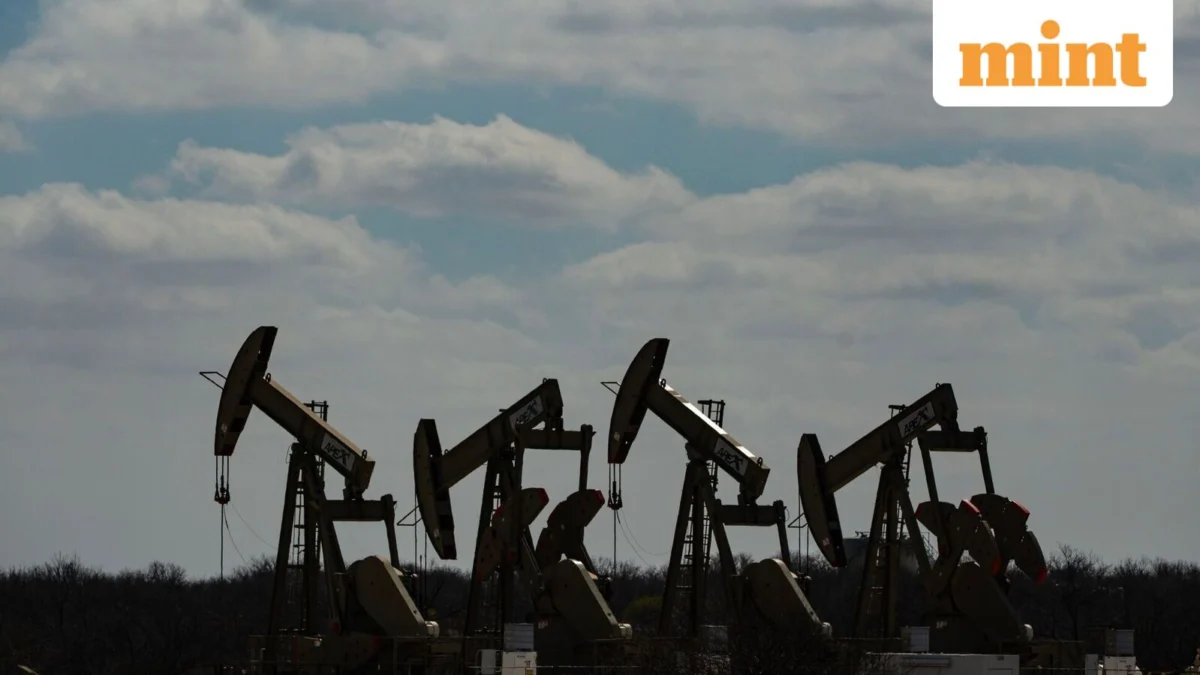
Global energy markets experienced a significant jolt during Thursday’s trading session as crude oil prices surged to their highest levels in nearly a month. The primary catalyst for this rally is the United States’ preparation of an extensive and aggressive package of economic sanctions aimed at Tehran. This move, orchestrated by the Trump administration, seeks to systematically isolate Iran from the global financial and commercial ecosystem, raising fears of a protracted supply disruption in an already volatile geopolitical landscape.
International benchmark Brent crude climbed by nearly $3 to settle around $92 a barrel, marking its highest price point since July 22. This surge represents a fifth consecutive session of gains for the benchmark, signaling a robust upward trend driven by geopolitical risk premiums. Simultaneously, the U.S. benchmark West Texas Intermediate (WTI) crude experienced a sharp 3.3% jump, reaching $86.72 a barrel. The synchronized rise in both major benchmarks underscores the market’s growing anxiety over the stability of Middle Eastern oil exports and the potential for a wider regional conflict.
The Sanctions Offensive and the "Secondary Sanctions" Threat
The momentum in oil prices accelerated following comments from U.S. Treasury Secretary Scott Bessent. In a high-profile interview with CNBC, Bessent outlined a strategy designed to provide a "maximum pressure" environment far exceeding previous iterations of economic warfare. The centerpiece of this strategy is the implementation of secondary sanctions. Unlike primary sanctions, which prohibit U.S. entities from doing business with Iran, secondary sanctions target third-party countries and foreign corporations.
Secretary Bessent explicitly warned that any nation or business continuing to facilitate trade or financial transactions with Iran would face being cut off from the U.S. financial system. "It is time for our allies and trading partners to decide where they stand," Bessent stated. This "with us or against us" approach is specifically designed to target the remaining lifelines of the Iranian economy.
While the Treasury Secretary did not explicitly name specific nations, the implications for major energy consumers like China and India are profound. Both countries have historically remained significant purchasers of Iranian crude, often utilizing non-dollar payment mechanisms to bypass previous U.S. restrictions. By threatening the global operations of banks and shipping firms involved in these trades, the U.S. aims to make the cost of dealing with Tehran prohibitively high.
President Trump’s "Choke" Strategy
The administrative push for sanctions was further solidified by President Donald Trump, who utilized his Truth Social platform to announce a "crushing economic operation." The President’s rhetoric was uncompromising, stating that the U.S. intends to "choke" the Iranian economy by penalizing any entity that provides "any type of lifeline" to the Islamic Republic.
Trump warned of "tremendous" consequences for those who offer financial assistance or engage in commercial exchange with Tehran. This aggressive stance marks a definitive end to any hopes for a diplomatic de-escalation in the near term. Earlier in the week, the President confirmed that the U.S. was not engaged in any active talks with Iranian leadership and had no intention of reviving negotiations. Furthermore, the 60-day interim peace deal, which had provided a fragile period of relative calm, expired on Monday without renewal, leaving a vacuum that is now being filled by economic and military posturing.
The Strait of Hormuz and the Blockade Crisis
At the heart of the current price surge is the ongoing closure of the Strait of Hormuz, the world’s most critical oil transit chokepoint. Historically, approximately one-fifth of the world’s daily oil consumption passes through this narrow waterway. Iran effectively closed the Strait following military exchanges with Israel and the United States on February 28, 2024.
The current standoff is defined by a mutual refusal to blink. Iran has maintained a steadfast position, refusing to consider reopening the Strait until the United States lifts its blockade of Iranian ports and fulfills a series of other geopolitical conditions. Conversely, the U.S. maintains that the blockade and the subsequent sanctions are necessary responses to Iranian aggression and its nuclear program.

The prolonged closure of the Strait has forced global shipping to seek alternative, more expensive routes, while significantly reducing the global "cushion" of available oil supply. Analysts suggest that as long as the Strait remains contested or closed, a "war premium" of $10 to $20 per barrel will likely remain baked into global oil prices.
A Chronology of Escalation
To understand the current market volatility, it is essential to trace the timeline of events that led to the $92 Brent price point:
- February 28, 2026: Initial military hostilities break out involving Israel, the U.S., and Iran. In response, Tehran moves to restrict traffic through the Strait of Hormuz.
- March-May 2026: Global oil prices fluctuate wildly as the international community attempts to broker a ceasefire. Temporary waivers and strategic reserve releases prevent a full-scale price explosion.
- June 2026: A 60-day interim peace deal is signed, providing a temporary freeze on further military escalation and allowing for limited humanitarian corridors.
- August 17, 2026: The interim peace deal expires. President Trump announces that the U.S. will not seek an extension, citing Iranian non-compliance and continued regional instability.
- August 19, 2026: Reports emerge of ballistic missile attacks on the United Arab Emirates (UAE). The UAE responds by suspending all financial and economic transactions with Iran, further isolating Tehran within the Gulf Cooperation Council (GCC).
- August 20, 2026: The U.S. Treasury and the White House announce the "sweeping sanctions" package. Crude oil prices jump 3.3% as markets price in a long-term supply deficit.
Iran’s Response: "Economic Terrorism"
The reaction from Tehran has been one of defiance and condemnation. Foreign Minister Abbas Araghchi dismissed the U.S. threats as a continuation of "failed policies" that would only serve to harden Iranian resolve. In a series of public statements, Araghchi characterized the U.S. sanctions as "economic terrorism" and "crimes against humanity."
Araghchi argued that the Trump administration’s focus on Iran is a tactical distraction intended to divert the American public’s attention from domestic economic challenges, such as inflation and national debt. He further asserted that such unilateral measures threaten global economic stability and violate the national sovereignty of independent nations.
Despite the rhetoric, the Iranian economy is under immense pressure. The combination of the port blockade and the new wave of secondary sanctions threatens to collapse the value of the Iranian Rial and trigger hyperinflation, a scenario the U.S. appears to be betting on to force a change in Tehran’s strategic calculus.
Regional Shifts and the UAE’s Pivot
A significant development in the current crisis is the hardening stance of regional neighbors, most notably the United Arab Emirates. The UAE’s decision to suspend all economic ties with Iran marks a major shift in regional dynamics. Historically, the UAE—and Dubai in particular—served as a vital commercial hub for Iranian businesses and a conduit for trade that bypassed international restrictions.
The UAE’s pivot followed accusations that Tehran-backed forces launched ballistic missiles at Emirati territory. By aligning more closely with the U.S. "maximum pressure" campaign, the UAE is effectively closing one of the last remaining windows for Iranian capital flight and trade. This regional alignment makes the U.S. sanctions significantly more potent than those imposed in previous decades, as Tehran finds itself increasingly alienated from its immediate neighbors.
Broader Economic Impact and Market Analysis
The surge in oil prices to $92 a barrel has immediate and far-reaching implications for the global economy. For major oil-importing nations, particularly in Europe and Asia, the rising cost of energy threatens to reignite inflationary pressures that central banks have been struggling to contain.
- Inflationary Pressures: Higher crude prices translate directly to increased costs for transportation, manufacturing, and heating. This could force central banks to maintain higher interest rates for longer, potentially slowing global economic growth.
- Supply Chain Disruptions: The continued closure of the Strait of Hormuz affects more than just oil. Liquefied Natural Gas (LNG) shipments and general cargo are also impacted, leading to delays and increased freight insurance premiums.
- Shift in Energy Policy: The current crisis is likely to accelerate the transition toward renewable energy and nuclear power in Western economies as they seek to reduce their dependence on Middle Eastern hydrocarbons. However, in the short term, the world remains tethered to oil, leaving it vulnerable to these geopolitical shocks.
- U.S. Production Response: With prices near $90, U.S. shale producers are incentivized to increase output. However, capital discipline and supply chain constraints in the American oil patch mean that a surge in U.S. production may not arrive fast enough to offset the loss of Iranian barrels or the closure of the Strait.
Conclusion: A High-Stakes Stalemate
As the United States prepares to codify these new sanctions, the global energy market remains on a knife-edge. The "sweeping" nature of the proposed measures suggests that the Trump administration is no longer interested in containment, but rather in a total economic blockade of Iran.
The immediate market reaction—sending Brent to a one-month high—reflects a consensus among traders that the situation will likely get worse before it gets better. With the 60-day peace deal now a thing of the past and both sides digging in their heels, the path to $100 oil seems increasingly plausible. Investors and world leaders alike are now watching to see how major buyers like China will respond to the threat of secondary sanctions, a decision that will ultimately determine the effectiveness of the U.S. strategy and the future trajectory of global energy prices.
