

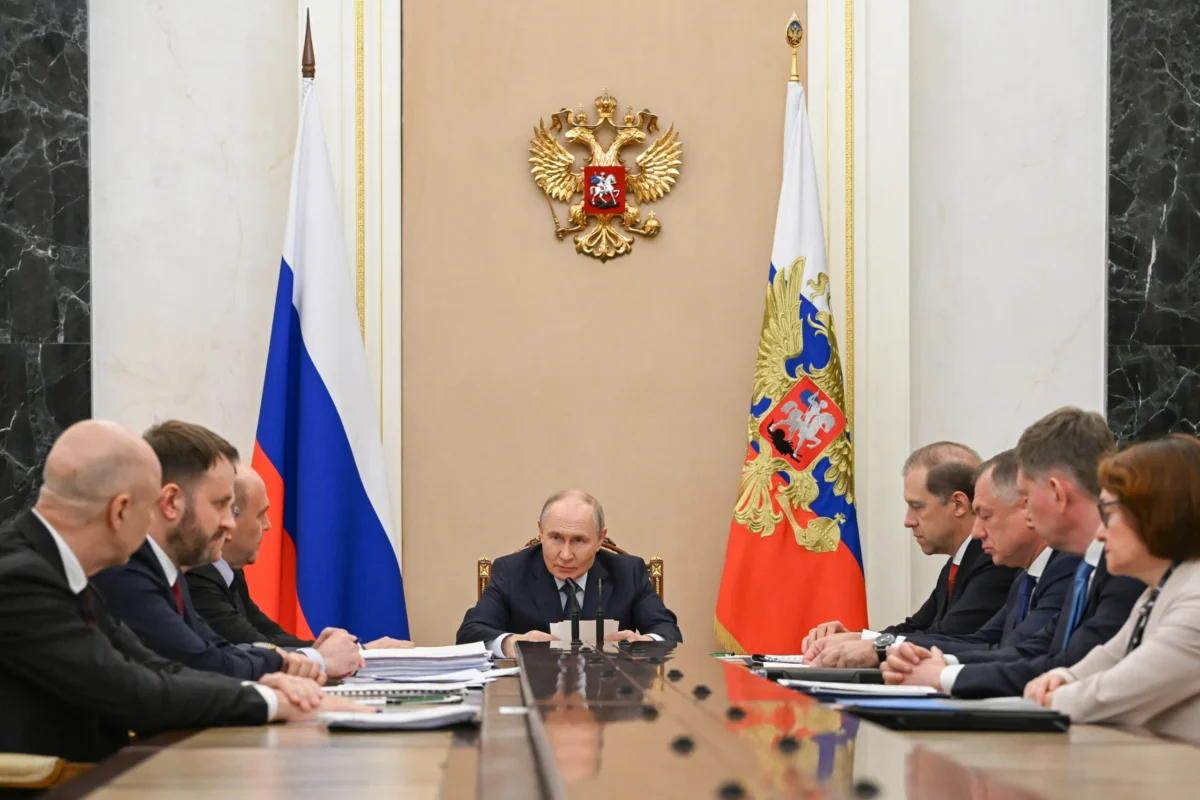
The Russian government continues to assert the strength and health of its economy, even as it faces "unprecedented foreign pressure" following its full-scale invasion of Ukraine in early 2022. This official narrative, however, stands in stark contrast to the increasingly vocal concerns of some within Russia’s own economic circles. A recent, highly publicized dismissal of a former chief economist from a state-controlled development bank has brought these internal divisions to the forefront, fueling debate about the long-term viability of Russia’s economic strategy amidst a protracted conflict.
The controversy ignited with the reported dismissal of Andrei Klepach, a former deputy economy minister and previously the chief economist at VEB.RF, Russia’s state-controlled development bank. Klepach’s termination, which occurred on a Sunday in August 2026, was directly linked to an economic assessment he presented earlier in the year. Reports, initially surfaced in Russian-language media and subsequently amplified by exiled independent outlets like The Bell, indicated that Klepach’s report warned of Russia’s inability to sustain a prolonged war of attrition with Ukraine and predicted a significant social crisis.
According to a translation of a speech Klepach delivered on May 21, 2026, to fellow economists, he expressed a grim outlook on Russia’s economic competitiveness in the ongoing conflict. "In this war of attrition, we will not win the competition," Klepach stated. "We’re under the illusion that everything will collapse. It hasn’t, and it won’t. Our costs are mounting." His assessment extended beyond mere military expenditure, hinting at broader systemic challenges. He further elaborated, "I believe Russia won’t collapse, but I’m almost certain that we’ll end up in a social crisis. We won’t collapse economically, but our lag will widen, with all the ensuing consequences."
The implications of Klepach’s dismissal are far-reaching. It underscores a Kremlin policy of near-zero tolerance for public dissent or critical viewpoints regarding its military campaign in Ukraine, a conflict that has now surpassed four and a half years. In a climate where public discourse is tightly controlled, the silencing of a prominent economist, especially one with Klepach’s credentials as a former deputy economy minister, sends a clear message about the boundaries of acceptable economic commentary. The Kremlin’s desire to project an image of unwavering strength and economic stability appears to outweigh the acknowledgment of internal expert concerns.
Russia’s Official Stance: Defiance and Economic Resilience
In response to these internal rumblings and persistent international sanctions, Russian government officials have maintained a steadfastly defiant stance regarding the nation’s fiscal position. The Russian embassy to the U.K., in a statement to CNBC, asserted that Russia’s fiscal standing remains "significantly stronger" than that of many Western economies. They pointed to Russia’s relatively low foreign public debt, estimated at around $57 billion, contrasting it with the substantial debt servicing costs incurred by nations like the U.S., U.K., Italy, and France.
"The Russian economy remains resilient, as does the will of our people," a spokesperson for the Russian Embassy to the U.K. communicated via email. "Attempts to undermine Russia through economic pressure have not produced the results their authors expected." The embassy further argued that the West, including the U.K., is bearing a significant economic cost for its "reckless sanctions policy." According to their assessment, British businesses have lost access to the Russian market, while disruptions to global supply chains and elevated energy and commodity prices have imposed additional financial burdens on the U.K. economy.
This official pronouncement paints a picture of an economy that has successfully weathered the storm of international sanctions, adapting and even thriving in certain sectors. The narrative emphasizes self-sufficiency and the inherent weaknesses of economies reliant on external factors. The government’s message is one of national resolve and strategic economic management, suggesting that external economic warfare has been rendered ineffective.
Internal Alarm Bells: Expert Concerns and Historical Parallels
However, the dismissal of Klepach has amplified concerns among international observers and analysts specializing in the Russian economy. Anders Åslund, a prominent Swedish economist and former senior fellow at the Atlantic Council, was quick to comment on the news. He stated via X (formerly Twitter) that Klepach’s dismissal was unsurprising, given the economist’s "eminent analysis" that Russia could not win a war of attrition and was likely headed for a social crisis akin to that of 1917.
Åslund’s reference to 1917 evokes the tumultuous period leading to the Russian Revolution, a stark historical parallel that underscores the gravity of Klepach’s reported concerns about social unrest. The suggestion is that economic hardship, coupled with the prolonged strain of war, could once again push Russian society to a breaking point.
Nigel Gould-Davies, a senior fellow for Russia and Eurasia at the International Institute for Strategic Studies, echoed this sentiment. Describing Klepach as "very capable and smart," Gould-Davies remarked on social media that the situation confirmed his long-held view: "the best economic minds in Russia are the most alarmed." This assertion implies that those with the deepest understanding of Russia’s economic fundamentals are acutely aware of the precariousness of its current trajectory, a perspective that is being suppressed by official channels.
The Wartime Economy: Growth Masking Deeper Issues
Russia’s economy has indeed shown surprising resilience since the imposition of extensive Western sanctions in 2022. Official data has indicated slow but consistent growth, defying many initial predictions of a swift collapse. This apparent recovery has been partly attributed to a surge in military spending, which has stimulated industrial production and employment. The government has also implemented various measures, including capital controls, import substitution programs, and subsidized lending, to stabilize the financial system and support key industries.
Recent weeks have seen Ukraine’s long-range drone attacks on Russian oil refineries and logistics hubs bring the vulnerabilities of Russia’s wartime economy into sharper focus. While these attacks have not crippled the energy sector, they have highlighted the ongoing strategic contest and its potential to disrupt critical infrastructure.
Despite the positive headline growth figures, analysts suggest that these mask underlying structural weaknesses. The Kremlin’s heavy reliance on military expenditure as a primary driver of economic activity creates an unsustainable model. This reliance necessitates higher taxes, often borne by the population and businesses, and a continued reliance on subsidized bank lending, which can distort market mechanisms and create future financial risks. Furthermore, the diversion of significant resources towards the war effort inevitably leads to underinvestment in other crucial sectors, potentially hindering long-term productivity and innovation.
The widening economic lag that Klepach predicted could manifest in several ways: a decline in living standards for ordinary Russians, a brain drain of skilled professionals seeking better opportunities abroad, and a diminished capacity for technological advancement and diversification. The economic isolation imposed by sanctions, while mitigated by new trading partnerships, continues to limit Russia’s access to advanced technologies and global markets, potentially trapping it in a cycle of resource extraction and basic manufacturing.
A Complex Geopolitical and Economic Conundrum
The situation presents a complex geopolitical and economic conundrum. Russia’s government appears committed to its strategic objectives in Ukraine, viewing the economic sacrifices as necessary for national security and geopolitical standing. The official narrative of resilience and defiance serves to bolster domestic support and project an image of strength on the international stage.
However, the internal dissent, as exemplified by Klepach’s controversial assessment and dismissal, suggests that the economic realities of a protracted conflict are becoming increasingly difficult to ignore, even within the corridors of power. The long-term sustainability of Russia’s current economic model, heavily geared towards military production and reliant on state intervention, remains a subject of intense debate.
The coming years will likely reveal whether Russia’s economy can continue to withstand the dual pressures of international sanctions and the immense costs of a prolonged war. The diverging perspectives between official pronouncements of strength and the privately expressed concerns of economists like Klepach offer a critical insight into the underlying tensions and potential fragilities of Russia’s wartime economy. The potential for a widening economic lag and a subsequent social crisis, as warned by Klepach, looms as a significant, albeit officially downplayed, consequence of the ongoing conflict. The world watches to see how these internal pressures and external challenges will ultimately shape Russia’s economic future and its broader geopolitical ambitions.
