

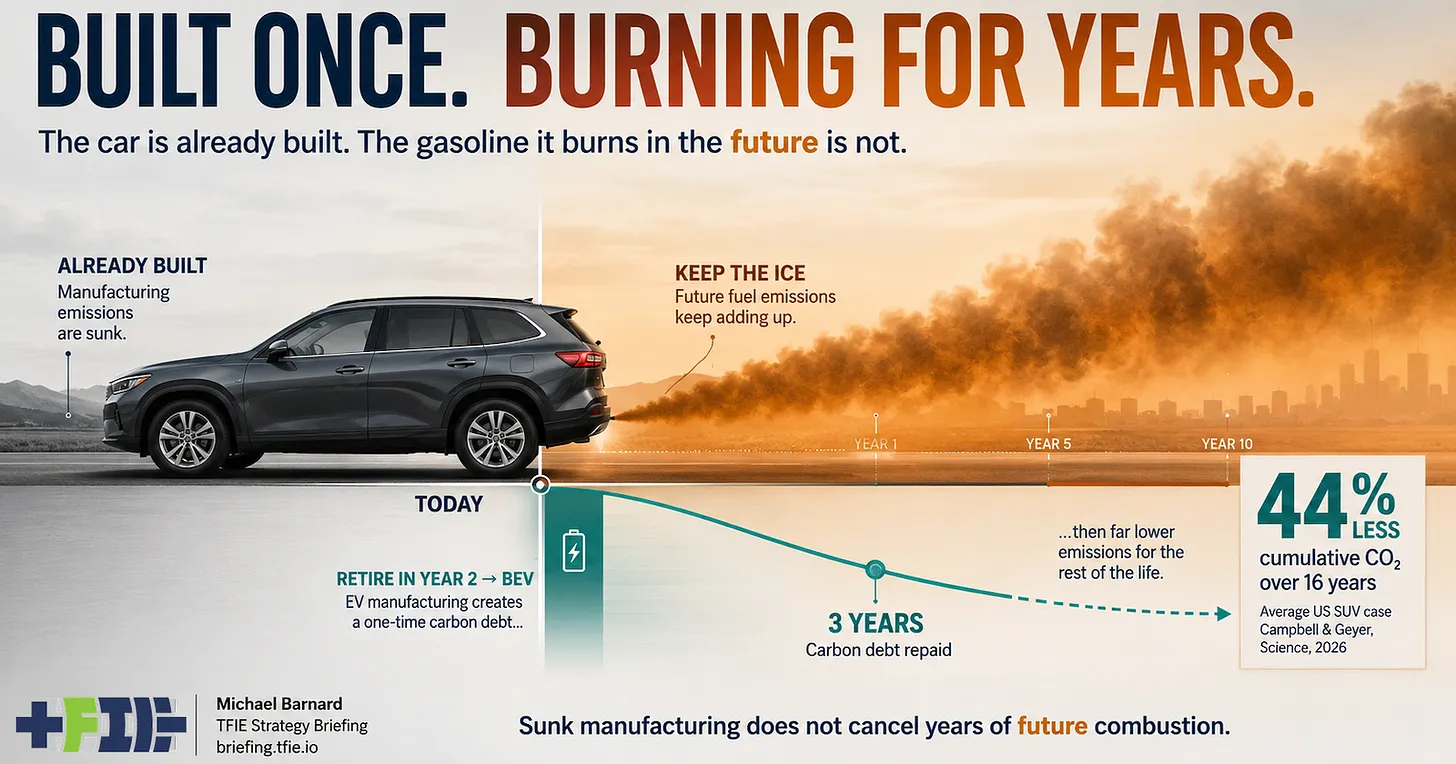
The long-standing environmental maxim that "the greenest car is the one already built" is facing significant scientific scrutiny as researchers delve deeper into the lifecycle emissions of transportation. For years, critics of electric vehicle (EV) adoption have argued that the carbon-intensive process of manufacturing a new battery-electric vehicle (BEV) outweighs the benefits of replacing a functional internal combustion engine (ICE) vehicle. However, a landmark study published in the journal Science suggests that for the vast majority of drivers, retiring a working gasoline car early in favor of an electric alternative provides a substantial net benefit for the climate.
The study, authored by J. Elliott Campbell of the University of California, Santa Cruz, and Roland Geyer of the University of California, Santa Barbara, provides a comprehensive lifecycle assessment (LCA) that challenges the "keep it until the wheels fall off" philosophy. By accounting for the "carbon debt" incurred during the manufacturing of new vehicles and comparing it against the recurring emissions of burning fossil fuels, the researchers have mapped out the specific conditions under which vehicle retirement becomes a climate necessity rather than a waste of resources.
The Calculus of Carbon Debt and Payback
The core of the debate rests on the concept of front-loaded emissions. Manufacturing a modern battery-electric vehicle requires mining lithium, cobalt, and nickel, as well as energy-intensive battery cell production. This creates a "carbon debt" before the car even travels its first mile. Conversely, an existing gasoline car has already "paid" its manufacturing debt; its environmental impact from this point forward is almost entirely tied to the fuel it burns.
However, the Science study found that this manufacturing debt is repaid much faster than previously estimated. For a representative production-weighted SUV operating on the average United States electrical grid, replacing a two-year-old gasoline model with a BEV reduced cumulative emissions by 44% over a 16-year period. While the manufacturing of the replacement EV creates an initial spike in emissions, the significantly lower operating emissions of the electric motor allow the vehicle to reach a "break-even" point in approximately three years.
The researchers discovered that the earlier a high-emission vehicle is retired, the greater the cumulative climate benefit. This is because every additional year an inefficient ICE vehicle remains on the road, it locks in a set amount of CO2, nitrogen oxides, and particulate matter that cannot be recovered. By shifting the perspective from "sunk costs" (the emissions already spent to build the old car) to "future liabilities" (the gasoline yet to be burned), the study clarifies that the manufacturing of a new EV is a one-time investment that prevents a decade or more of recurring pollution.
Analyzing the Variables: Efficiency, Grid, and Mileage
The strength of the Campbell and Geyer study lies in its sensitivity analysis. Rather than assuming a best-case scenario for EVs, the researchers modeled thousands of variations, including different vehicle efficiencies, annual mileage, battery sizes, and the carbon intensity of regional power grids.

Across 92% of the modeled scenarios, early retirement of the gasoline vehicle led to lower total emissions. In the most favorable cases, replacing a gas-guzzler with an EV resulted in an 82% reduction in lifecycle emissions. However, the study also identified specific "thresholds of utility" where replacing a working car does not make environmental sense.
To justify the carbon cost of a new EV, the vehicle being replaced must be driven a minimum number of kilometers annually. The researchers established the following thresholds:
- Passenger Cars: Must be driven at least 7,054 kilometers (approx. 4,383 miles) per year.
- SUVs: Must be driven at least 6,837 kilometers (approx. 4,248 miles) per year.
- Light Trucks: Must be driven at least 10,794 kilometers (approx. 6,707 miles) per year.
Vehicles driven less than these amounts—such as "Sunday drivers" or secondary vehicles used only for short errands—may actually be better for the environment if kept in service, as they would never drive enough miles to "pay back" the carbon debt of a new replacement battery. Furthermore, the study noted that replacing highly efficient hybrids or plug-in hybrids (PHEVs) with BEVs often yields diminishing returns or, in some cases, a net increase in emissions if the local power grid is heavily reliant on coal.
The Socio-Economic Challenge: The Used Car Ladder
While the environmental data increasingly supports aggressive vehicle retirement, the social and economic implications present a more complex hurdle. In the United States, the "used car ladder" is a vital component of economic mobility. Lower-income households rarely purchase new vehicles; instead, they rely on a supply of decade-old cars that have depreciated in value.
According to Federal Reserve survey data, approximately two-thirds of lower-income individuals who recently acquired a vehicle bought it used, with nearly 80% of those purchases costing less than $10,000. When a policy encourages the early "scrapping" or crushing of a functional 10-year-old gasoline car to save carbon, it effectively removes a rung from the ladder of affordable transportation.
Critics of broad "Cash for Clunkers" programs argue that such initiatives can inadvertently spike the prices of remaining used cars, disproportionately harming those who cannot afford to transition to electric technology. The Science study acknowledges these system effects, suggesting that a climate-focused retirement policy must be balanced with a strategy to ensure the bottom of the market remains accessible.
Lessons from the Past: From CARS to Modern Policy
The 2009 Consumer Assistance to Recycle and Save (CARS) program, popularly known as "Cash for Clunkers," serves as a historical cautionary tale. While it succeeded in stimulating the auto industry during the Great Recession and removed some inefficient vehicles from the road, it was criticized for its lack of precision. It offered flat bounties regardless of whether a car was driven 5,000 or 25,000 miles a year, and it did not account for the carbon intensity of the replacement vehicles to the degree modern science allows.

A modern, data-driven vehicle retirement program would look significantly different. Based on the findings of Campbell and Geyer, as well as modeling from organizations like Resources for the Future, a sophisticated policy would include:
- Targeted Scrappage: Incentives should be scaled based on the expected future emissions of the vehicle being retired. A high-mileage, 15-mpg pickup truck should receive a much higher retirement bounty than a low-mileage, 40-mpg compact car.
- Regional Grid Consideration: Incentives could be adjusted based on the local electricity mix. In states like Washington or Vermont, where the grid is nearly carbon-neutral, the case for retirement is immediate. In states still reliant on coal, the threshold for retirement might be higher.
- Used EV Integration: To protect the "used car ladder," policies should incentivize the trade-in of old ICE vehicles for used EVs, not just new ones. This helps circulate affordable electric options into the lower-income market.
- Fleet Prioritization: Governments and corporations with high-mileage fleets (delivery vans, rental cars, and police cruisers) should be the primary targets for early retirement programs. These vehicles accumulate mileage rapidly, ensuring the fastest possible "payback" of manufacturing carbon debt.
Industry and Environmental Reactions
The reaction to the study from industry stakeholders has been a mixture of validation and concern. Environmental advocacy groups have seized on the data to push for more aggressive retirement mandates. "This study puts to rest the myth that we should wait for every gas car to die a natural death before switching to electric," said one policy analyst specializing in clean transportation. "The ‘future liability’ of burning gasoline is the real climate killer, not the factory emissions of a new Tesla or Ford F-150 Lightning."
On the other hand, some automotive trade groups and consumer advocates urge caution regarding the "crushing" of functional assets. They argue that a focus on "repair over replace" might still hold value for certain demographics and that the rapid destruction of the ICE fleet could lead to a shortage of affordable vehicles before the EV secondary market is fully mature.
Conclusion: A Shift in Perspective
The research by Campbell and Geyer marks a pivotal shift in how the transition to sustainable transport is calculated. It moves the conversation away from a static comparison of "old vs. new" and toward a dynamic model of "ongoing combustion vs. one-time manufacturing."
The data suggests that for the average American driver, the environmental cost of building a new electric vehicle is a price worth paying to stop the decade-long bleed of tailpipe emissions. However, the "greenest car" is no longer a universal title. It depends on the odometer, the efficiency of the engine, and the source of the electricity. As the U.S. continues to navigate its climate goals, the challenge will be to design policies that are as nuanced as the science—targeting the heaviest polluters for retirement while ensuring that the transition to a zero-emission future does not leave the most vulnerable drivers stranded.
