

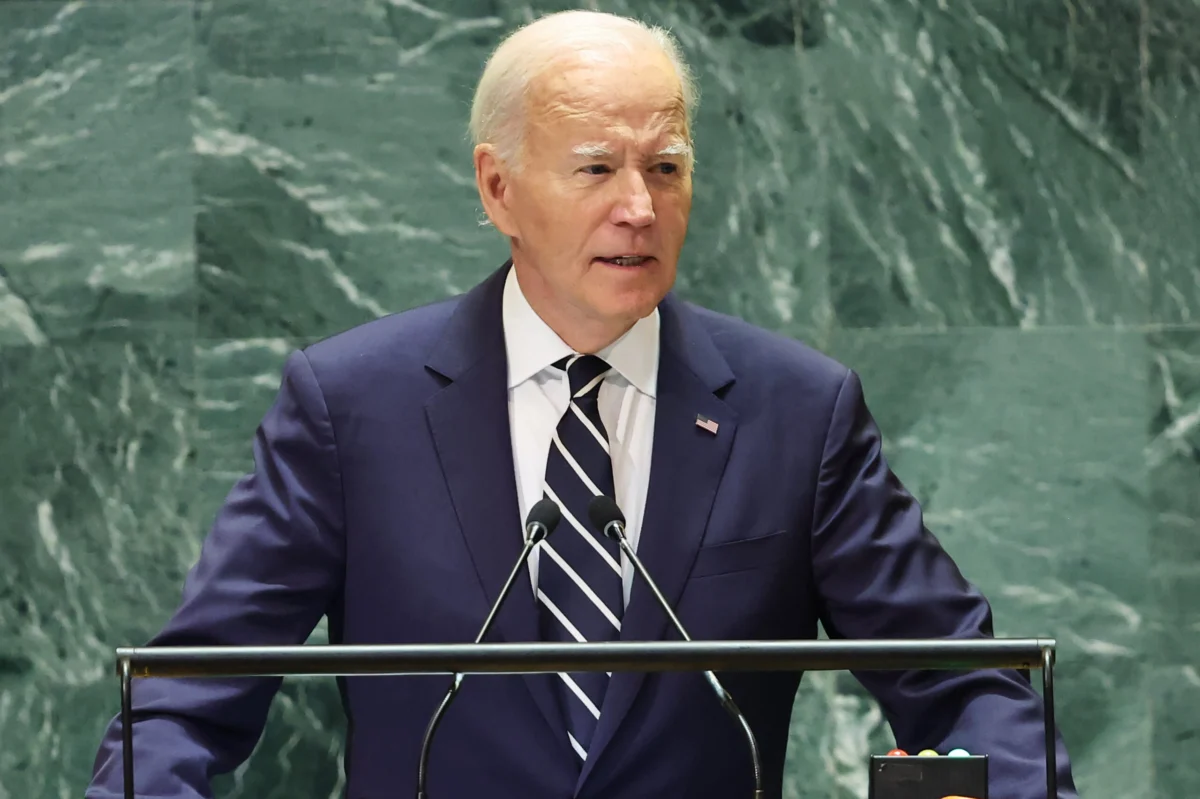
President Joe Biden took the rostrum at the United Nations General Assembly in New York on Tuesday for the final time of his presidency, attempting to reconcile his vision of a cooperative international order with the stark reality of escalating global violence. Speaking to a hall filled with world leaders, Biden used his address to frame his half-century of public service as a testament to the power of diplomacy, even as the world grapples with devastating conflicts in the Middle East, Eastern Europe, and East Africa. His speech, delivered during the 79th session of the General Assembly, served as both a valedictory message and a somber warning about the fragility of the democratic principles he has championed since taking office in 2021.
The President’s address comes at a pivotal moment in his administration, with only four months remaining before a new leader takes the helm of the United States. Biden sought to underscore what he views as the hallmark achievements of his foreign policy: the revitalization of the NATO alliance, the management of a complex and competitive relationship with China, and the establishment of global norms for emerging technologies like artificial intelligence. However, the optimism of his message was frequently tempered by the acknowledgment of the "grim reality" facing millions of civilians in Gaza, Ukraine, and Sudan.
A Legacy Framed by Hope and Crisis
Biden opened his remarks by acknowledging the pervasive sense of "despair" that has gripped the international community. "I know many look at the world today and see difficulties and react with despair," Biden told the assembly. "But maybe because of all I’ve seen and all we have done together over the decades, I have hope." This appeal to hope was rooted in his long history in the American political landscape, referencing his entry into the Senate during the Cold War and his witness to the eventual fall of the Berlin Wall.
Despite this hopeful rhetoric, the President spent a significant portion of his speech addressing the immediate crises that threaten to overshadow his legacy. He highlighted the administration’s efforts to uphold the U.N. Charter, particularly in the face of territorial aggression. For Biden, the defense of Ukraine has been the centerpiece of his "democracy vs. autocracy" narrative. He reminded the audience that when Russia invaded Ukraine in February 2022, many expected the sovereign nation to fall within days. Instead, through U.S. leadership and international cooperation, Ukraine remains a sovereign state.
"We could have stood by and merely protested," Biden said, referring to the early days of the invasion. "But Vice President Harris and I understood that that was an assault on everything this institution was supposed to stand for." He emphasized that the United States "stepped into the breach," providing billions in security, economic, and humanitarian assistance. He further celebrated the expansion of NATO, which saw the inclusion of Finland and Sweden during his term—a direct consequence of President Vladimir Putin’s aggression that arguably backfired on the Kremlin’s strategic goals.
The Middle East on the Brink
While the war in Ukraine has been a consistent focus of the Biden administration, the sudden and violent escalation in the Middle East has become the most pressing challenge of his final year. Since Biden’s last address to the General Assembly in September 2023, the region has been transformed by the October 7 Hamas attacks and Israel’s subsequent military operations in Gaza.
The President used the UN platform to reiterate his call for a ceasefire and a hostage deal, an objective that has remained elusive despite months of high-level negotiations involving the U.S., Qatar, and Egypt. "Now is the time for the parties to finalize its terms, bring the hostages home, to secure security for Israel and Gaza free from Hamas’ grip, ease the suffering in Gaza, and end this war," Biden declared.
However, the geopolitical backdrop of his speech was further complicated by the recent flare-up of hostilities between Israel and Hezbollah in Lebanon. As Biden spoke, the world was watching for signs of a full-scale regional war. The President addressed the humanitarian toll of the conflict, noting the tens of thousands of Palestinian casualties and the worsening crisis in the West Bank. He reaffirmed his commitment to a two-state solution, which he described as the only path toward a future where Israel enjoys normalized relations with its neighbors and Palestinians live with "security, dignity, and self-determination."
Chronicling a Week of High-Stakes Diplomacy
The UN General Assembly address was just one component of a grueling final diplomatic sprint for the President. His schedule reflects an attempt to solidify alliances across multiple theaters before the November election.

- September 21: Biden hosted the "Quad" summit in Wilmington, Delaware, meeting with the leaders of Australia, India, and Japan. The summit focused on maritime security in the Indo-Pacific, a clear signal to China regarding the maintenance of a "free and open" region.
- September 23: In Washington, Biden met with United Arab Emirates President Mohamed bin Zayed Al Nahyan to discuss trade and the ongoing instability in the Middle East.
- September 24: Following his UNGA speech, Biden chaired a summit on synthetic drug trafficking, focusing on the global fentanyl crisis that has devastated American communities.
- September 25: A scheduled meeting with President Tô Lâm of Vietnam highlights the administration’s "pivot to Asia" and the strengthening of ties with former adversaries to balance regional power.
- September 26: Biden will host Ukrainian President Volodymyr Zelenskyy at the White House. This meeting is critical as Zelenskyy is expected to present his "victory plan" and request permission to use Western-supplied long-range missiles for strikes deeper into Russian territory.
The Transition of Power: Domestic Politics on the Global Stage
In a moment of personal reflection that resonated through the General Assembly hall, Biden addressed his decision to withdraw from the 2024 presidential race. In July, following a period of intense political pressure, Biden announced he would not seek re-election, effectively passing the torch to Vice President Kamala Harris.
"As much as I love the job, I love my country more," Biden said. "I decided, after 50 years of public service, it’s time for a new generation of leadership to take my nation forward." He framed this decision as a lesson in democratic values, pointedly telling the gathered heads of state—some of whom have held power for decades—that "some things are more important than staying in power."
This domestic transition was visible in the hallways of the United Nations. Foreign leaders are increasingly looking past the current administration toward the two individuals who might succeed him. Both Kamala Harris and Donald Trump have engaged in their own diplomatic outreach this week. Harris held a separate meeting with the UAE president and is slated to meet Zelenskyy. Meanwhile, Donald Trump’s campaign confirmed meetings with Zelenskyy, Indian Prime Minister Narendra Modi, and Polish President Andrzej Duda. This "shadow diplomacy" underscores the global anxiety regarding the future of U.S. foreign policy, particularly concerning aid to Ukraine and commitments to NATO.
Data and Implications: The Cost of Global Instability
The challenges Biden described are backed by staggering data that illustrate the difficulty of his "hopeful" outlook. In Ukraine, the U.S. has committed more than $175 billion in total aid since the start of the war, yet the front lines remain largely static, and the human cost continues to climb. In Gaza, the death toll has reportedly surpassed 41,000, according to local health officials, while over 100 hostages remain in captivity.
Furthermore, the "forgotten war" in Sudan, which Biden briefly mentioned, has resulted in the world’s largest displacement crisis. More than 10 million people have been forced from their homes, and famine has been officially declared in parts of North Darfur. The Biden administration has faced criticism for not dedicating the same level of diplomatic resources to Sudan as it has to Ukraine or the Middle East.
From a geopolitical standpoint, analysts suggest that Biden’s final UNGA speech was an attempt to institutionalize his brand of "multilateralism" before he leaves office. By focusing on AI principles and climate change alongside traditional security concerns, Biden sought to demonstrate that the U.S. remains a comprehensive leader. However, the effectiveness of this message is hampered by the deep political divisions within the U.S. Congress. Many Republicans have become increasingly vocal in their opposition to continued Ukraine funding, raising questions about whether the "just and durable peace" Biden promised can be sustained under a different administration.
Conclusion: The Unfinished Business of the 46th President
As President Biden concludes his final major international appearance, the "uncertainty" he mentioned upon taking office in 2021 remains a defining characteristic of the global landscape. His presidency has seen the largest land war in Europe since World War II, a transformative conflict in the Middle East, and a fundamental shift in the technological race with China.
While his speech was intended to project strength and continuity, it also highlighted the limitations of even the most powerful nation’s influence. Biden’s plea to the international community—"You cannot grow weary. You cannot look away"—is a call to action that his successor will have to answer. For now, Biden remains focused on the "four months of work" ahead, attempting to secure a ceasefire in Gaza and ensure that Ukraine is in the strongest possible position before the American electorate decides the future direction of the country.
The legacy of the Biden years will likely be debated for decades: was he the leader who successfully held the democratic world together during a time of unprecedented peril, or a president whose tenure was defined by the eruption of conflicts he could not fully resolve? His final words to the UNGA suggested that he is content to leave that judgment to history, provided that the "new generation of leadership" continues the work of preserving the international order.
