

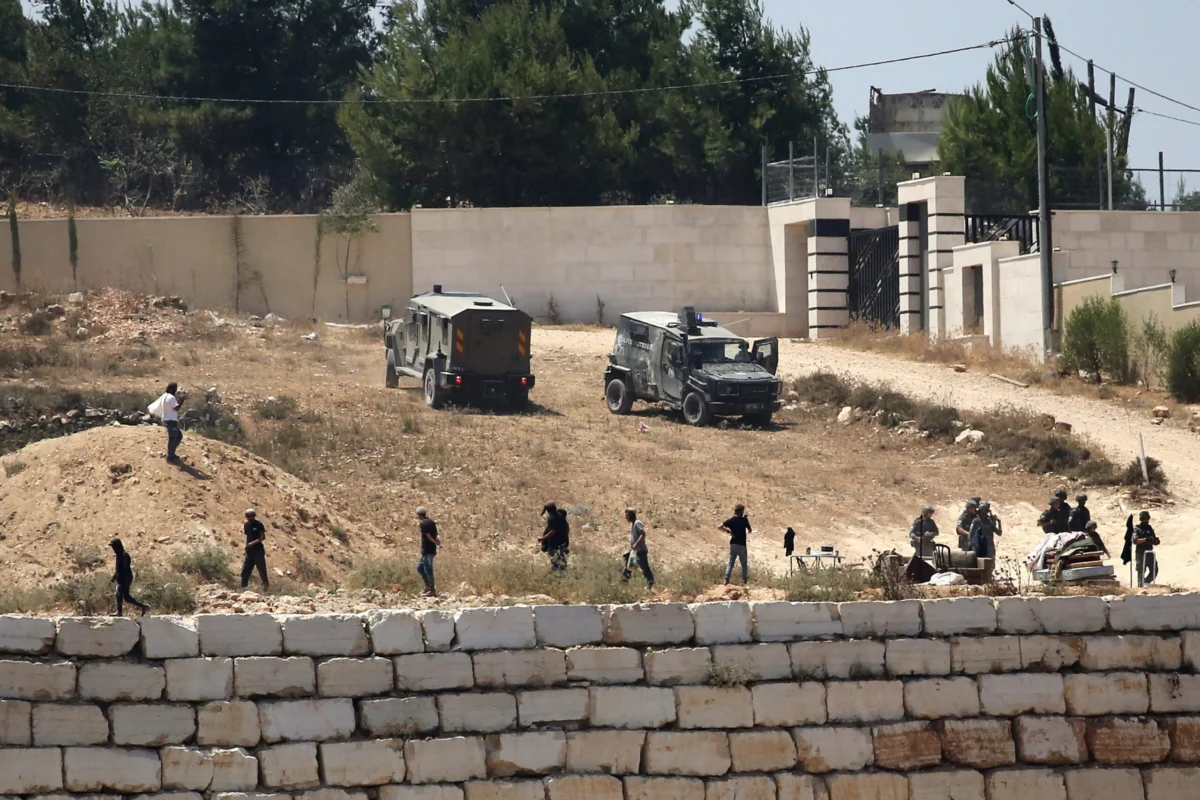
The occupied West Bank town of Qusra, situated south of Nablus, has become the center of a harrowing humanitarian standoff as approximately 15 Palestinian residents, including two young children, remain trapped within three homes under a week-long siege by Israeli settlers. This blockade, characterized by the severance of essential utilities and the obstruction of humanitarian aid, underscores a deteriorating security situation in the northern West Bank. On Friday, the crisis intensified as Israeli military forces intervened not to disperse the settlers, but to prevent activists from delivering food and water to the besieged families, declaring the area a closed military zone.
The families, residing in the Ras al-Ain area of Qusra, have been unable to leave their premises or access basic necessities since the beginning of the week. According to reports from the Palestinian news agency Wafa and international observers, Israeli settlers have utilized physical barriers, including large stones and the establishment of a makeshift outpost, to isolate the homes. The United Nations has characterized the situation as a "state of terror," noting that the residents are being deprived of water and electricity in what appears to be a coordinated effort to force them from their land.
A Chronology of the Siege in Qusra
The current escalation began early in the week when a group of Israeli settlers descended upon the Ras al-Ain neighborhood. By Monday, the settlers had effectively blocked the primary access roads leading to the three targeted homes. Witnesses reported that the settlers erected a tent in close proximity to the residences, signaling an intent to establish a permanent presence or a "wildcat" outpost—a tactic frequently used to seize Palestinian land in Area C of the West Bank.
By Tuesday and Wednesday, the situation grew more dire as the settlers reportedly sabotaged local infrastructure, cutting off the water supply and electricity to the three houses. During this period, a group of Italian humanitarian activists managed to reach the homes to provide temporary support. However, their presence was short-lived. Qusra Mayor Abdel Azim Wadi confirmed that Israeli security forces intervened to forcibly remove the international activists from the site, leaving the families once again isolated.
On Thursday, the Israeli military entered the area. Rather than removing the settlers who were blockading the private property, the soldiers issued a temporary evacuation order to the Palestinian families. The residents, fearing that their homes would be immediately seized and occupied by settlers if left vacant, refused to comply. In an act of collective resilience, the 15 residents gathered in one of the three houses to consolidate their remaining resources and maintain a presence on the property.
The standoff reached a critical point on Friday morning. Members of the Israeli peace group Peace Now, accompanied by foreign activists, attempted to deliver emergency supplies of food and water to the trapped families. They were met by a heavy deployment of Israeli military reinforcements. The army officially declared the Ras al-Ain area a "closed military zone," a legal designation that grants the military the authority to bar entry to any civilians. Consequently, the activists were turned away, and the humanitarian aid remained undelivered while settlers continued to maintain their presence nearby.

Humanitarian Impact and the Role of International Observers
The United Nations Office for the Coordination of Humanitarian Affairs (OCHA) has expressed grave concern over the safety of the trapped individuals. The presence of two children among the besieged has heightened the urgency of the calls for intervention. According to UN monitors, the psychological toll of being surrounded by hostile actors while being denied the ability to attend to basic needs is profound.
The blockade of water and electricity during a period of high tension is viewed by human rights organizations as a form of collective punishment. "These families are being held hostage in their own homes," stated a spokesperson for a local rights group. "The fact that the military is preventing food and water from reaching them while allowing settlers to remain on-site suggests a level of state complicity in the displacement process."
Qusra has a long and documented history of being a flashpoint for such violence. Earlier this year, the UN reported that Qusra had recorded more settler-related incidents than any other community in the West Bank. These incidents range from the destruction of olive groves—the economic lifeblood of the village—to direct assaults on residents and the burning of religious sites. A notable historical incident in the village involved the torching of a local mosque, an act accompanied by Hebrew graffiti vowing "revenge."
Data and Context: The Surge in Settler Violence
The events in Qusra are not isolated but part of a broader, statistically significant surge in settler violence across the occupied West Bank since late 2023. According to data from OCHA, there has been a marked increase in both the frequency and severity of attacks. Between October 2023 and mid-2024, the UN recorded hundreds of incidents involving settlers that resulted in Palestinian casualties or property damage.
In many of these cases, the "outpost" strategy is utilized. Settlers establish small, often illegal (even under Israeli law) encampments on hilltops or near Palestinian villages. These outposts then serve as bases for further expansion and the systematic harassment of nearby Palestinian farmers. In Qusra, the attempt to erect a tent on Friday was a clear manifestation of this strategy. Although the military eventually removed that specific tent, the settlers remained in the vicinity, maintaining the blockade.
The economic impact is equally devastating. By targeting villages like Qusra, settlers and the supporting military framework often prevent farmers from reaching their lands during crucial harvest seasons. This leads to a gradual process of economic strangulation, which often precedes the physical displacement of rural communities.
Structural Shifts in Governance: The Katz Directive
The siege in Qusra coincides with a controversial administrative shift within the Israeli government that may have long-term implications for the West Bank. Israeli Defence Minister Israel Katz recently ordered preparations to transfer the responsibility for enforcing civilian law over settlers from the military to the Israeli police.

Traditionally, the Israeli Defense Forces (IDF) have held primary jurisdiction over the West Bank, as it is considered territory under military occupation. However, the move to transfer enforcement to the police—a civilian body—is seen by many analysts as a step toward "de facto" annexation. Ibrahim Rabaia, a political scientist and former editor of the journal Palestinian Affairs, argues that this shift is deeply political.
The Israeli police fall under the jurisdiction of the Ministry of National Security, currently headed by Itamar Ben-Gvir. Ben-Gvir, a far-right politician, has been a vocal supporter of the settlement movement and has overseen the distribution of firearms to "security squads" within settlements. Rabaia notes that transferring enforcement duties to a body controlled by Ben-Gvir is unlikely to result in increased protection for Palestinians.
"The police are controlled by a minister who actively arms and encourages these settlers," Rabaia told Al Jazeera. He suggested that the coordination between the army and police already exists, but formalizing this transfer legitimizes a system where settlers are treated as domestic civilian subjects while Palestinians remain under military rule, further entrenching a dual legal system.
Implications for the Future of the West Bank
The developments in Qusra and the legislative shifts in the Israeli cabinet point toward a strategy of creating "irreversible realities" on the ground. Rabaia and other experts suggest that the expansion of infrastructure, the securing of funding, and the strategic placement of outposts are designed to make a two-state solution geographically and politically impossible.
The Ras al-Ain area of Qusra is strategically significant. By placing pressure on this specific point, settlers can potentially link existing settlements, creating a contiguous block of Israeli-controlled territory that bisects Palestinian lands. This "fragmentation" of the West Bank is a primary concern for international diplomats and human rights advocates.
As of Friday evening, the situation in Qusra remains a stalemate. The 15 residents remain inside their homes, the military continues to enforce a closed zone that bars aid, and the settlers maintain their watchful presence. The international community, including the UN and various European missions, continues to monitor the situation, but without a change in the military’s stance or a withdrawal of the settler blockade, the humanitarian crisis for the families in Ras al-Ain is expected to worsen.
The siege of Qusra serves as a microcosmic look at the current state of the West Bank: a landscape where civilian settlers, supported by state military and political structures, exert increasing control over Palestinian life, while the legal and administrative frameworks governing the territory undergo a fundamental and permanent transformation. For the two children trapped inside the homes in Ras al-Ain, the immediate reality is one of thirst, darkness, and fear—a reality that shows no sign of abating as the sun sets on another day of isolation.
