

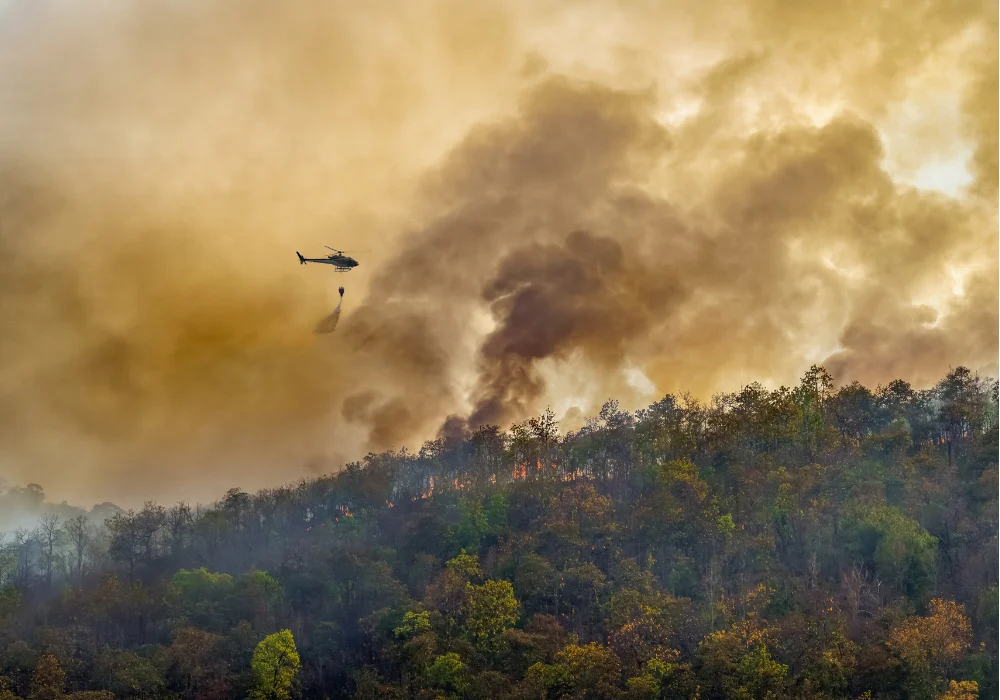
The expansive forests of Canada, long regarded as a vital global carbon sink that helps mitigate the effects of climate change, have undergone a fundamental shift and are now functioning as a net source of carbon emissions. According to a landmark study published in the journal Global Change Biology, the increasing frequency and intensity of wildfire disturbances have begun to overwhelm the natural recovery processes of these landscapes. This transition, which researchers indicate reached a critical tipping point around 2021, represents a significant challenge for Canada’s environmental policy and global efforts to stabilize atmospheric greenhouse gas concentrations.
The study utilizes a sophisticated new modeling framework known as the Canadian Land Surface Scheme Including Biogeochemical Cycles (CLASSIC). Unlike previous models that relied heavily on observational estimates or extrapolated future conditions from current trends, CLASSIC employs process-based modeling. This approach uses fundamental scientific laws, such as the conservation of energy and mass, alongside historical data to simulate real-life ecological processes across the entirety of Canada’s forested and unforested land. By providing the first "wall-to-wall" estimate of carbon pools and fluxes tailored specifically to the Canadian landscape, the research offers a more accurate and physically coherent picture of the nation’s carbon cycle than ever before.
The Paradigm Shift in Carbon Modeling
For decades, the scientific community viewed Canada’s 347 million hectares of forest—representing nearly 9% of the world’s total forest cover—as a reliable reservoir for sequestering carbon dioxide. However, the accuracy of these assessments was often limited by the complexity of the boreal ecosystem and the difficulty of accounting for all carbon "pools," including soil, biomass, and dead organic matter.
The implementation of the CLASSIC model marks a significant advancement in terrestrial carbon cycle science. By integrating specific geophysical and plant-functional data, the model can calculate the intricate balance between carbon gain through photosynthesis (Gross Primary Productivity) and carbon loss through respiration and disturbance. The authors of the study emphasize that this tailored approach is essential for understanding the unique conditions of high-latitude forests, where slow growth rates and cold-climate soil processes create a different carbon dynamic than that found in tropical or temperate regions.
A Century of Sequestration Followed by Rapid Decline
To understand the current state of Canada’s forests, the researchers simulated carbon cycling across the country from 1750 to 2023. This reconstruction accounted for nearly three centuries of wildfire activity, timber harvesting, forest regrowth, and "CO2 fertilization"—a phenomenon where increased levels of atmospheric carbon dioxide stimulate faster plant growth.
The historical data revealed that for the vast majority of this timeline, Canada’s forestland acted as a net carbon sink. The massive intake of CO2 by growing trees and the storage of carbon in forest soils outweighed the losses from natural decay and occasional fires. Even as industrial-scale logging became a factor in the 20th century, the regenerative capacity of the forest remained robust enough to maintain a net positive carbon balance.
However, the dawn of the 21st century brought a discernible shift. As global temperatures rose, the frequency and severity of wildfires began to climb. The study notes that starting in 2009, the immediate impacts of these disturbances began to overwhelm the recovery-driven carbon sink. While forests naturally regenerate after a fire, the rate of carbon loss during high-intensity burn events—and the subsequent slow recovery of northern vegetation—has created a deficit. This trend culminated in the period around 2021, when the model indicates that Canadian forests officially crossed the threshold from a carbon sink to a carbon source.
The Role of Wildfire Disturbance in Central Canada
The researchers identified wildfire as the primary catalyst for this unprecedented trend. While harvesting remains a significant factor in forest management, it is the unpredictable and massive scale of wildfires that has tipped the scales. The study highlights that these disturbances are particularly concentrated in central Canadian forests.
In these regions, lower rates of carbon uptake from plant growth mean that vegetation recovery is significantly slower than in more southern or coastal climates. When a fire ravages these areas, the carbon released into the atmosphere is not replaced quickly enough by new growth. This creates a "carbon debt" that persists for decades. The authors concluded that the current trend is "unprecedented over the last ~100 years," suggesting that the climate-driven changes to fire regimes are moving faster than the ecosystem’s ability to adapt.
The 2023 wildfire season, though occurring at the very end of the study’s primary data range, serves as a stark illustration of this reality. With over 18 million hectares burned—an area roughly the size of North Dakota—the carbon emissions from that single season were estimated to be more than the annual emissions from many industrialized nations. Such "mega-fire" years are becoming more frequent, pushing the forest further into a source state.
Economic and Management Implications
The transition of forests into carbon sources carries profound implications for Canada’s economic and land-management strategies. Traditionally, sustainable land management and fire suppression were seen as tools to preserve a valuable carbon sink. However, the study warns that the rising trend of forest disturbance may "imperil efforts to manage the carbon sink through sustainable land management practices."
The economic burden of this shift is multifaceted:
- Rising Management Costs: The cost of fire suppression is skyrocketing. Provincial and federal agencies are forced to allocate increasingly larger budgets to combat fires that threaten communities and infrastructure.
- Forestry Industry Volatility: Increased fire risk complicates long-term timber supply projections, threatening the stability of the forestry sector, which is a cornerstone of many rural Canadian economies.
- Carbon Accounting and Policy: Canada has committed to ambitious net-zero targets by 2050. If the nation’s forests are no longer absorbing carbon, the industrial, transportation, and energy sectors will have to achieve even deeper emissions cuts to compensate for the forest’s transition to a source.
Furthermore, the study suggests that the rising cost of wildfire management may divert funds away from other critical climate adaptation and mitigation projects, creating a feedback loop where the symptoms of climate change hinder the ability to address its causes.
Scientific Limitations and the Role of Peatlands
While the CLASSIC model provides a more accurate wall-to-wall estimate than previous efforts, the authors acknowledge certain limitations. Specifically, the study does not explicitly model peatland carbon cycles or the specific role of peatlands in boreal fire emissions.
This is a critical "known unknown" in Canadian climate science. Canada is home to approximately 25% of the world’s wetlands, much of which consists of peatlands that store vast amounts of carbon in waterlogged soil. When peatlands dry out due to drought and then burn, they release carbon that has been sequestered for thousands of years. By omitting peatland-specific soil emissions, the study’s findings might actually be a conservative estimate. If peatland degradation were fully integrated into the models, the shift from sink to source might appear even more dramatic.
Future Projections and Global Impact
The outlook for the coming decades remains concerning. Projections cited by the researchers indicate that wildfire risk will continue to surge as rapid climate change brings warmer, drier summers to the boreal region. This suggests that the trend of forests acting as a carbon source is not a temporary anomaly but a new ecological reality.
The global implications are equally significant. The boreal forest is one of the world’s largest terrestrial carbon stores. If the Canadian portion of this biome remains a net source, it could accelerate global warming, leading to further drying and even more fires—a classic climate feedback loop. International climate bodies, such as the Intergovernmental Panel on Climate Change (IPCC), rely on accurate national data to formulate global carbon budgets. The findings of this study suggest that global models may need to be adjusted to reflect the diminishing capacity of northern forests to buffer human-caused emissions.
In conclusion, the transition of Canada’s forests from a carbon sink to a source marks a pivotal moment in the nation’s environmental history. The "wall-to-wall" data provided by the CLASSIC model underscores the urgency of integrating disturbance-driven emissions into national climate strategies. As wildfires continue to reshape the landscape, the focus must shift from merely preserving the sink to managing a complex, emitting landscape in a way that minimizes further carbon loss and protects the remaining resilience of the boreal ecosystem.
