

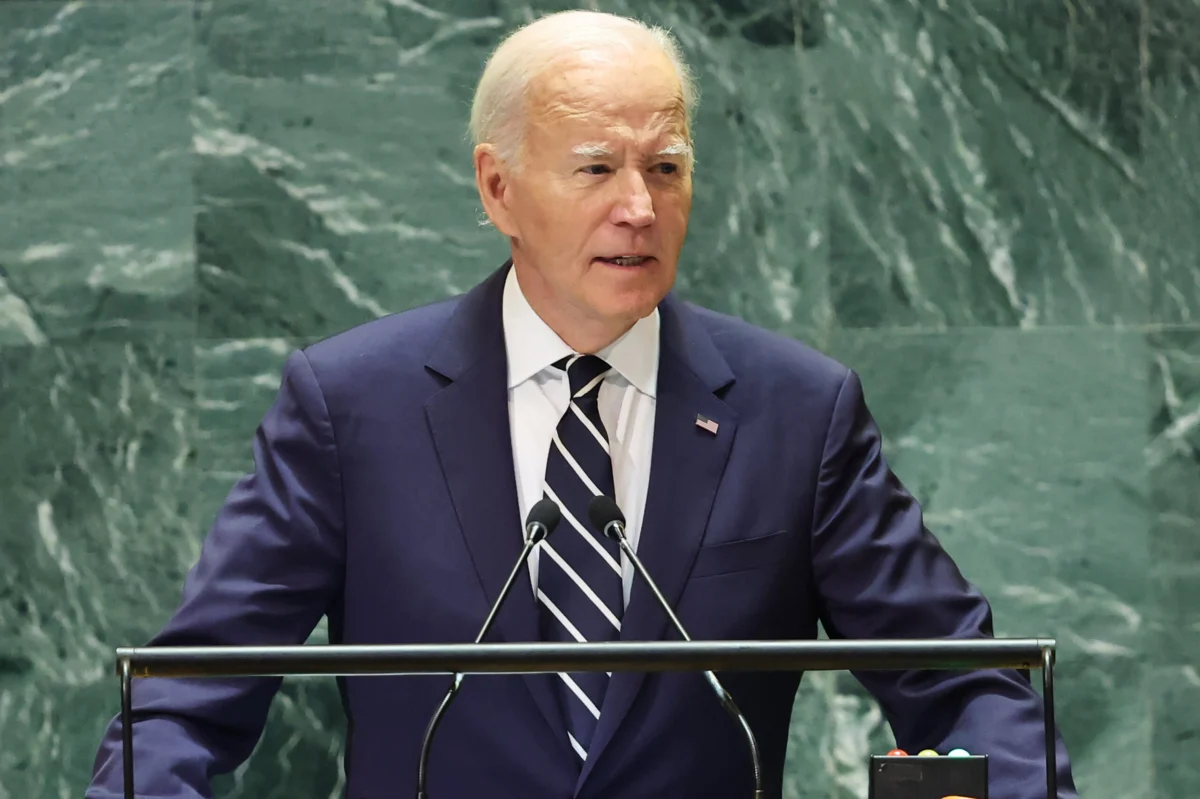
President Joe Biden stood before the United Nations General Assembly on Tuesday to deliver his final address as the leader of the United States, attempting to reconcile a career-long commitment to multilateral diplomacy with a world increasingly fractured by relentless warfare and humanitarian catastrophes. Speaking to a hall filled with heads of state and global dignitaries, Biden sought to frame his four-year tenure as a period of restoration for American leadership, while acknowledging that the "rules-based international order" he has championed faces its most severe tests since the end of the Cold War.
The President’s speech arrived at a critical juncture in global history. As he enters the final four months of his presidency, the geopolitical landscape is dominated by the protracted Russian invasion of Ukraine, a Middle East on the verge of a regional conflagration involving Israel and Hezbollah, and a devastating civil war in Sudan that has triggered one of the world’s worst hunger crises. Despite these grim realities, Biden maintained a tone of characteristic optimism, urging his fellow leaders to reject despair in favor of collective action.
A Legacy Defined by Inflection Points
President Biden’s address was designed to be a summation of his "foreign policy for the middle class" and his belief that the United States is more secure when it acts in concert with allies. He reflected on his half-century in public service, noting that he entered the presidency at a time of profound "crisis and uncertainty," referencing the tail end of the COVID-19 pandemic and the domestic political divisions following the January 6th Capitol riot.
"I know many look at the world today and see difficulties and react with despair," Biden told the assembly. "But maybe because of all I’ve seen and all we have done together over the decades, I have hope. We have the tools, the capacity, and the will to meet the challenges if we work together."
The administration’s self-defined successes were central to the narrative. Biden highlighted the revitalization of the NATO alliance, which expanded to include Finland and Sweden during his term—a direct response to Vladimir Putin’s aggression. He also pointed to the formation of the AUKUS security pact and the elevation of the "Quad" (the U.S., Japan, Australia, and India) as evidence of a renewed focus on the Indo-Pacific region to counter Chinese influence.
The Crises in the Middle East and Eastern Europe
While the President sought to highlight achievements, the immediate focus of the international community remained on the escalating violence in the Middle East. Since Biden’s 2023 UNGA address, the region has been transformed by the October 7 Hamas attacks and Israel’s subsequent military operations in Gaza. The conflict has resulted in the deaths of over 41,000 Palestinians and 1,200 Israelis, according to regional health and government authorities.
Biden used the platform to reiterate his call for a ceasefire and a hostage release deal, emphasizing that "now is the time" for both parties to finalize terms. However, the diplomatic reality remains stalled. The President also addressed the surge in settler violence against Palestinians in the West Bank and reaffirmed the U.S. commitment to a two-state solution—a goal that many analysts believe is further away now than at any point in the last two decades.
In Eastern Europe, the war in Ukraine continues to strain Western resources and political unity. Biden’s speech served as a direct plea to the international community—and perhaps more pointedly to the U.S. Congress—to maintain support for Kyiv. He argued that the defense of Ukraine is not merely a regional concern but a defense of the UN Charter itself.
"We could have stood by and merely protested, but Vice President Harris and I understood that that was an assault on everything this institution was supposed to stand for," Biden said. He warned that the world "cannot grow weary" or "look away" until a "just and durable peace" is achieved.
Chronology of a Final Diplomatic Blitz
The UNGA address is the centerpiece of a week-long diplomatic marathon for President Biden, intended to solidify his administration’s alliances before a potential shift in American leadership following the November election.

- September 21: Biden hosted the Quad Leaders’ Summit in Wilmington, Delaware. The meeting with Prime Ministers Anthony Albanese of Australia, Narendra Modi of India, and Fumio Kishida of Japan focused on maritime security in the South China Sea and expanding healthcare cooperation.
- September 23: The President met with UAE President Mohamed bin Zayed Al Nahyan in Washington, D.C., the first-ever visit by a UAE president to the U.S. capital. Discussions centered on trade, technology, and the stability of the Middle East.
- September 24: Biden delivered his final UNGA address. Later in the day, he hosted a summit focused on the Global Coalition to Address Synthetic Drug Threats, aiming to curb the international trafficking of fentanyl and other opioids.
- September 25: A scheduled meeting with President Tô Lâm of Vietnam, continuing the "Comprehensive Strategic Partnership" established during Biden’s 2023 visit to Hanoi.
- September 26: President Biden will host Ukrainian President Volodymyr Zelenskyy at the White House. Zelenskyy is expected to present a "victory plan" to Biden and Vice President Kamala Harris, while also seeking permission to use Western-supplied long-range missiles for strikes deeper into Russian territory.
Supporting Data: The Humanitarian and Economic Toll
The enrichment of Biden’s foreign policy record requires an examination of the scale of the challenges mentioned. The conflict in Sudan, which Biden specifically cited, has led to more than 14,000 deaths and displaced over 10 million people, creating a famine risk that the UN warns could eclipse any other current global crisis.
In Ukraine, the U.S. has provided more than $175 billion in total aid since February 2022, including $56 billion in direct military assistance. This level of support has become a flashpoint in domestic politics, with some factions of the Republican Party questioning the long-term sustainability of such funding.
On the technological front, Biden’s mention of artificial intelligence principles refers to the U.S.-led effort to establish international norms for "safe, secure, and trustworthy" AI. In March 2024, the UN General Assembly adopted its first global resolution on AI, a move heavily lobbied for by the Biden administration to ensure that the technology is not used to undermine human rights or democracy.
Passing the Torch: The Domestic Shadow
A unique element of this year’s UNGA was the explicit acknowledgment of Biden’s decision to withdraw from the 2024 presidential race. By doing so, Biden positioned himself as a leader who prioritized national interest over personal power—a message he encouraged other world leaders to emulate.
"As much as I love the job, I love my country more," Biden said. "I decided, after 50 years of public service, it’s time for a new generation of leadership to take my nation forward. My fellow leaders, let us never forget: Some things are more important than staying in power."
This statement served a dual purpose: it bolstered his moral standing on the world stage while also serving as a subtle critique of authoritarian leaders who refuse to relinquish control. However, the domestic transition complicates the diplomatic landscape. Foreign leaders are acutely aware that the U.S. approach to the UN and international alliances could shift dramatically depending on whether Vice President Kamala Harris or former President Donald Trump wins in November.
Broader Impact and Implications
The reaction to Biden’s final address was a mix of respect for his commitment to traditional alliances and skepticism regarding the effectiveness of U.S. policy in the face of current conflicts. While European allies generally lauded Biden’s steadfastness on Ukraine, leaders from the "Global South" have expressed frustration over what they perceive as a double standard in U.S. foreign policy—specifically, the contrast between the forceful condemnation of Russian actions in Ukraine and the continued military support for Israel’s operations in Gaza.
The implications of Biden’s departure from the world stage are significant. For four years, he has been the primary architect of a "return to normalcy" in American diplomacy. His absence will leave a void in the personalized diplomacy that has characterized his career.
The upcoming meetings with President Zelenskyy will be the first true test of this transition. As Zelenskyy meets with both Harris and Trump, the world is watching to see if the "Biden doctrine" of "as long as it takes" will survive his presidency. Trump’s campaign has already signaled a more transactional approach to foreign aid, while Harris has largely aligned herself with Biden’s current path while signaling a potentially more nuanced stance on the humanitarian aspects of the Middle East conflict.
As the 79th session of the UN General Assembly continues, Biden’s speech remains a testament to a fading era of American foreign policy—one rooted in the post-WWII institutions that he spent his entire career defending. Whether those institutions can survive the current "inflection point" without his direct stewardship remains the defining question for the leaders he leaves behind.
