

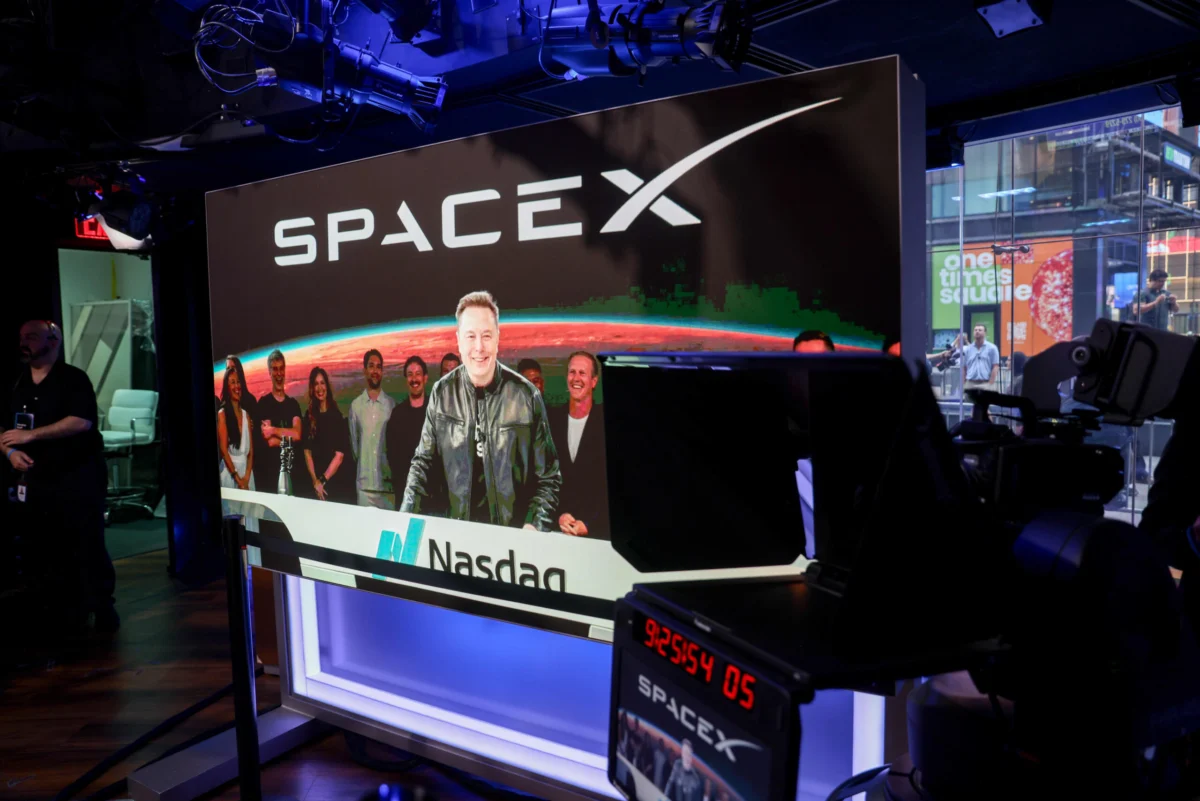
SpaceX is scheduled to report its fiscal second-quarter results after the closing bell on Tuesday, marking a historic milestone as the company’s debut earnings report following its record-breaking initial public offering (IPO) in June. This financial disclosure represents the first time that Elon Musk’s aerospace giant, which has long operated under a veil of private-sector secrecy, will face the rigorous scrutiny of public market analysts and institutional investors. The report comes at a volatile time for the company’s stock, which has experienced significant fluctuations since its mid-June debut, leaving investors eager for clarity on the company’s path to long-term profitability and its aggressive pivot toward artificial intelligence infrastructure.
Since opening at $150 per share on June 12, SpaceX’s stock has weathered a turbulent period, dropping by approximately 24% and erasing nearly $500 billion in market capitalization. The shares are currently trading at nearly 50% below their intraday peak reached on June 16, a decline that reflects broader market anxieties regarding the company’s massive capital expenditure and its complex integration with other Musk-led ventures. As the "reusable rocket maker" prepares to open its books, the focus is shifting from the spectacle of its launches to the hard reality of its balance sheet.
The Financial Landscape: A Multi-Billion Dollar AI Gamble
The central tension in SpaceX’s current financial narrative is the contrast between its traditional aerospace successes and its recent, massive investments in artificial intelligence. In 2025, SpaceX reported a net loss of $4.9 billion. While such losses are not uncommon for high-growth tech companies, the scale and the source of the deficit have raised eyebrows on Wall Street. A significant portion of this loss was attributed to the company’s strategic decision to build out an unprecedented AI infrastructure.
In February, SpaceX executed a transformative merger with xAI, another Musk-led entity. The merger was framed as a visionary step toward creating a new frontier of "space-based compute." The goal is to develop and deploy massive data centers in orbit, leveraging the vacuum of space for cooling and the company’s own Starlink constellation for global, high-speed data transmission. By merging with xAI, SpaceX integrated the Grok AI models, specialized chatbot technologies, and the social network X (formerly Twitter) into its corporate structure.
This pivot was further cemented in June when SpaceX struck a deal to acquire Cursor AI for approximately $60 billion. This transaction, expected to close in the third quarter, underscores the company’s commitment to becoming an AI powerhouse. However, this ambition comes with a staggering price tag. In the first three months of the year, SpaceX reported capital expenditures (capex) of $10.1 billion, with $7.7 billion—over 75%—dedicated specifically to AI expenses. Analysts, according to FactSet data, expect capex to rise to $13.2 billion for the second quarter as the company accelerates its data center construction and AI model training.
Segment Performance: Starlink as the Sole Profit Engine
As investors pore over the upcoming results, they will be looking at SpaceX through the lens of its three primary business segments: Launch, Connectivity (Starlink), and AI Applications. Currently, these segments tell very different stories.

The Launch segment, despite its dominance in the global satellite deployment market and lucrative contracts with NASA and the Department of Defense, remains a loss-making endeavor. The high costs associated with the development of the Starship megarocket and the maintenance of the Falcon 9 fleet continue to outpace the revenue generated from commercial and government payloads.
In contrast, the Connectivity segment, powered by the Starlink satellite internet service, is the company’s "golden goose." Starlink provides global high-speed internet coverage via a constellation that currently exceeds 10,200 satellites in low Earth orbit (LEO). In its IPO prospectus, SpaceX revealed that Starlink generated $11.39 billion in revenue in 2025, accounting for 61% of the company’s total sales. More importantly, it was the only profitable arm of the company last year, generating $4.42 billion in income.
To maintain this growth, SpaceX has been aggressive in its pricing strategy. In June, the company introduced a $10 "monthly kit fee" for terminal rentals and adjusted subscription rates across various tiers. These moves are aimed at increasing the average revenue per user (ARPU), a metric that analysts say will be critical in Tuesday’s report. With a subscriber count that surpassed 12 million in early June, the ability of Starlink to scale profitably is the primary factor supporting the company’s multi-hundred-billion-dollar valuation.
Market Skepticism and the Rare ‘Sell’ Rating
Despite the revolutionary nature of SpaceX’s technology, some corners of Wall Street are sounding the alarm. While the majority of analysts remain cautiously optimistic or "neutral," a small but vocal group has issued "sell" ratings—a rarity for a Musk-led company in its honeymoon phase with the public markets.
Analysts at Phillip Capital recently initiated coverage with a "sell" rating and a price target of $75 per share. This target suggests a potential 35% drop from recent closing prices. Phillip Capital joins Morningstar as one of the few firms advising investors to exit their positions. The primary concern cited by these analysts is the company’s projected cash flow. With the massive burn rate associated with AI and Starship development, these firms do not expect SpaceX to achieve consistent positive cash flow until at least 2030.
"The capital intensity of building a space-based AI network is being underestimated by the broader market," a Phillip Capital report noted. "While the vision is peerless, the financial bridge to 2030 is fraught with dilution risks and execution hurdles."
Chronology of the SpaceX IPO and Post-IPO Events
To understand the weight of Tuesday’s earnings, one must look at the rapid-fire timeline of events that led SpaceX to this moment:

- February 2026: SpaceX announces a surprise merger with xAI, signaling a shift from a pure aerospace company to an "AI and Infrastructure" conglomerate.
- Early June 2026: SpaceX confirms its Starlink subscriber base has reached 12 million users and announces price adjustments for satellite hardware and services.
- June 12, 2026: SpaceX goes public in a record-setting IPO. The stock opens at $150, valuing the company at over $1 trillion.
- June 16, 2026: The stock reaches an intraday peak as retail and institutional excitement reaches a fever pitch.
- Late June 2026: SpaceX announces the $60 billion acquisition of Cursor AI, intended to bolster its software and coding automation capabilities.
- July 2026: General market volatility and concerns over AI spending lead to a steady decline in share price, with the stock losing nearly a quarter of its value by the end of the month.
- August 2026: The company prepares for its first quarterly earnings call as a public entity.
Analyst Expectations and Key Metrics to Watch
According to LSEG and StreetAccount data, the consensus among analysts involves several key performance indicators that will determine the market’s reaction on Tuesday:
- Starlink Subscriber Growth: Investors are looking for "net adds" to the 12 million subscriber base. Any slowdown in growth could signal that the satellite internet market is reaching saturation in premium regions.
- AI Capex Transparency: Analysts are seeking a clearer breakdown of how the $13.2 billion in expected capex is being utilized. Specifically, they want to know the timeline for the first operational "space data centers."
- Launch Margins: While the launch business is expected to show a loss, investors are looking for a narrowing of that loss, indicating that the Falcon 9 program is becoming more efficient even as Starship development continues.
- The ‘Musk Factor’ and xAI Integration: With the merger of xAI and the acquisition of Cursor AI, there are questions regarding corporate governance and the overlap of resources between SpaceX, X, and Tesla.
Broader Implications for the Aerospace and AI Sectors
The results of SpaceX’s earnings call will likely have ripple effects far beyond the company’s own stock price. As the first major "Space-AI" hybrid to go public, SpaceX is serving as a bellwether for the entire New Space economy. If SpaceX can demonstrate that Starlink’s profits are sufficient to bankroll its AI ambitions, it may validate the "conglomerate" model Musk has built.
Furthermore, the success or failure of the "data centers in space" concept could redefine the global AI race. If SpaceX successfully argues that space-based compute is a viable solution to the energy and cooling crises facing terrestrial data centers, it could trigger a new wave of investment in orbital infrastructure.
However, if the losses are wider than expected or if Starlink growth shows signs of stagnation, it could lead to a cooling of the AI investment frenzy that has gripped Wall Street for the past two years. For now, the world’s most valuable aerospace company finds itself in an unfamiliar position: having to prove to the public market that its reach for the stars is matched by a grounded and sustainable financial strategy.
The SpaceX conference call is scheduled to begin at 4:30 p.m. ET on Tuesday. Given the high stakes and the historical nature of the report, it is expected to be one of the most-watched financial events of the year, providing a definitive look at whether the "Musk premium" can survive the cold reality of quarterly reporting.
