

The transition toward sustainable public transportation is often viewed through the lens of urban centers, where short routes and frequent stops make battery-electric buses an obvious choice. In Edinburgh, this shift is already visible in the form of electrified regional rail, trams, and a growing fleet of battery-electric double-decker buses. However, while city-based electrification is progressing at a steady, predictable pace, a more significant transformation is taking place in the intercity sector. Ember, an Edinburgh-based startup, has demonstrated that scheduled regional coach services can achieve full electrification far earlier than industry experts initially projected, challenging the notion that long-distance travel must wait for another generation of battery technology.
Launched in October 2020, Ember began its journey with just two electric coaches running between Dundee and Edinburgh. At the time, skeptics argued that the weight of the batteries, the lack of charging infrastructure, and the demands of Scotland’s rugged terrain would limit electric coaches to short, flat demonstration routes. By early 2026, those doubts have been decisively addressed. Ember now operates more than 100 electric coaches across a network that spans the length and breadth of Scotland, proving that the intercity segment is not just ready for electrification but is, in many ways, an ideal market for it when the business model is built around the technology from the ground up.
The Growth and Scale of a Native Electric Fleet
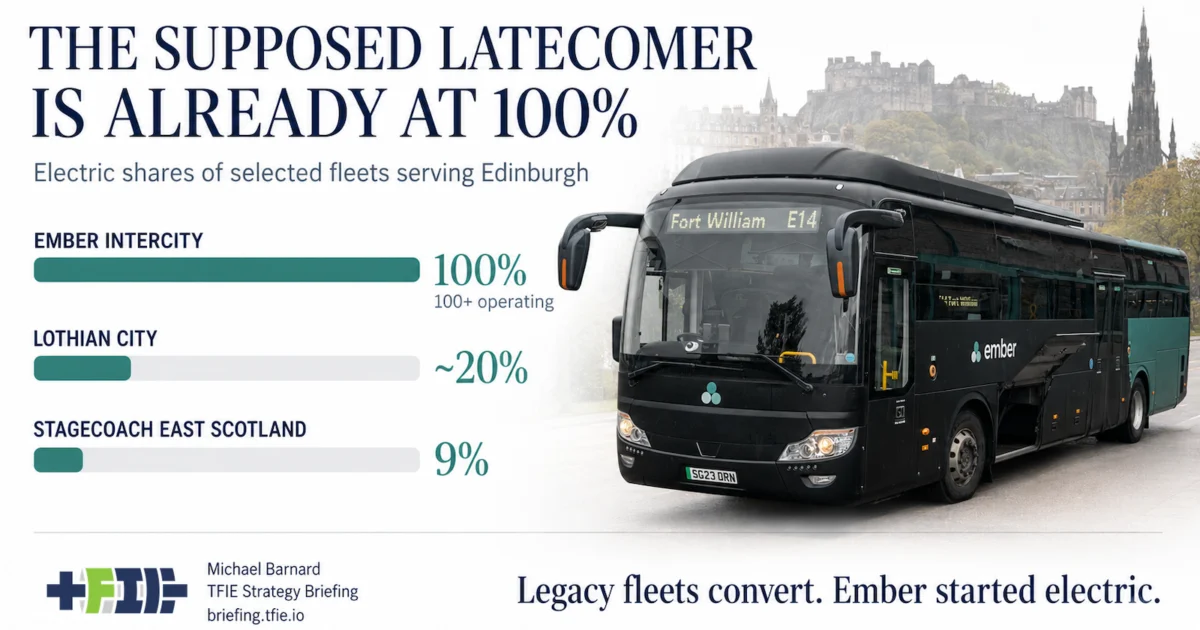
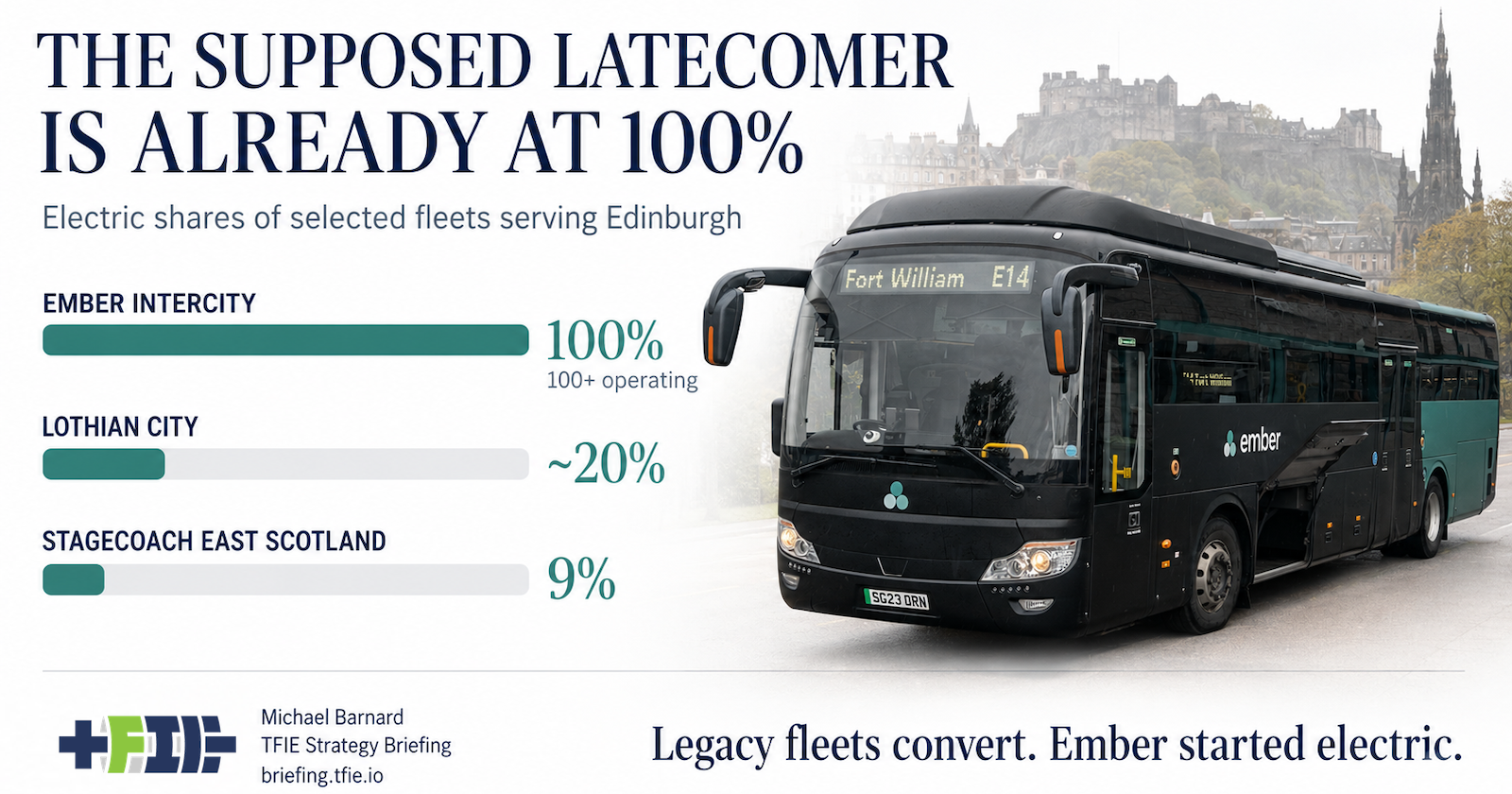
The scale of Ember’s operations provides a stark contrast to the traditional model of fleet conversion. While legacy operators like Lothian—the publicly owned company dominating Edinburgh’s city network—are managing the complex task of transitioning inherited fleets, Ember started as a "native" electric operator. This distinction is critical to understanding the pace of their expansion.
Lothian’s approach is characteristic of a large-scale urban operator. Currently, approximately one in five buses assigned to its primary Edinburgh depots is battery-electric. This includes a mix of Volvo double-deckers and Wrightbus single-deckers. While Lothian continues to secure funding for more zero-emission vehicles, including 60 additional double-deckers in the most recent Scottish funding round, the company must balance this transition with the need to rebuild depots and secure massive amounts of electrical capacity for hundreds of vehicles simultaneously.
In contrast, Ember’s growth has been rapid and focused. Over the year leading into January 2026, the company reported carrying more than 1.5 million passengers and delivering over 120 million zero-emission passenger-kilometers. Their network now connects major hubs including Edinburgh, Glasgow, Dundee, Aberdeen, and Inverness, while also serving more remote locations such as Fort William, Oban, and Thurso. Many of these corridors operate at frequencies that rival rail timetables, with round-the-clock services ensuring that electric transit is a viable option for all travelers, regardless of their schedule.
Overcoming Topography and the Scottish Climate
One of the most significant achievements of the Ember model is its performance in challenging geographical conditions. The argument that electric heavy vehicles are only suitable for "low-relief" or flat urban environments has been dismantled by Ember’s Highland routes. The service from Edinburgh to Fort William, for instance, requires coaches to navigate the steep inclines of Glencoe and the winding roads of the Trossachs.
When a fully loaded coach climbs through such terrain, the power draw on the battery is substantially higher than on a flat motorway. Furthermore, Scotland’s harsh winters introduce additional variables. Sustained cabin heating and battery thermal management systems require significant energy, which can reduce the total range available for propulsion. While regenerative braking allows the coaches to recover energy during descents, it does not entirely offset the massive energy expenditure required for the initial climb.
Ember has addressed these challenges not through "heroic" battery range, but through a sophisticated charging and operational strategy. While their Yutong coaches are rated for up to 350 miles on a single charge, the company does not rely on the maximum range for its daily operations. Instead, the business is built on high-utilization cycles. Coaches charge several times a day at high-power hubs, allowing individual vehicles to cover nearly 200,000 miles annually.
Infrastructure and the Integrated Booking Model
Central to Ember’s success is its proprietary infrastructure and software ecosystem. The company has established a network of high-power charging facilities in strategic locations, including Dundee, Aberdeen, Inverness, Oban, Thurso, Fort William, and Perth. These chargers are rated at up to 300 kW, allowing for rapid energy replenishment during scheduled dwell times.
This infrastructure is inextricably linked to Ember’s booking and dispatch system. Unlike traditional "turn up and go" bus services or unrestricted charter coaches, Ember’s intercity model uses demand-responsive elements to maximize efficiency. Many intermediate stops require passengers to book at least ten minutes in advance. If no bookings are made for a specific stop, the coach remains on the main road, bypassing the stop to preserve journey time and battery life.
This level of control allows the company to plan vehicle allocation and charging sessions with mathematical precision. Because the distances, termini, and likely dwell times are known in advance, charging is treated as a core component of the timetable rather than an external disruption. This "scheduled" nature of intercity travel makes it a fundamentally different—and more solvable—problem than the charter coach market, where routes are unpredictable and high-power charging is rarely guaranteed.
The Procurement Gap and Industrial Implications
The rise of Ember has also highlighted a significant gap in the British and European automotive manufacturing sectors. When Ember sought to launch its service, it repeatedly approached domestic manufacturers, including Alexander Dennis, Scotland’s premier bus builder. However, the company was informed that no suitable battery-electric intercity coach was available or even in the immediate pipeline.
As a result, Ember turned to Yutong, a Chinese manufacturer that has spent years refining electric bus technology for its massive domestic market. The Yutong coaches have proven to be robust and adaptable, with the manufacturer working closely with Ember to iterate on the product based on real-world Scottish data.
This procurement story serves as a wake-up call for the European bus industry. While companies like Volvo, Wrightbus, and Alexander Dennis are successfully supplying the urban bus market, they were caught off guard by the rapid demand for zero-emission intercity coaches. The latest round of the Scottish Zero Emission Bus (ScotZEB) program reflects this reality, supporting the purchase of another 100 Yutong coaches for Ember. This £53.8 million project, which includes £13.2 million in public funding and £40.6 million in private investment, effectively doubles Ember’s fleet and solidifies Yutong’s position in the UK market.
Financial Breakdown and Public-Private Partnership
The financial structure of Scotland’s transit electrification reveals a commitment to a dual-track transition. The ScotZEB program is designed to de-risk the transition for operators by providing the "green premium"—the price difference between a standard diesel vehicle and a zero-emission equivalent—while the operators provide the bulk of the capital.

In the most recent funding round, the investment was distributed as follows:
- Ember: A £53.8 million total project cost for 100 coaches and 43 chargers, with £13.2 million in public support.
- Lothian: Funding for 60 additional electric double-deckers to continue the decarbonization of the capital’s streets.
- Stagecoach East Scotland: Support for 44 zero-emission vehicles to bolster regional connectivity.
Stagecoach’s data provides a useful benchmark for the broader industry. Currently, Stagecoach East Scotland reports that 41 of its 477 vehicles (9%) are electric. This highlights the "long tail" of the transition for legacy operators who must manage the retirement of hundreds of diesel assets while scaling up new technology. Ember, by contrast, operates at 100% electrification, demonstrating the agility of a specialized, new-entrant model.
Broader Impact and Global Lessons
The success of Ember in Scotland offers a blueprint for regional transit authorities worldwide. It challenges the "urban-first" dogma of electrification and proves that intercity routes are not only viable but potentially more lucrative for electric conversion due to high vehicle utilization.
The environmental impact is substantial. By displacing diesel coaches on long-distance routes, Ember is removing significant amounts of CO2 and NOx emissions from the atmosphere. Because these coaches travel far greater distances than the average city bus, the carbon payback period for the batteries is significantly shorter.
Furthermore, the "Ember Model" suggests that the future of transit lies in the integration of hardware and software. By controlling the charging network, the vehicle specifications, and the booking platform, the company has removed the friction points that often hinder EV adoption.
In conclusion, Scotland is currently backing two successful models of transition. Lothian is proving that a massive, inherited urban fleet can be methodically decarbonized without disrupting the life of a major city. Simultaneously, Ember is proving that the intercity market can leapfrog traditional timelines when a service is designed around electricity from day one. The lesson for the global transit industry is clear: scheduled regional and intercity coach service is no longer a "future" market for battery-electric technology—it is a practical, high-performance reality today.
